
Your Hotel Is Invisible to AI. Here's What the Data Shows.
A real-world AI visibility audit of a Madrid hotel reveals a pattern most properties share: strong branded recognition, near-zero discovery visibility. Here's what it means — and what to do about it.
The Branded Visibility Trap
When we ran a full AI visibility audit on a well-known Madrid hotel — testing its presence across Perplexity, ChatGPT, and Google Gemini — the headline numbers looked reassuring. We tested 100 distinct queries that real travelers would ask AI, broken down across six search themes and five traveler personas. The hotel appeared in the majority of those queries, with over 800 total mentions and citations across all three AI engines.
But the story changed completely when we looked at which types of queries drove those appearances. The data revealed a pattern we see across nearly every hotel we audit: the property dominated branded queries but was virtually invisible in the discovery layer where new guests actually find hotels.
How We Measured AI Visibility
We asked each AI engine 100 queries across six themes: branded queries (where the hotel is mentioned by name), comparison queries (where travelers compare it against competitors), competitor-branded queries (where travelers search for a rival by name), and three types of non-branded queries — city-level, regional, and location-based (near a specific landmark or point of interest). Each query was also tagged to one of five traveler personas, from executive business travelers to romantic getaway couples.
The visibility index runs from 0 to 100. A score of 100 means the hotel was consistently recommended across AI engines for that category. A score of 0 means it never appeared. Think of it as: out of every 100 opportunities for AI to recommend your hotel to that audience or for that type of query, how many times did it actually do so?
Theme Performance: Where the Real Story Lives
The results split cleanly into two tiers.
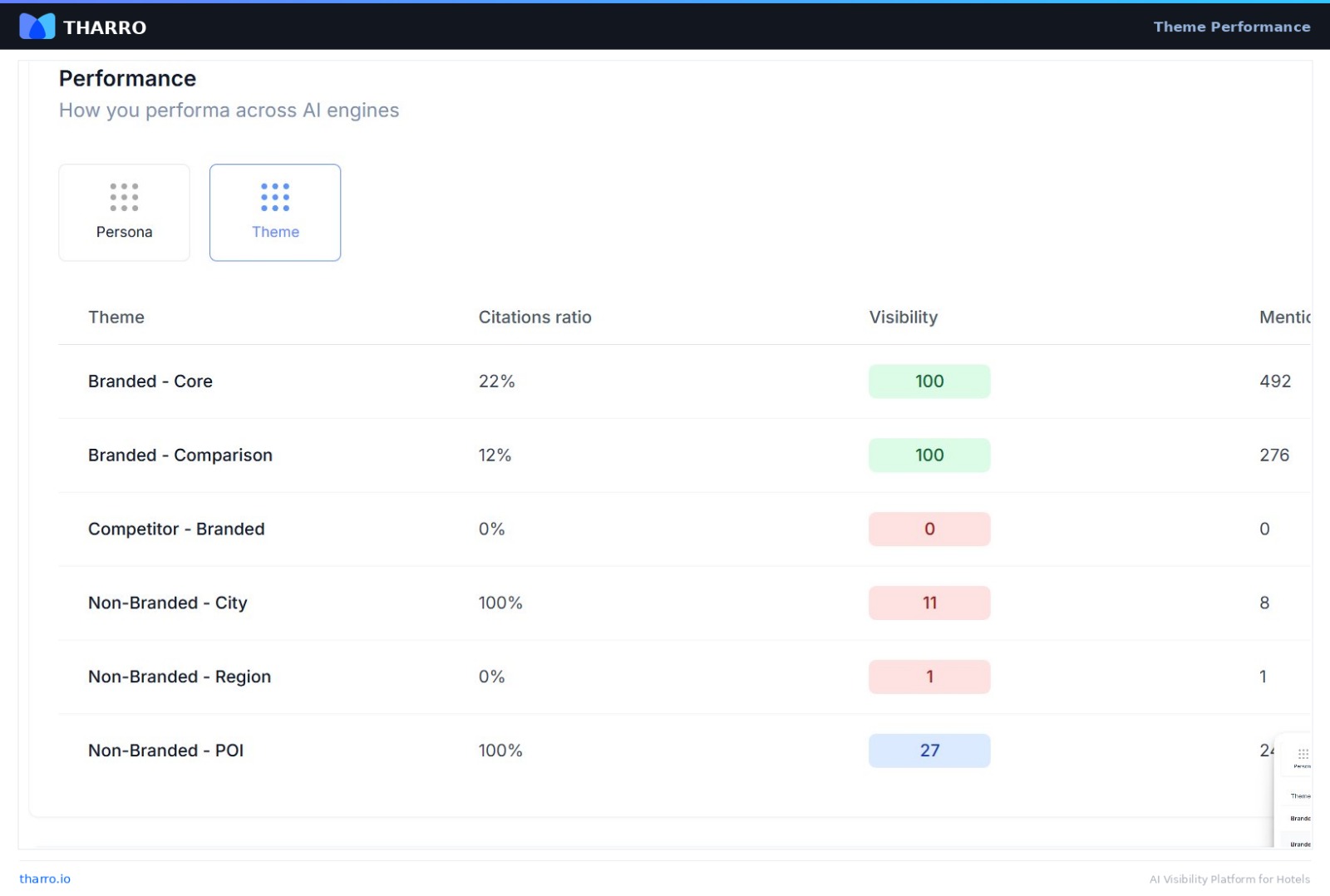 Theme performance across all three AI engines — Tharro dashboard
| Query Theme | Visibility (0–100) | Citation Rate | Total Mentions | Verdict |
|---|---|---|---|---|
| Branded — Core | 100 | 22% | 492 | ✓ Full visibility |
| Branded — Comparison | 100 | 12% | 276 | ✓ Full visibility |
| Competitor — Branded | 0 | 0% | 0 | ✗ Invisible |
| Non-Branded — City | 11 | 100% | 8 | ✗ Near-invisible |
| Non-Branded — Region | 1 | 0% | 1 | ✗ Invisible |
| Non-Branded — POI | 27 | 100% | 24 | ⚠ Emerging |
The pattern is stark. When someone asks AI "What's it like staying at [Hotel Name]?" the property scores a perfect 100 — AI recommends it every single time. But when a traveler asks "What's the best hotel in Madrid for a business trip?" — the type of query that actually drives new bookings — the hotel appeared in only about 1 out of 10 AI responses. For regional queries like "Best hotels in central Spain?", it appeared in roughly 1 out of 100.
This is the branded visibility trap: the hotel looks healthy in aggregate because branded queries inflate the overall numbers, masking a fundamental weakness in the discovery layer where undecided travelers search.
Persona Performance: Not All Travelers See You Equally
We tested visibility across five distinct traveler personas. The results reveal which guest segments AI is actively sending to the hotel — and which ones are being quietly redirected to competitors.
| Traveler Persona | Visibility (0–100) | Citation Rate | Mentions & Citations | Signal |
|---|---|---|---|---|
| Executive Business Traveler | 89 | 19% | 196 | Core strength |
| Luxury Leisure Seeker | 88 | 21% | 194 | Core strength |
| Special Occasion Traveler | 75 | 21% | 181 | Core strength |
| Romantic Getaway Couple | 69 | 23% | 122 | Near-miss gap |
| Event Attendee | 55 | 22% | 108 | Revenue gap |
Three personas — business travelers, luxury seekers, and special occasion travelers — all score a perfect 100, meaning AI recommends this hotel virtually every time someone fitting that profile asks for a recommendation. But Romantic Getaway Couples drop to 69 and Event Attendees fall to 55. In practical terms, that 45-point gap for Event Attendees means that roughly one in two times someone asks AI for a Madrid hotel for a conference or event, this property doesn't get mentioned at all.
There's an interesting nuance in the citation rates. Romantic Getaway Couples have the highest citation rate at 23% despite lower visibility — meaning that when AI does mention the hotel for this audience, it backs up the recommendation with credible sources. The problem isn't the quality of the recommendation. It's the frequency.
What Citations Tell You About AI Trust
Not all mentions are equal. When AI talks about your hotel, it can do so in three different ways, each carrying a different weight for the traveler making a decision.
Direct Citations are the gold standard. This means the AI engine links directly to your hotel's website or official booking page when recommending you. The traveler sees your name, clicks through, and lands on your property. No intermediary, no OTA, no competitor noise. Direct citations drive the highest-quality traffic because the traveler arrives with intent and lands on a page you control.
Indirect Citations mean AI references a third-party source — a travel blog, a review site, a magazine article — that mentions your hotel. The traveler still gets a recommendation, but the trust is filtered through someone else's content. You don't control the narrative, and you're often sharing that page with competitors. Still valuable, but you're one step removed from the booking.
Simple Mentions are the most common but least powerful. AI drops your hotel's name into a response — often as part of a list — without linking to any source. There's no click path, no authority signal, no way for the traveler to verify the recommendation. It's awareness without conversion power.
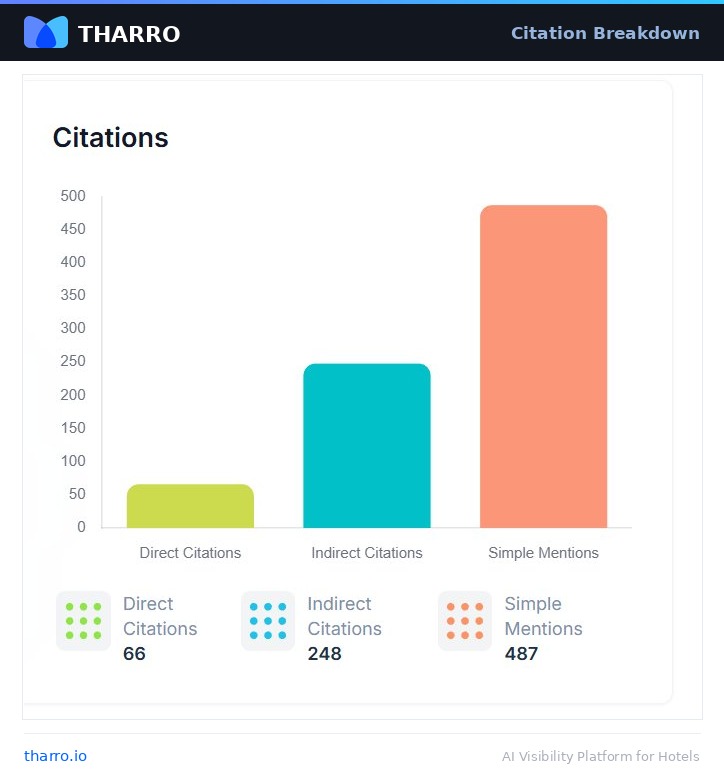 Citation breakdown: Direct 66, Indirect 248, Simple Mentions 487 — Tharro dashboard
For this Madrid hotel, the citation breakdown across all three AI engines was: 66 direct citations (8%), 248 indirect citations (31%), and 487 simple mentions (61%). The hotel gets talked about, but rarely with the kind of authority that drives direct bookings. And the imbalance matters most in non-branded queries, where travelers are still deciding — and where trust signals are the difference between clicking through to your site or scrolling past to a competitor.
The Competitive Landscape: A 3x Authority Gap
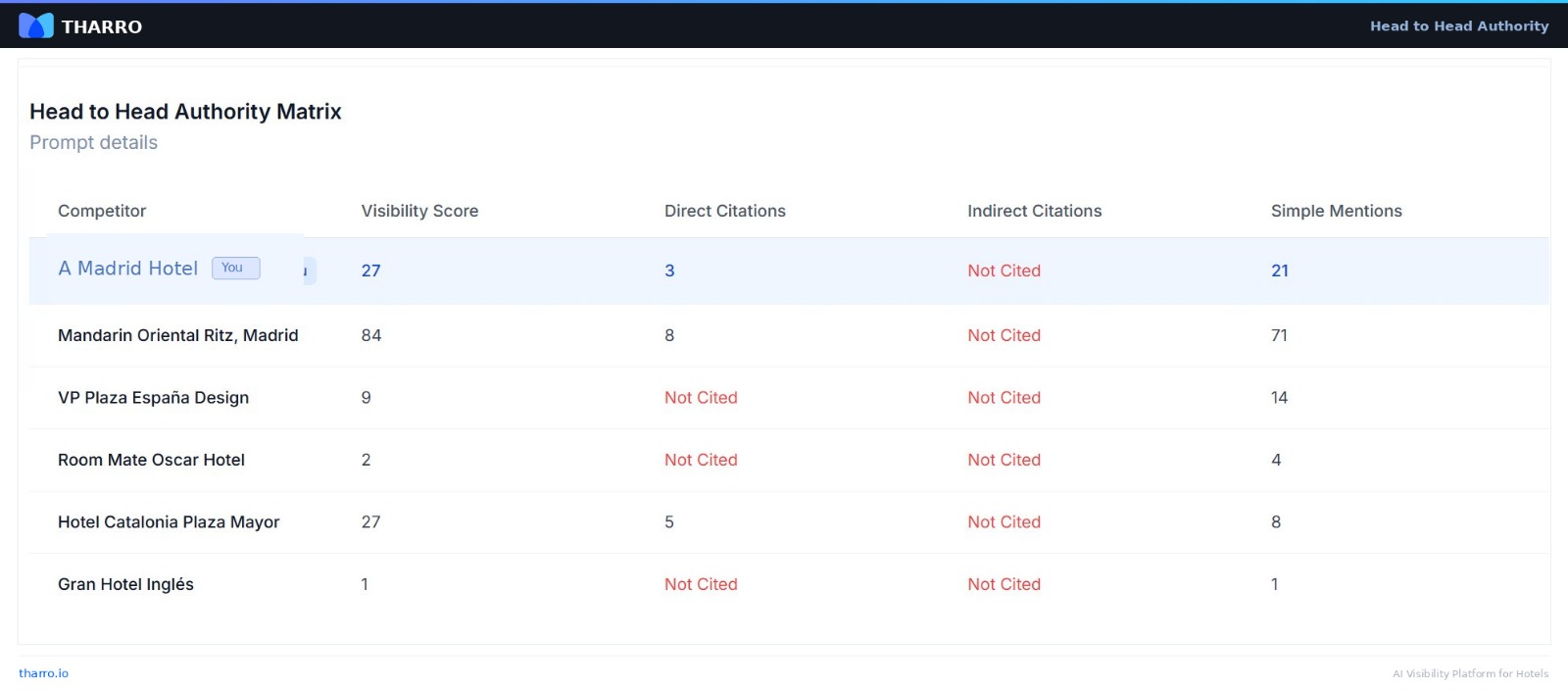
The head-to-head authority matrix tells the competitive story clearly. When AI compared the hotel directly against its competitive set, the hotel scored a visibility of 27 out of 100. The Mandarin Oriental Ritz scored 84 — more than three times the authority. The Ritz captured 71 simple mentions to the hotel's 21, and earned 8 direct citations versus just 3.
What makes this particularly significant is that the Mandarin Oriental Ritz operates in the ultra-luxury tier — a different price bracket entirely. The fact that it dominates the AI mindshare even in the mid-to-upper segment suggests that the hotel's positioning and digital authority, not just its marketing spend, need recalibrating for how AI engines categorize and recommend properties.
AI Visibility Over Time
AI rankings aren't static. The hotel's total visibility score has fluctuated between measurement periods, reflecting how volatile AI recommendations can be.
This volatility is itself a key insight. Hotels that measure once and assume the picture is stable are making a dangerous assumption. AI engines update their models, retrain on new data, and shift recommendations constantly. Continuous monitoring is the only way to detect drops before they become sustained losses.
From Diagnosis to Action: What Tharro Recommends
Identifying the gap is only the first step. Tharro doesn't just diagnose AI visibility problems — it generates specific, actionable query recommendations tailored to each hotel's competitive set, market, and weak spots. For this Madrid hotel, Tharro identified approximately 60 high-value queries per AI engine where the property should appear but currently doesn't.
These recommendations span across the gaps the audit revealed. For example:
"Boutique hotels Madrid for romantic escape" — targeting the Romantic Getaway Couple persona where visibility dropped to 69. The hotel has the product for this audience but isn't being surfaced by AI when couples search for it.
"Hotels near conference venues Madrid" — targeting the Event Attendee gap. With visibility at only 55 for this persona and zero presence in non-branded city queries about events, this is a direct revenue leak.
"Luxury hotels near Prado Museum booking" — a Non-Branded POI query where the hotel scored just 27 visibility. The hotel is close to key Madrid landmarks but AI doesn't associate it with them. Meanwhile, competitors like Hotel Catalonia Plaza Mayor and Mandarin Oriental Ritz already own this space.
Each recommendation maps to a specific theme-persona intersection, so hotels know exactly what type of content, structured data, or digital authority building will close the gap. This is the difference between knowing you have a problem and knowing exactly how to fix it.
What This Means for Hotels
This audit isn't unique to one Madrid hotel. It's the pattern we see across most properties that haven't specifically optimized for AI visibility. The key takeaways:
Theme-level analysis is essential. Aggregate scores hide the branded-vs-discovery split. A hotel scoring high overall but only 11 out of 100 on city queries has a fundamentally different problem than one with moderate overall scores but strong non-branded presence.
Persona gaps are revenue gaps. Each persona maps to a booking segment with its own value. An Event Attendee visibility of 55 versus 100 means the hotel is losing roughly a quarter of that segment's AI-driven demand to competitors — travelers who would have been a good fit but never saw the hotel's name.
Non-branded visibility is the growth frontier. This is where hotels compete for guests who haven't decided where to stay yet. Right now, AI is sending those travelers to competitors. Content strategy, structured data, and digital authority need to target these specific query themes.
Citations drive conversion, not just awareness. Moving from simple mentions (61% of this hotel's references) to direct citations requires building authoritative, well-structured content that AI engines can reference, attribute, and link to. A mention gets awareness. A direct citation gets a click.
Specific recommendations beat generic advice. Knowing that your hotel is "weak on non-branded" isn't enough. You need to know the exact queries, the exact personas, and the exact competitor dynamics to build a targeted optimization strategy. That's what the data makes possible.
AI visibility is volatile — this hotel's total score has fluctuated significantly between measurement periods. Hotels that monitor, benchmark, and act on theme-persona data will capture the demand that others leave on the table.