From Google's Top 3 to AI's Answer: How Hotel Search Visibility Carries Over to AI Assistants
We ran 695 unbranded hotel searches through ChatGPT and Google's AI Mode across the Algarve, Mallorca and Rhodes, and matched every answer against 293,925 ranked Google and Bing results. Search visibility only partially carries over — and the hotel's own website barely counts.
Published 4 July 2026 · Data collected June 2026 · By the Tharro research team
Key findings
- 1
- 2
- 3
- 4
- 5
- 6
The study at a glance
695
unbranded searches, run through both engines
293,925
ranked Google & Bing results matched against the answers
~10,000
hotel recommendations captured
3,626
distinct hotels named
14,129
citations, across 1,604 domains
3
markets: the Algarve, Mallorca, Rhodes
Google rank carries over to AI — but only partially
A hotel whose own website ranked in Google's top 3 for a specific search was named by AI about 66% of the time. The rate falls with every band of Google positions — hotels in the top 10 are named more than twice as often as those further down the rankings.
| Hotel's own-site Google position | Named by AI for the same search |
|---|---|
| Own site in Google top 3 | ~66% |
| Own site in Google top 10 | ~61% |
| Positions 11–20 | ~45% |
| Below position 20 | ~27% |
| Beyond position 30 | ~24% |
The carryover is real — and it is far from a guarantee. Even in Google's top 10, roughly four in ten well-ranked hotels were passed over by AI for the same search. In Albufeira, around a dozen hotels ranked on the first two pages of Google with their own websites; AI named just two of them.
About half of AI's recommendations aren't in Google's results at all
Across the whole study, 48–56% of the hotels AI recommended did not appear anywhere in Google's organic results for the same search. AI assistants are not a mirror of the search page — they are a second, partly independent discovery surface, with their own winners and their own blind spots.
The hotel's own website is cited under 10% of the time
<10%
of all recommendations cite the hotel's own domain as the source
~20%
own-site citation rate even when the hotel ranked its own website in Google
37%
own-site citation rate even for hotels in Google's top 10
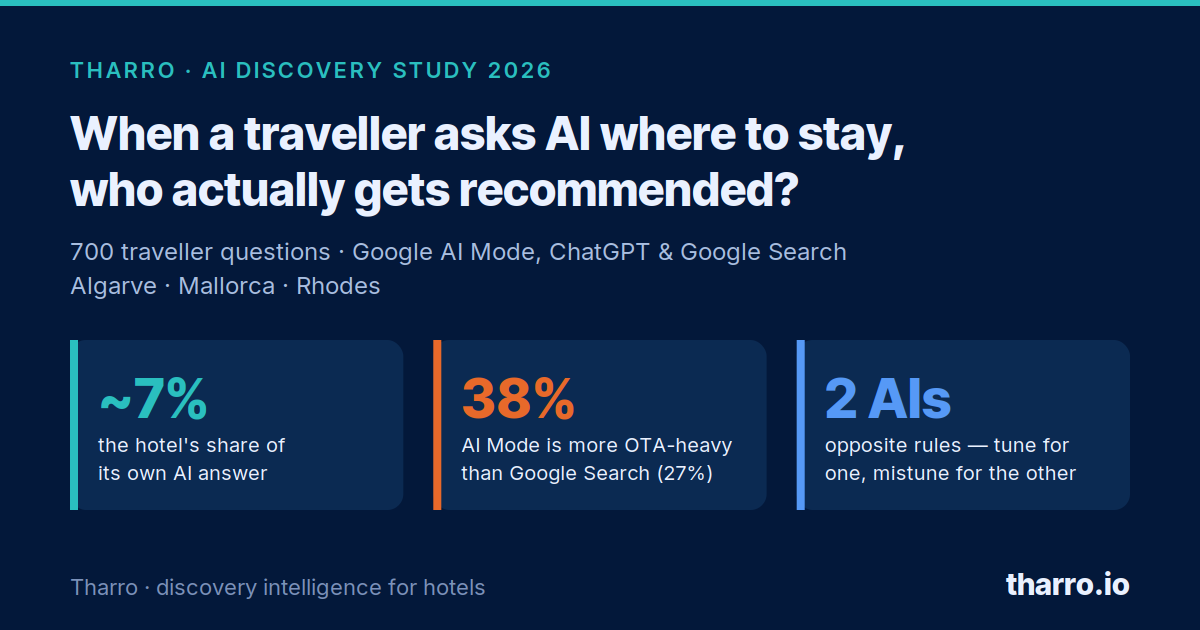
When AI names a hotel, the credited source is usually an intermediary: OTAs such as Booking.com and Expedia, review platforms such as Tripadvisor and Oyster, and editorial guides and regional roundups. Per surface, the hotel's own website is only about 7% of what Google's AI Mode cites, and 12–17% of what ChatGPT cites.
ChatGPT and Google AI Mode agree on almost nothing
3,151
distinct hotels named by ChatGPT
1,286
distinct hotels named by Google AI Mode
18%
overlap — only 691 hotels appeared on both lists
The two engines draw on visibly different supply — Bing's results surfaced individual hotels in only about 1% of listings versus roughly 8% on Google, which is consistent with ChatGPT leaning on a different retrieval mix. Practically, this means AI visibility has to be measured per engine: tuning for one can mistune for the other.
Independent hotels take 60–80% of AI recommendations
Across every engine-market combination, independent properties dominate AI's answers and global flags never break 9%. That mirrors market supply rather than AI favouritism — branded hotels are just 8% of all hotels in Greece (GBR Consulting), around 30% in Portugal and around 38% in Spain (Horwath HTL).
| Engine | Market | Independent | Domestic / regional | Global chain |
|---|---|---|---|---|
| Google AI Mode | Algarve | 73.0% | 19.2% | 7.7% |
| Google AI Mode | Mallorca | 60.0% | 36.9% | 3.1% |
| Google AI Mode | Rhodes | 79.1% | 16.5% | 4.4% |
| ChatGPT | Algarve | 74.6% | 16.7% | 8.7% |
| ChatGPT | Mallorca | 60.7% | 32.2% | 7.1% |
| ChatGPT | Rhodes | 79.5% | 15.2% | 5.3% |
What each surface actually cites
Share of cited sources by type, averaged across the three markets. Google's AI Mode concentrates harder toward OTAs than Google Search itself (+11 points on average, 46% vs 28% in Rhodes). ChatGPT swings the other way: away from OTAs (−7) and tour operators (−8), toward editorial (+9) and directories (+8) — and it is the friendliest surface to a hotel's own site (+5 points vs Google).
| Source type | Google Search | Google AI Mode | ChatGPT |
|---|---|---|---|
| OTA | 26.7% | 37.9% | 19.8% |
| Editorial / blogs | 22.7% | 22.8% | 31.9% |
| Tour operator | 17.5% | 11.8% | 9.6% |
| Metasearch | 12.4% | 9.4% | 10.0% |
| Directory | 4.6% | 3.5% | 13.0% |
| Hotel's own website | 8.6% | 6.7% | 13.8% |
Google Search remains the only surface where tour operators carry real weight (~18%, vs ~10% in AI).
What predicts an AI mention
Review volume and star class mattered most, price next, and guest rating least: hotels rated 4.8 and above were named no more often than hotels rated below 4.3. Roughly three-quarters of the hotels AI recommends are four- or five-star, with a median of around 600 reviews. Every correlation was modest — no single attribute was decisive.
Methodology
Questions.We built 695 unbranded traveller searches — the questions travellers actually ask, spanning trip type, traveller profile, location, season and feature ("family hotels in Mallorca", "where to stay in Rhodes", "hotels in Albufeira"). Each keyword cluster was converted into exactly one AI prompt — a clean 1:1 mapping.
Engines and markets. Every question ran through ChatGPT and Google's AI Mode in three Mediterranean markets: the Algarve (Portugal), Mallorca (Spain) and Rhodes (Greece). Google organic Search ran the same questions as a comparison surface.
Matching. Every AI answer was matched against 293,925 ranked Google and Bing results for the same searches. We captured every hotel named in each response and every source cited — nearly 10,000 recommendations, 3,626 distinct hotels, 14,129 citations across 1,604 domains.
Classification. Cited sources were typed as OTA, metasearch, tour operator, affiliate directory, editorial/blog, rental, or the hotel's own website. Recommended hotels were typed as independent, domestic/regional group, or global chain. High-frequency names were hand-verified; the long tail of one-off mentions was assigned by rule, with no material effect on the shares.
Normalisation. Shares were computed within each market and then averaged — never pooled. Each hotel and source was counted once per answer. Supply benchmarks come from Horwath HTL (Spain, Portugal) and GBR Consulting (Greece).
Limitations. This is a single June 2026 snapshot. The relationships we report are associational, not causal — though the patterns were consistent across all three markets and both engines. AI answers change; we expect to repeat the measurement.
Download the data
The key aggregates behind every table on this page are free to download and reuse with attribution (CC BY 4.0). No signup, no gate.
Download key findings (CSV)How to cite this study
Tharro (2026). From Google's Top 3 to AI's Answer: How Hotel Search Visibility Carries Over to AI Assistants. Tharro Research, July 2026 (data: June 2026). https://tharro.io/research/serp-to-ai-carryover-2026
Linking to this page is the preferred citation. Every section heading is a stable deep link (e.g. #own-domain-cited-under-10).
Coverage and related reading
- Hotel News Resource: Nearly Half of AI-Recommended Hotels Not Found in Google's Top Results, Research Shows
- Hospitality.today: In AI search, the hotel's own website barely counts
The two companion write-ups walk through the findings in more depth: what 695 searches reveal about AI hotel visibility and how AI actually recommends hotels.
Where does your hotel stand in AI answers?
Tharro tracks how visible your property is on ChatGPT, Gemini and Google's AI surfaces — the same measurement this study is built on, run continuously for your hotel and your competitors.