
Protect your direct booking revenue
If ChatGPT mentions your hotel but links to Booking.com, you're paying 15-25% commission on every AI-referred guest. Knowing this lets you fix the source so AI starts linking to you directly.
Track how ChatGPT, Gemini, and Perplexity recommend hotels in your destination - and whether they're sending bookings to you or to OTAs.
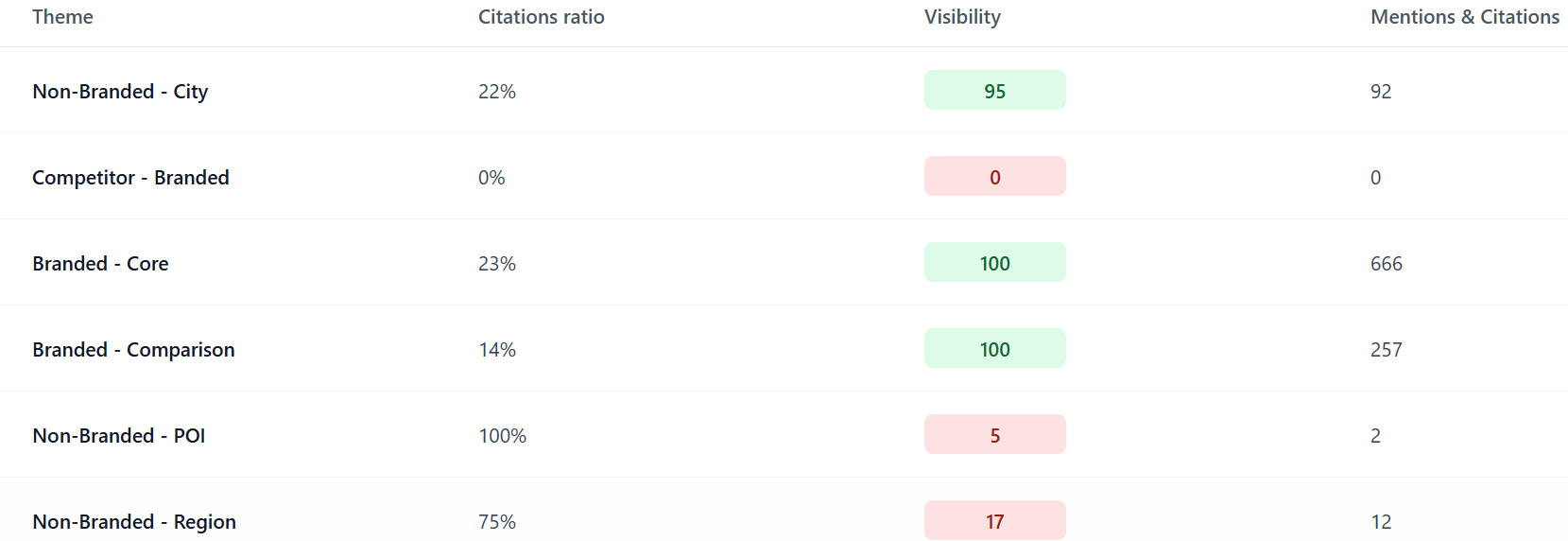
When a traveler asks ChatGPT "best luxury hotels in Paphos," your property is either in the answer or it isn't.
 No scrollNo second chanceNo ad you can buy
OTAs are disproportionately cited as booking sources even when your hotel is mentioned. We call it the OTA Paradox - even when AI recommends you, the booking often goes to Booking.com anyway.

To get a reliable picture of your AI visibility, you'd need to ask hundreds of questions across traveler personas, themes, platforms, countries, and languages. Then read every response, extract every hotel mentioned, note every source cited, and structure it all into something you can compare over time.
Tharro handles this entire process systematically, at scale so you can focus on acting on the insights instead of gathering them.
Tracking AI visibility isn't an exercise in vanity metrics. It's a direct input into your revenue, your marketing ROI, and your ability to compete for direct bookings.
If ChatGPT mentions your hotel but links to Booking.com, you're paying 15-25% commission on every AI-referred guest. Knowing this lets you fix the source so AI starts linking to you directly.
When a competitor starts appearing in AI answers for your city and you don't, that's a revenue leak. Without tracking, you won't know it's happening until the season is over.
You invested in a new website and fresh content. Did it change what AI says about you? With tracking, you can show exactly how investment translates to recommendations.
AI gives different answers to "best hotel for couples" vs. "best for families." If your positioning is misaligned, you lose the guests you actually want.
When AI pulls your description from a Booking.com listing, the OTA controls your brand story. Citation tracking shows exactly which sources AI relies on.
AI visibility data, connected to demand intelligence and Google SERP data, tells you which fixes deliver the most bookings per euro.
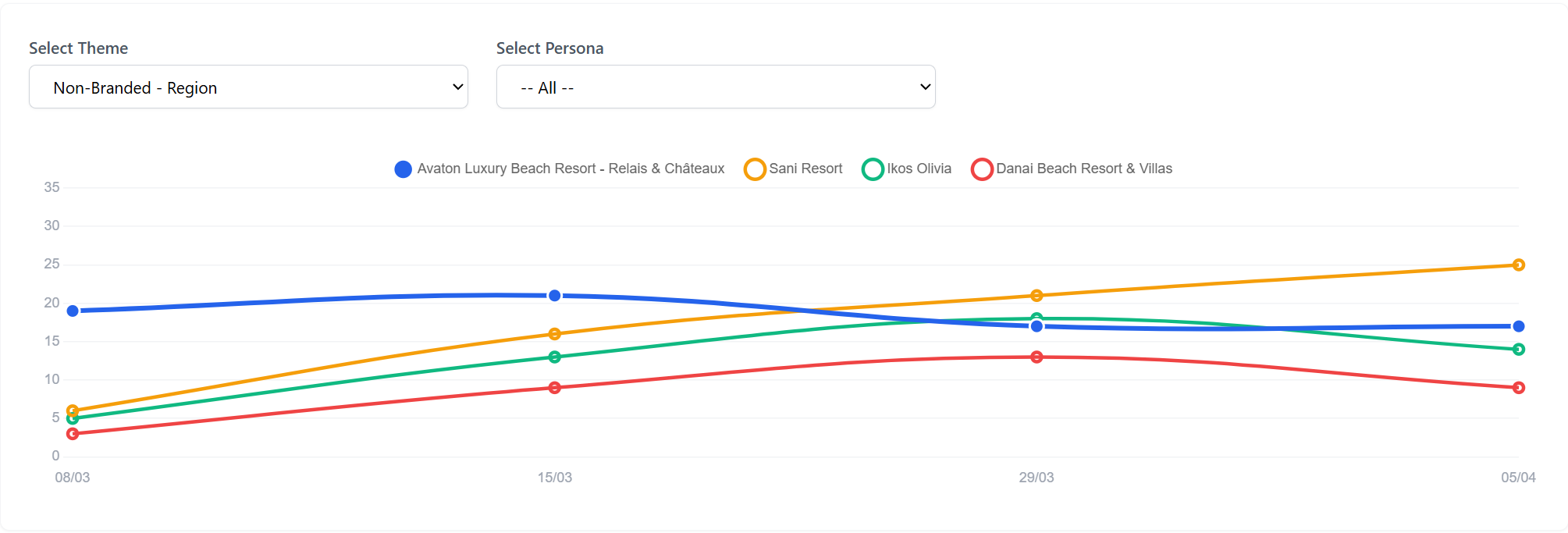

In our study of 2,000+ AI recommendations across 29 European cities, we found OTAs are cited as booking sources far more than their mention share suggests.
Read Full Report01

See whether your content and SEO investments are translating into AI recommendations. Prove impact to leadership with connected data - or identify exactly where strategy needs to shift.
02
Understand which feeder markets AI is directing toward competitors. Use that signal to adjust distribution and pricing ahead of the season - while there's still time to capture demand.
03
Get a clear answer to one question: are we visible where travelers are looking? Just key metrics, competitive context, and what to do about it.
Start a free trial and get your AI Visibility Score across ChatGPT, Gemini, and Perplexity - benchmarked against your competitive set.
Hotel AI visibility measures how often and how favorably your hotel appears when travelers use AI assistants like ChatGPT, Gemini, and Perplexity to research where to stay. It includes mention frequency, recommendation position, description accuracy, and whether AI links to your direct booking site or to an OTA.
ChatGPT (including GPT-4o and newer models), Google Gemini, and Perplexity. We monitor multiple model versions and update as new platforms gain traveler adoption.
Weekly as standard. Enterprise plans get daily monitoring - useful for hotel groups tracking visibility shifts across multiple properties and markets.
Branded = someone asks about you by name. Unbranded = "best spa hotels in Limassol." Unbranded is where real competition happens - that's what we benchmark. Competitive intelligence focuses on unbranded queries because that's where AI chooses which hotels to include.
Yes. Every hotel tracked in Tharro includes competitive benchmarking - visibility scores, theme associations, platform preferences, and trends over time.
AI responses vary by model, context, language, and time. A single query gives you one data point. To build reliable intelligence, you'd need hundreds of queries across personas, themes, platforms, countries, and languages - then extract and structure results over time. Tharro does this systematically, at scale, and delivers structured output ready to act on.
Yes. When AI recommends a hotel, it often includes a booking source. If that source is your website, it's commission-free. If it's an OTA, you pay 15-25%. And if you're not in the AI answer at all, you've lost a potential guest. As more travelers use AI for hotel research, AI visibility becomes a direct revenue factor.
Most impactful actions: complete your Google Business Profile, enrich website content, invest in recent positive reviews, implement Hotel schema markup, and expand your digital footprint across travel blogs and guides. Tharro's Command Center delivers weekly prioritized actions based on your data.
Related but distinct. SEO focuses on Google's list of links. AI visibility focuses on being included in curated answers. The inputs overlap - quality content, reviews, structured data - but the optimization differs. Hotels should track both.
A finding from Tharro's research: OTAs are cited as booking sources in AI far more than their mention share suggests. Hotels get named - but OTAs capture the booking intent. This means being mentioned isn't enough - you need to influence which source AI cites for bookings.
Over 40% of travelers now use AI tools during trip planning. ChatGPT alone has hundreds of millions of weekly active users, with travel among its most popular use cases. For hotels, this creates a parallel competitive front alongside Google search. Direct booking revenue: When AI cites Booking.com instead of your website, you pay commission on an AI-referred guest. Tracking citation sources identifies and quantifies this leak. Competitive intelligence: Competitors may be gaining AI visibility without your knowledge. A new hotel winning AI recommendations could erode your bookings before you notice. Marketing ROI: Content and review investments should improve AI visibility, not just Google rankings. Without AI tracking, you can't measure impact on this growing channel. Brand control: AI constructs hotel descriptions from multiple sources. If it pulls from outdated OTA listings, your property may be misrepresented to millions of travelers.
How AI platforms decide which hotels to recommend
Review quality and volume: AI platforms heavily weight review data from Booking.com, TripAdvisor, and Google. Hotels with higher scores, recent reviews, and positive sentiment are recommended more frequently.
Website content quality: Detailed, well-structured content gives AI platforms richer material. Thin content forces AI to rely on OTA descriptions instead.
Structured data: Hotel schema markup helps AI understand your property's attributes - room types, amenities, location, pricing - and present them accurately.
Third-party mentions: Travel blogs, media, social media, and destination guides expand your digital footprint. Hotels with broader presence appear more consistently across platforms.
Google Business Profile: For Gemini specifically, a complete GBP is critical. Research suggests the majority of Gemini's hotel links point to GBP listings.
AI visibility is an outcome of your entire digital presence - not just one channel. This is why Tharro monitors it alongside Google SERP ownership, reputation intelligence, and demand signals.
Why hotels should track AI visibility in 2026
1. Complete your Google Business Profile. The single most impactful action for Gemini. Ensure name, address, category, amenities, photos, and hours are complete and consistent.
2. Enrich your website content. Write detailed content about your hotel's experience - local guides, dining, activities, "best for" positioning. Give AI your content instead of letting it rely on OTA descriptions.
3. Invest in reviews strategically. Focus on recent, detailed reviews on Booking.com and TripAdvisor. A hotel with 50 reviews from the past 3 months outperforms one with 500 from 5 years ago.
4. Implement structured data. Hotel schema markup makes it easier for AI to parse your attributes and present them accurately.
5. Expand your digital footprint. Get mentioned in travel blogs, destination guides, and social media. More quality mentions = more confident AI recommendations.
6. Monitor and iterate. Check AI visibility weekly. Connect changes to actions taken. Tharro's Command Center automates this loop with prioritized weekly actions and estimated booking impact.
AI pulls from top-ranking Google sources. See who owns your SERP and how it feeds AI recommendations.
Learn MoreReviews are a core AI input. Benchmark scores against competitors and watch AI visibility follow.
Learn MoreAI signals become prioritized weekly actions: what to fix, what to push, and what it is worth in bookings.
Learn More