Who really owns your keywords β€” you or the OTAs?

Track your hotel's Google search performance against OTAs, metasearch, and competitors β€” with SERP domain ownership analysis built specifically for hospitality.

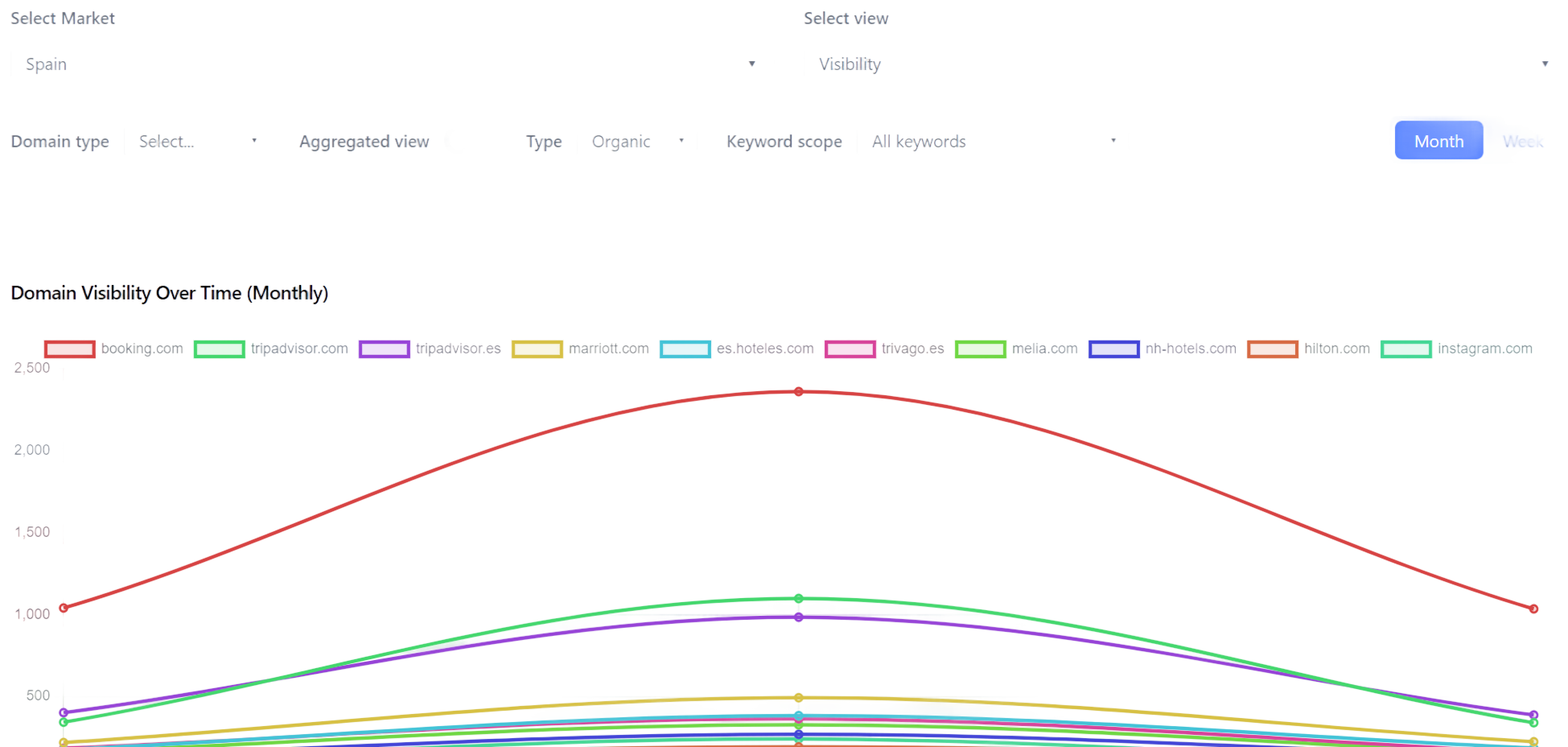
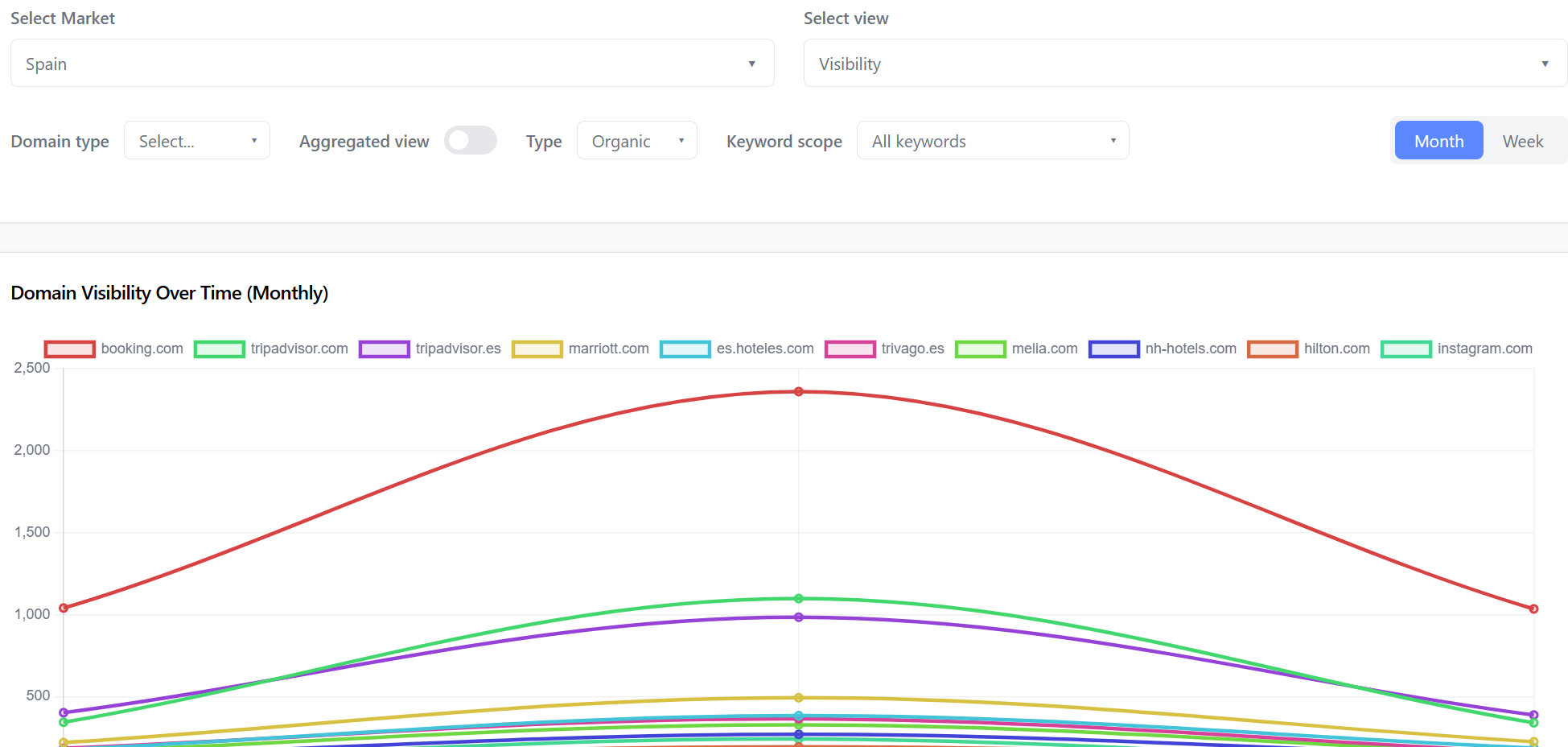
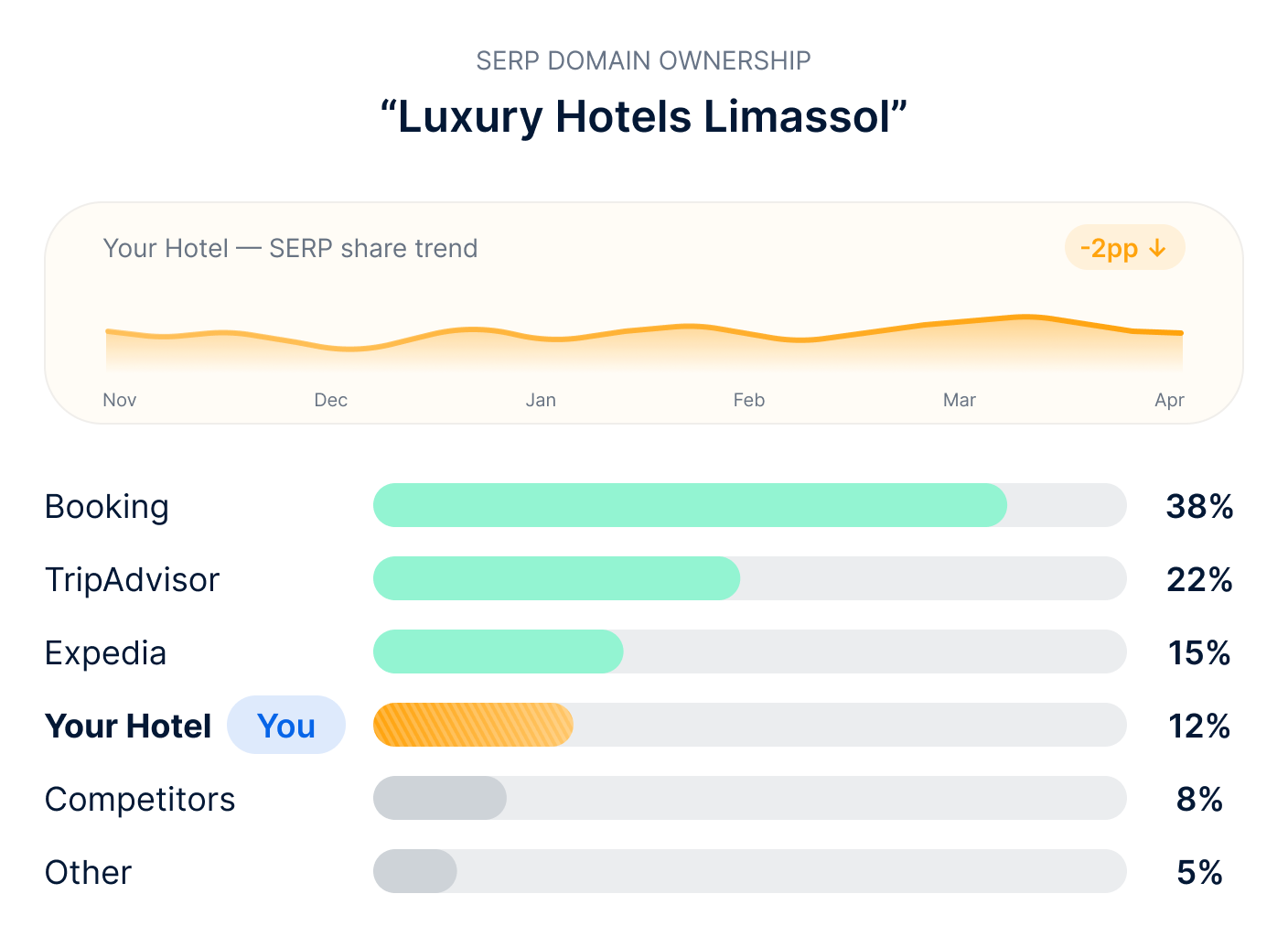
Google visibility SERP chart

You're investing in SEO you can't measure against the right benchmarks

Most hotels track their own Google rankings but never see the full picture: which domains actually own the search results for their destination? Booking.com, Expedia, TripAdvisor, niche blogs β€” they all compete for the same keywords you need to win direct bookings.

And branded keywords? Many hotels assume they own their own name on Google. Often, they don't. OTAs bid on your brand terms, outrank you with domain authority, and intercept travelers who were already searching for you β€” converting what should be a commission-free booking into a 15-25% OTA commission.

What Google visibility tracking actually does for your hotel

Knowing your rankings in isolation is almost meaningless. What matters is who owns the results around you β€” and what you're losing because of it.

Recover direct bookings lost to OTAs on your brand name

If Booking.com outranks you for your own hotel name, every click they capture is a booking you pay commission on β€” for a guest already looking for you. SERP data shows exactly where this is happening.

Find unbranded keywords where you can actually win

Ranking for "best spa hotel Limassol" drives high-intent traffic. But which unbranded keywords does your hotel have a realistic shot at? SERP ownership shows where OTA dominance is weakest.

Stop wasting SEO budget on unwinnable keywords

If Booking.com, Expedia, and TripAdvisor own positions 1-5, investing to rank #6 is a waste. Tharro shows where to invest and where to redirect to other channels like AI visibility.

Catch competitors gaining ground in real time

A competitor launches a blog and starts outranking you. Without SERP monitoring, you won't notice for months. With it, you see the shift and respond before revenue is affected.

Connect Google visibility to AI visibility

AI platforms pull from top-ranking Google sources. If OTAs own your SERP, they influence what AI says about you too. Improving Google directly feeds AI visibility.

Prove SEO ROI to your owner or board

Report "we increased SERP ownership from 12% to 23% against OTAs, driving an estimated X additional direct sessions" β€” not just "we improved from position 8 to 5."

Complete Google search visibility intelligence for hotels

Google visibility dashboard

Brand strength analysis

SERP domain ownership

Competitive branded volume

Keyword position tracking

Market-level search volume

Actionable insights

This isn't another generic SEO tool

SEMrush, Ahrefs, and Moz are excellent for general SEO. But they weren't built for hotels. They don't understand OTA dynamics, don't separate hotel from OTA competitors, and don't connect Google data to AI visibility, demand, or reviews.

Hotel-specific keyword framing

Keywords categorized as branded vs. unbranded, destination + category, experience-based, seasonal β€” the way hotels think

OTA vs. hotel SERP ownership

We distinguish your site from OTAs, metasearch, direct competitors, and third-party content. The view that matters for direct booking strategy.

Connected to AI and demand

Your Google rankings influence AI recommendations. Your demand data tells you which keywords matter this season. Tharro connects all three.

Built for Your Role

01

Marketing Director

See which keywords you own vs. OTAs. Know where SEO investment is paying off and where to redirect β€” with data that connects to AI visibility and demand trends.

02

Revenue Manager

Understand which search queries drive direct bookings vs. OTA bookings. Use SERP ownership data to inform distribution and brand bidding decisions.

03

GM / Owner

One clear view: how much of Google do we own vs. OTAs for our destination? Is it improving? What's being done about it? No SEO jargon required.

Stop Guessing Who Owns Your Keywords

Get your SERP ownership analysis and see exactly where you stand against OTAs and competitors.

Frequently asked questions

What is SERP domain ownership?+

It measures which websites appear on Google's first page for a keyword - and how the space divides between your hotel, OTAs, metasearch, competitors, and third-party content. More useful than simple ranking position because it shows the competitive landscape.

How is Tharro different from SEMrush or Ahrefs?+

Those are general-purpose SEO tools. Tharro is built for hotels - with keyword categorization reflecting hotel distribution, competitive framing separating hotels from OTAs, and connections to AI visibility, demand, and review intelligence.

What keywords does Tharro track?+

Both branded (your hotel name) and unbranded (destination + category queries). We build your keyword universe during onboarding based on your market and comp set.

Can I see competitor rankings?+

Yes. Your full comp set is tracked with the same keyword universe for side-by-side SERP ownership comparisons.

How does Google visibility connect to AI visibility?+

AI platforms draw from top-ranking Google sources. OTA dominance on Google = OTA dominance in AI recommendations. Tharro tracks both and shows the connection.

Do hotels really lose bookings to OTAs on their own brand name?+

Frequently. OTAs bid on hotel brand terms and their domain authority earns organic positions too. Every click they capture on your name costs you 15-25% commission.

How often is data updated?+

Weekly. Position changes, SERP ownership shifts, and competitive movements - with enough frequency to act on trends.

Google visibility or AI visibility β€” which matters more?+

Both. Google is still the largest traffic source. AI is the fastest-growing discovery channel. They're connected - Google influences AI. Hotels that track both have a significant advantage.

Still have questions?Contact us

The Complete Guide to Google Search Visibility for Hotels

What is Google search visibility for hotels?

Google search visibility for hotels measures how prominently your website appears in search results for queries that drive bookings β€” both branded and unbranded. For hotels, it's not just about ranking positions β€” it's about SERP domain ownership: what share of the results page does your hotel own vs. OTAs and competitors?

When a traveler searches "best hotels in Limassol," the first page includes results from Booking.com, TripAdvisor, Expedia, travel blogs, Google Maps, and hotel websites. The question isn't "am I on page one?" but "what share do I own vs. intermediaries?" A hotel ranking #5 behind four OTA listings is technically visible but the traveler clicks an OTA, costing 15-25% commission.

Why Google visibility still matters in the age of AI+

Google remains the largest source of hotel website traffic. AI is growing fast - and Tharro tracks that via AI Visibility - but Google is still the foundation. More importantly, AI platforms draw from top-ranking Google sources. OTA dominance on Google means OTA dominance in AI recommendations. Improving Google visibility feeds AI visibility directly.

How to improve your hotel's Google visibility+

How to improve your hotel's Google visibility

1. Defend your brand terms. Defensive PPC on your own name is cheap and saves 15-25% commission per reclaimed click.

2. Create destination content. OTAs win with massive destination pages. Hotels compete with authentic local expertise - area guides, experience pages, seasonal content.

3. Optimize Google Maps. Complete your Google Business Profile. For "hotel near [landmark]" queries, Maps results dominate.

4. Target long-tail keywords. OTAs optimize for head terms. Queries like "adults only spa hotel near Paphos old town" are lower volume but higher intent - and less competitive.

5. Build backlinks. Domain authority matters against OTAs. Travel media, destination guides, and industry publications strengthen your ranking ability.

6. Monitor weekly. SERP ownership shifts constantly. Tharro's Command Center flags changes so you act before revenue impact hits.
Related Features

AI Visibility

AI pulls from top-ranking Google sources. Track both channels and see the connection.

Learn More

Demand Intelligence

Know which keywords matter now based on feeder-market demand trends.

Learn More

Command Center

Every SERP shift becomes a prioritized action: what to fix first, and what to push next.

Learn More