Research
Can a Hotel Outrank Booking.com? What the Data Says
We mapped thousands of hotel SERPs. Here's where hotels genuinely beat Booking.com, and where fighting for rank is wasted budget. Data-backed answer inside.

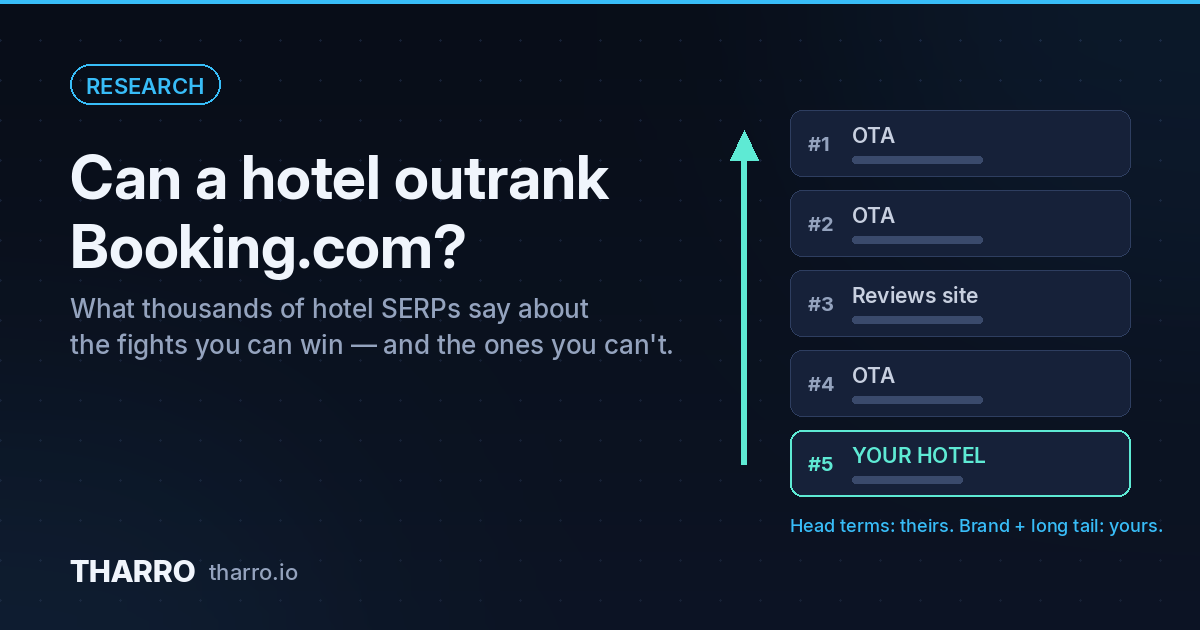
Every hotelier has typed their destination into Google and scrolled past four OTA results before finding a single hotel website. The honest question: is that fight winnable — and where?
Ask any SEO agency whether your hotel can outrank Booking.com and you'll get an optimistic proposal. Ask the SERP data and you get a more useful answer: it depends entirely on which battlefield you pick. On some keywords, hotels beat OTAs routinely. On others, no realistic budget will get you there — and knowing the difference is worth more than any optimization tactic.
The uncomfortable baseline
When we mapped a single UK→Paphos search corridor for one five-star resort, the keyword universe came to 1,824 keywords, 17,863 organic SERP results and 317 paid placements — the full breakdown is in our hotel keyword playbook. Reading who actually owned those results, the same pattern we see in every market repeated: the higher the search volume, the more completely intermediaries own the page.
This is structural, not a quality problem. Booking.com's domain has decades of authority, millions of pages, and an SEO team the size of a hotel's entire staff. On a head term like "hotels in Limassol", you are not competing with Booking's Limassol page — you're competing with Booking's entire domain. That fight is over before it starts, which is why the complete hotel SEO guide starts from who owns your results rather than from on-page checklists.
The three battlefields — and who wins each
Battlefield 1: Head terms ("hotels in [city]"). Verdict: OTAs win — don't fund this fight. High volume, brutal competition, and even the clicks you'd win carry mixed intent. The rational move on most head terms is to stop measuring your rank at all, and redirect the energy to battlefields you can win. Presence here comes through the intermediaries and the Maps pack, not your blue link.
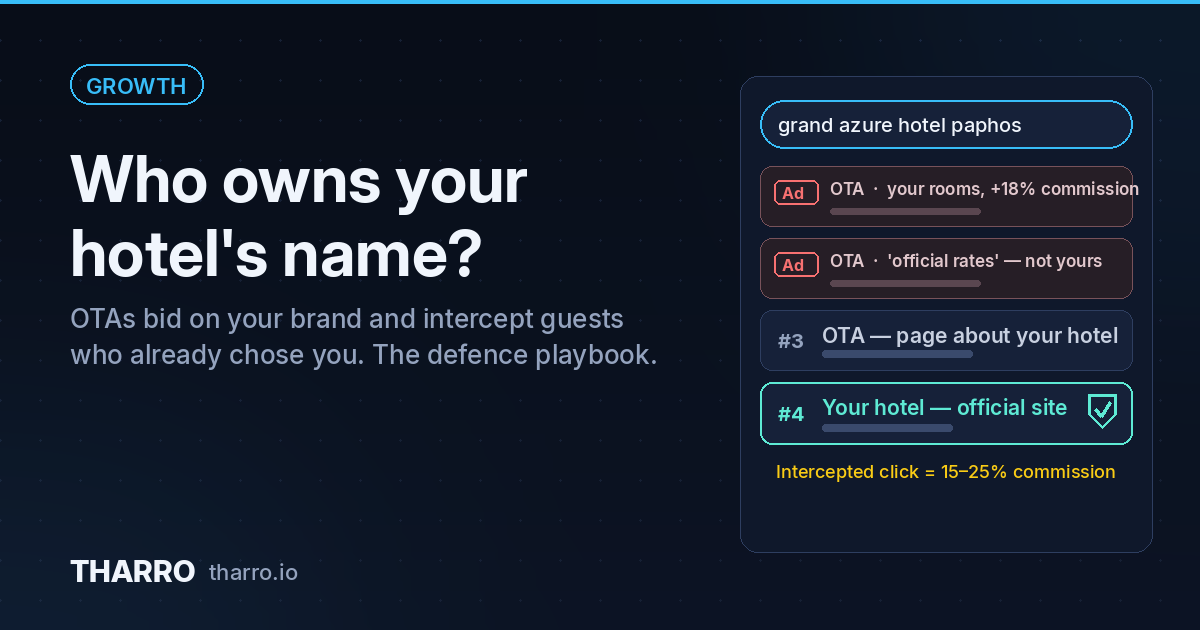
Battlefield 2: Your brand name. Verdict: you must win — and often you're not. Hotels assume they own their own name. Frequently they don't: OTAs bid on brand terms and earn organic slots around you, converting guests who were already searching for you into 15–25% commission payments. This is the one battlefield where losing is inexcusable and defending is cheap. (Full playbook: our brand-defence article.)
Battlefield 3: The long tail ("adults only spa hotel near Paphos old town"). Verdict: hotels win — this is your ground. OTAs optimize for volume; specificity is where their giant generic pages get weakest. A hotel page written for one precise intent — the honeymoon guide, the October-sun page, the near-the-marina page — competes with thin OTA category pages, not with their homepage authority. Lower volume, far higher intent, and cumulatively these queries add up to real demand.
Does outranking OTAs even matter in the AI era?
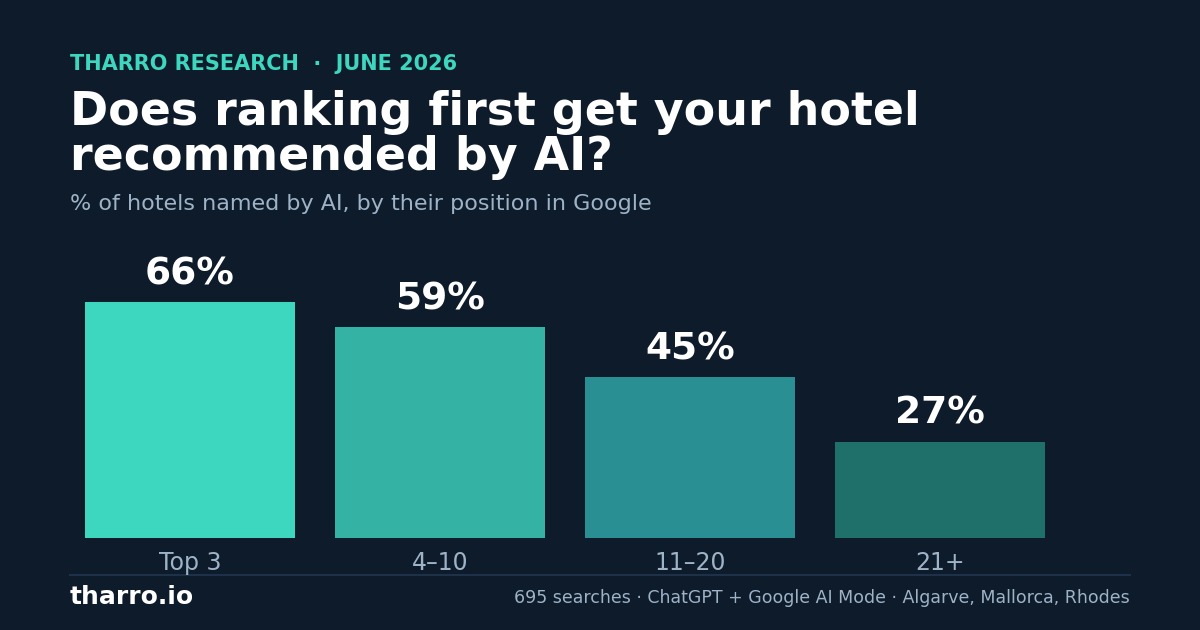
Partly — and less than the industry assumes. In our study of 695 unbranded hotel searches across ChatGPT and Google AI Mode, hotels whose own site ranked in Google's top 3 were named by AI about 66% of the time, versus ~27% below position 20. Ranking helps you get mentioned. But it barely gets you cited: even at Google top-3, a hotel's own site was the cited source in under 20% of cases — AI reads OTAs, review platforms and editorial guides to decide who to recommend.
So the SERP fight and the AI fight are related, but they're separate scoreboards. Beating Booking.com on a long-tail keyword wins you the searcher who scrolls. It doesn't automatically win you the traveler who asks ChatGPT.
The practical playbook
- Classify every keyword before you spend. Winnable (long-tail, brand) / defensive (brand under attack) / unwinnable (OTA-owned head terms). SERP domain ownership data — who actually holds positions 1–10 — makes this classification objective instead of hopeful.
- Defend the brand first. Cheapest, highest-ROI work in hotel SEO.
- Build one page per winnable intent. Depth beats breadth; a specific page for a specific searcher beats a generic page for everyone.
- Let the unwinnable go — publicly, in your own reporting. "We stopped chasing 'hotels in [city]' and reallocated to 12 winnable clusters" is a stronger board slide than a rank that moved from 9 to 7 behind five OTAs.
- Track SERP ownership monthly, not positions daily. Share of page one vs intermediaries is the metric that connects SEO to commission savings.
FAQ
Can a small independent hotel outrank Booking.com at all? Yes — on its own brand name and on long-tail unbranded queries where OTA pages are generic. Not on head terms; that's not defeatism, it's budget discipline.
Should hotels stop doing SEO because OTAs dominate? No. It means doing selective SEO: brand defence plus winnable long-tail clusters, measured by SERP ownership rather than vanity rankings.
Does ranking well on Google get my hotel into ChatGPT's recommendations? It helps but guarantees nothing — top-10 hotels were named by AI ~61% of the time in our data, and your own site is rarely the cited source. AI visibility needs its own tracking.
See who owns your SERPs. Tharro maps SERP domain ownership for your keyword universe — the winnable, the defensive, and the honest unwinnable. Check your Google Visibility → · Start Free Trial