Growth
Hotel Brand Defence: How OTAs Win Your Name on Google
OTAs bid on your hotel's name and outrank you with domain authority, turning guests who searched for YOU into 15–25% commissions. The defence playbook.

Hotel Brand Defence: How OTAs Win Your Name on Google — and How to Take It Back
The most expensive clicks your hotel loses aren't on competitive keywords. They're on your own name.
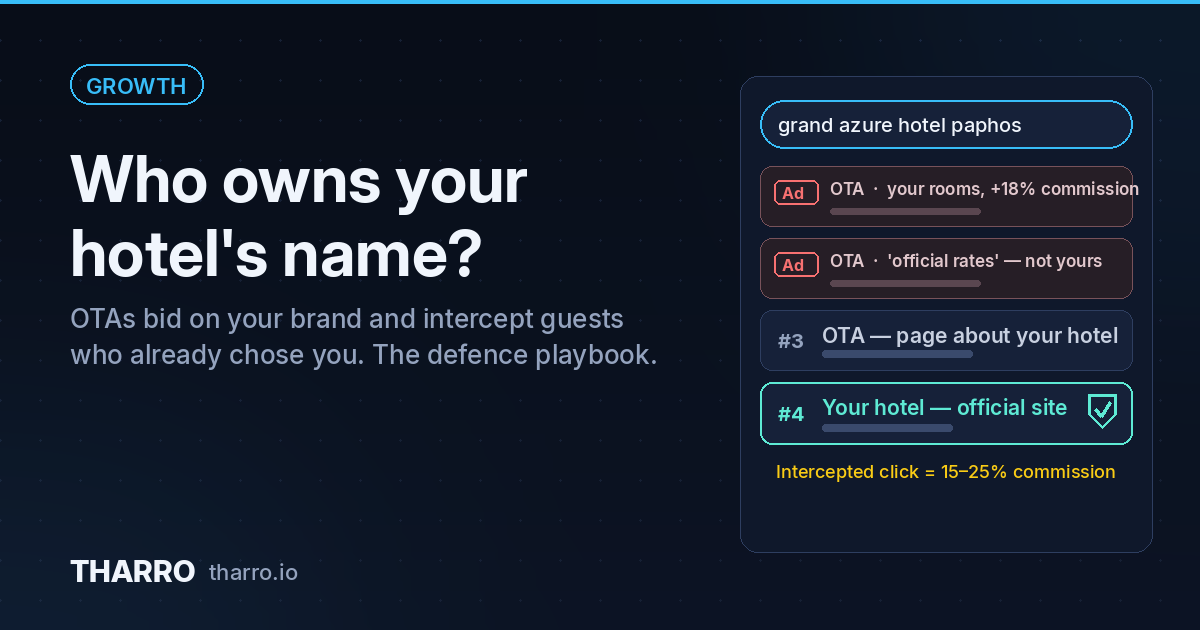
Here's a test that takes thirty seconds and regularly ruins a hotelier's morning: open an incognito window and search your hotel's exact name — then do it again the way a German or British guest would, from their market. Count what sits above your website. For many hotels the answer is two OTA ads, an OTA organic result, and a metasearch box — before the hotel itself appears.
Every one of those clicks is a guest who had already chosen you, redirected into a 15–25% commission. Brand interception isn't a marketing problem you might have. It's a leak that's either measured or invisible.
How the interception works
Mechanism 1: Brand bidding. OTAs buy ads on your hotel's name. It's legal in most markets, and it's rational for them: your name is the cheapest high-intent keyword in existence — the guest has done all the persuasion work already.
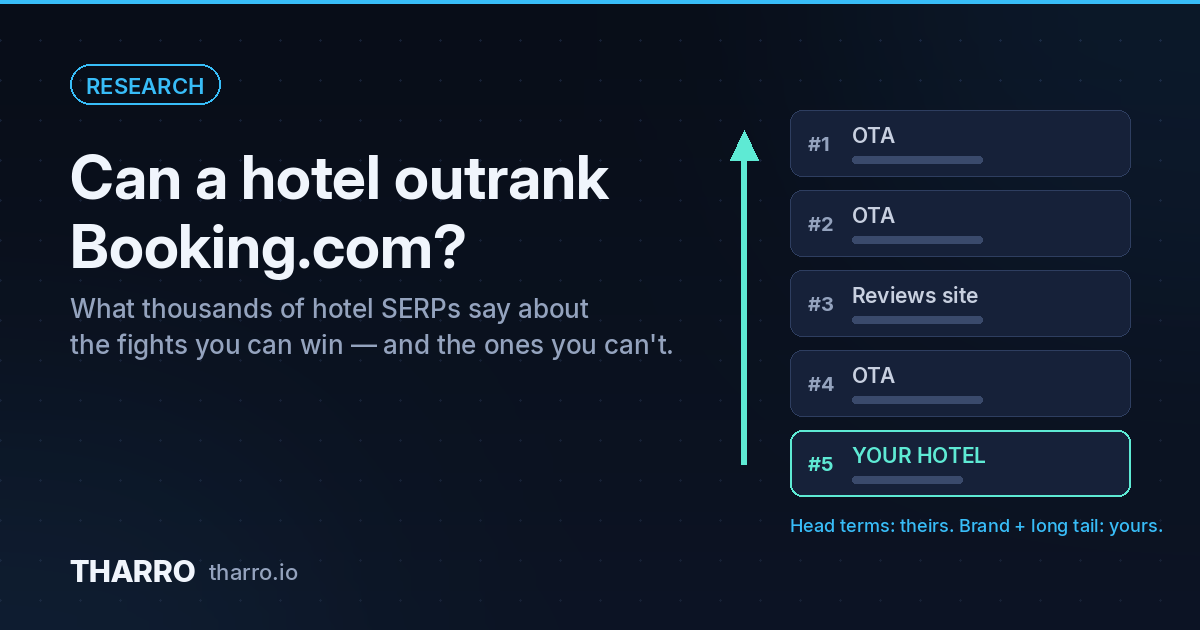
Mechanism 2: Organic authority. Even without ads, Booking.com's page about your hotel can outrank your hotel, because their domain authority dwarfs yours. Your own property page competes with one of the strongest domains on the internet — about you. (Whether that fight is winnable at all is a question we've answered with data.)
Mechanism 3: Market blindness. Hotels check their brand SERP from their own office, in English, logged into Google. Your guests search from Frankfurt, Manchester and Warsaw — where the ad mix, the OTA presence and even which OTAs show up are different. A brand SERP that looks clean in Nicosia can be fully intercepted in Germany.
What losing your name actually costs
The math is simple enough to put in a board slide. Take your monthly direct-booking value from brand search, apply the share of brand clicks the OTAs capture, and multiply by their commission rate. For most independent hotels this number is annual-salary-sized — and it's paid on demand the hotel itself generated through years of service, reviews and marketing. The AI equivalent shows up as the branded vs non-branded gap in your visibility report: strong when the machine is asked about you by name, near-zero when it isn't.
There's a second, quieter cost: narrative control. When the top result for your name is an OTA listing, the OTA's photos, the OTA's description and the OTA's rate presentation become your first impression — and increasingly, they become what AI assistants read about you too. In Tharro's research, a hotel's own website is cited as a source in under 20% of AI answers even when it ranks top-3 on Google; the intermediaries fill the gap.
The brand defence playbook
1. Audit from your feeder markets, not your desk. Check your brand SERP as searchers in each top feeder market see it — organic and paid, desktop and mobile. This is the baseline everything else is measured against.
2. Run defensive PPC where you're being bid on. Your own name is the cheapest keyword you'll ever buy — quality score is on your side. Where OTAs bid, matching them typically costs cents per click against a 15–25% commission saved per reclaimed booking. Where nobody bids, don't waste the money.
3. Make your result the obvious choice. Winning position back is half the job; winning the click is the other half. Best-rate guarantee in the meta description, direct-booking perks visible, sitelinks to rooms/offers/location, fresh schema so your result carries stars and prices.
4. Fortify the surfaces Google trusts. A complete Google Business Profile and a claimed, accurate knowledge panel anchor your brand SERP — and feed Gemini and Google's AI Mode directly.
5. Monitor continuously, per market. Brand SERPs shift — OTAs test bids seasonally, new intermediaries appear, metasearch layouts change. A monthly per-market brand check turns surprises into routine maintenance.
Brand defence is the first chapter of a longer job; the rest of it — SERP ownership, winnable unbranded terms, the AI channel — is laid out in our hotel SEO guide.
FAQ
Is OTA brand bidding even allowed? Generally yes, unless your OTA contract restricts it — some hotels have negotiated brand-bidding clauses. Check your contracts; enforcement is on you, and you can't enforce what you don't monitor.
Should I pay for ads on my own hotel name? If OTAs are bidding on it, almost always yes — defensive PPC on brand terms is among the highest-ROI spend in hotel marketing. If nobody is bidding, save the money and monitor instead.
Does brand defence matter for AI recommendations too? Increasingly. AI assistants build answers from the sources that dominate your brand's search footprint. If OTAs own your name on Google, they're disproportionately likely to own your story in AI answers as well.
Find out who owns your name — in every market that matters. Tharro's brand strength analysis shows exactly where OTAs intercept your brand searches and what it's costing you. See Google Visibility → · Start Free Trial