Research
SEO for AI Visibility: What Google Rank Buys in AI Answers
We matched Google rankings against real AI answers for thousands of hotels. Rankings drive AI mentions, not citations. Here's the data and the playbook.

SEO for AI Visibility: What Your Google Rankings Actually Buy You in AI Answers — and What They Don't
Every hotelier asking about AI visibility eventually asks the same question: does my SEO work carry over? If we rank well on Google, will ChatGPT and Google's AI Mode recommend us?
We tested this directly. We collected the actual Google results and the actual AI answers for the same unbranded searches across Mediterranean markets, matched thousands of hotels across both surfaces, and measured the carryover in both directions. The answer is more interesting than yes or no: SEO still matters — but it buys you something different than most hotels think.
Finding 1: Ranking predicts being named — with a clear gradient
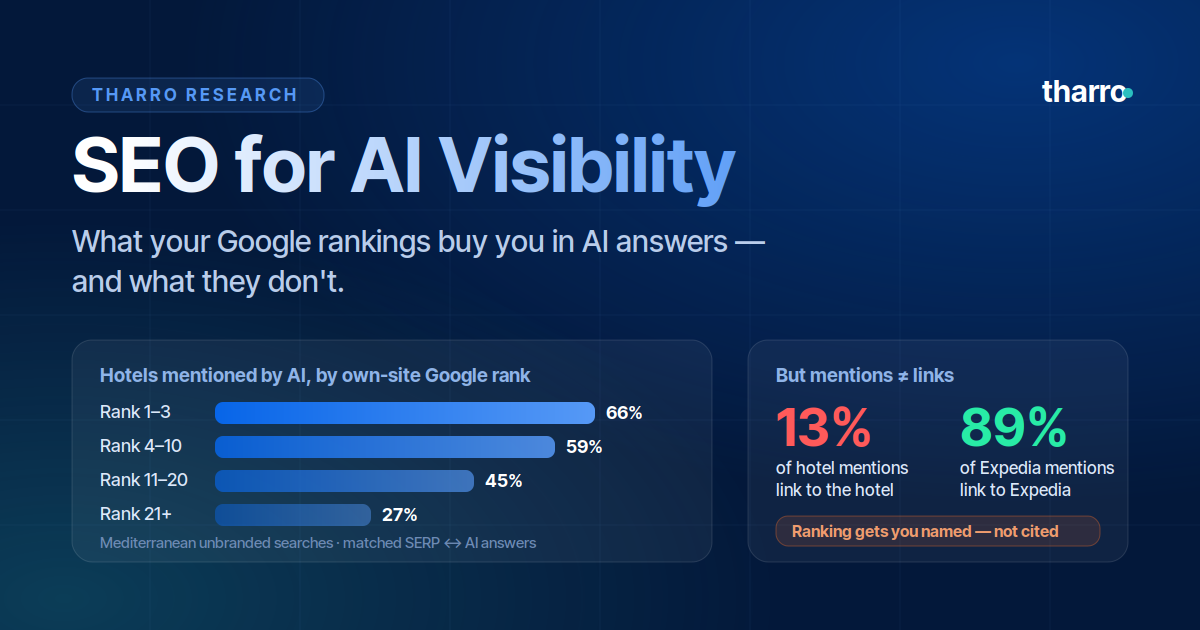
For unbranded searches where a hotel's own website ranks in Google:
- Ranks 1–3: ~51% of those hotels get named in AI answers for the same search intent
- Ranks 4–10: ~38%
- Ranks 11–20: ~32%
- Rank 21+: ~15%
A top-3 hotel is roughly 3.5x more likely to be mentioned by AI than one buried past page two. The gradient is clean and holds up across cuts of the data.
So no — SEO is not dead. Search visibility is still one of the strongest predictors we found of whether AI knows to name you at all. If your own site ranks for the searches that matter, you've cleared the first gate.
But notice what that number is measuring: being mentioned. Not being linked.
Finding 2: Ranking does not get you cited
A mention is your name in the answer. A citation is a link — the thing the traveller actually clicks. And here the carryover collapses.
Even among hotels ranking top-3 on Google with their own website, only roughly one in five had their own site cited in the AI answer. At every rank band, citation rates stayed low. The AI names the hotel — then links to an OTA, a travel guide, or an editorial roundup instead.
Our Berlin study put hard numbers on this gap. When a hotel is mentioned in an AI answer, only 13% of those mentions carry a link to the hotel's own website. When Expedia is mentioned, 89% of those mentions link to expedia.com. Same surface, same answers — an entirely different conversion of presence into clickable authority.
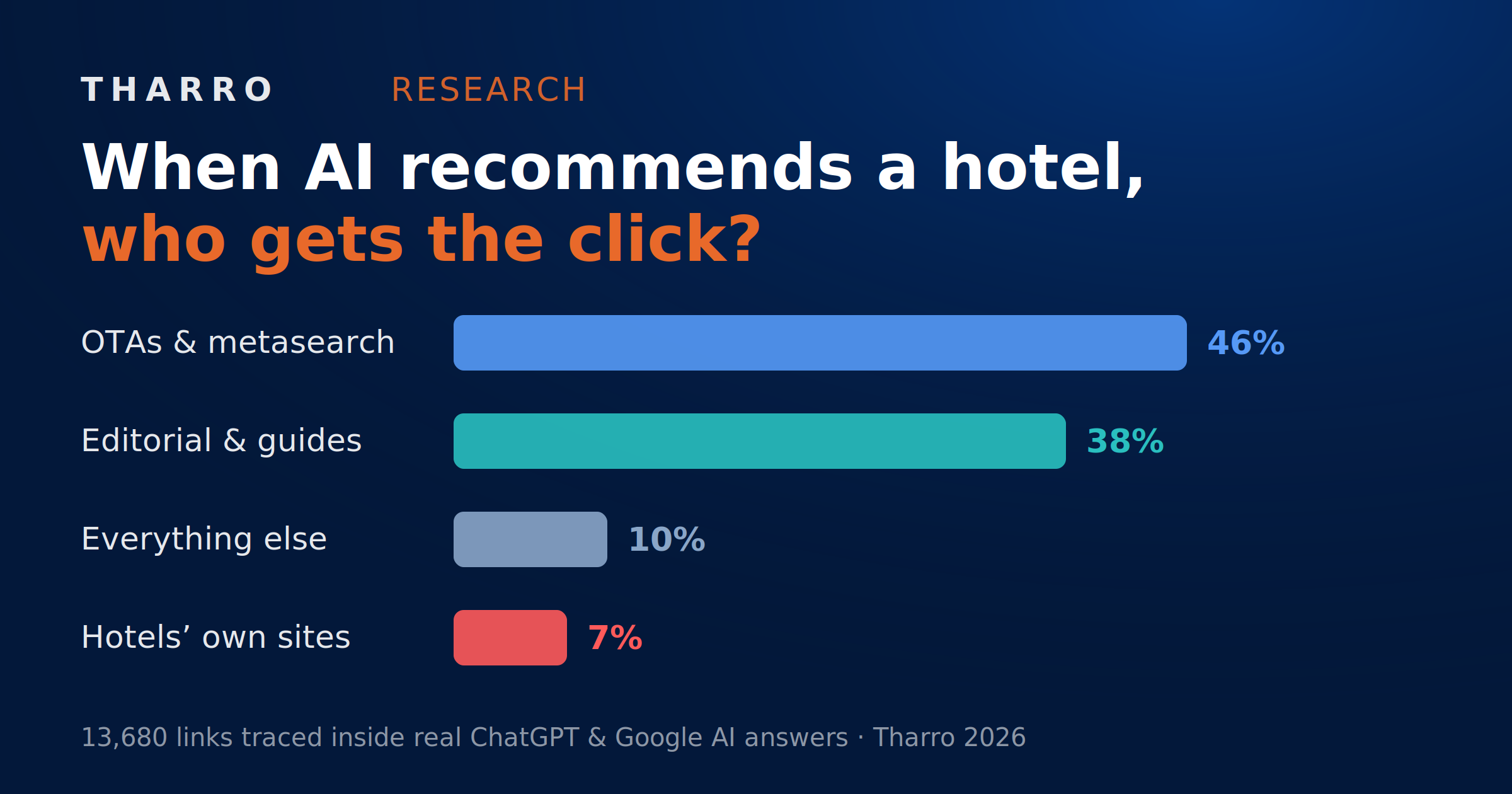
This is the single most important correction to how hotels think about AI visibility: you cannot rank your way into being the link. Google rewards your site; AI answers reward the sources they trust for hotel recommendations — and today, those are OTAs, review platforms, and travel media.
Finding 3: The road runs both ways — and the other direction is worse
Flip the question: take the hotels AI does recommend, and check whether they rank on Google for the same search. Many don't — at least not as themselves. In roughly two-thirds of cases (63.5%) where AI named a hotel that has its own working website, that website was absent from Google's organic results for the same search. Across three independent studies, hotels control only about 7% of their own AI presence — the rest is mediated by OTAs, review sites, and third-party content.
The practical meaning: AI assistants are not reading the same list Google shows travellers. They're assembling recommendations from a wider, messier source pool — one where your OTA profile, your Tripadvisor page, and a journalist's listicle can matter more than your homepage.
Finding 4: There is no single "AI" to optimize for
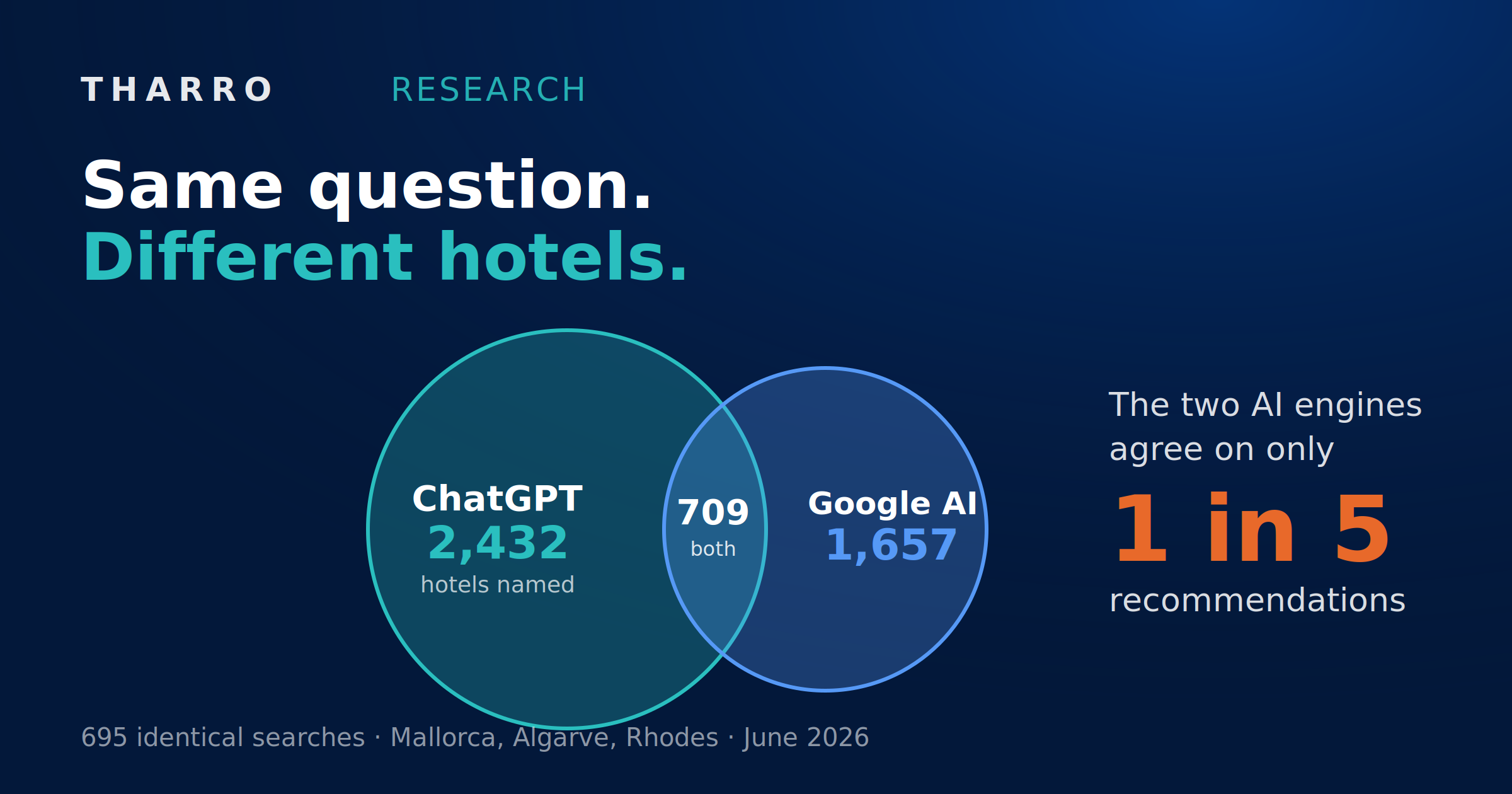
We compared which hotels Google's AI Mode names versus which hotels ChatGPT names for the same searches. The overlap was startlingly small — the two engines agreed on only a fraction of hotels (Jaccard similarity 0.21), and top-10 lists for the same markets can share zero hotels. ChatGPT named 2,432 distinct hotels across our three markets, Google's AI Mode 1,657 — but only 709 appeared in both.
The engines also behave differently in kind:
- AI Mode is a transaction surface. It leans on structural, bookable sources — OTAs, operators, metasearch — and its recommendations reward review volume and establishment signals.
- ChatGPT is a reputation surface. It leans on Tripadvisor, Reddit, and editorial coverage — sources you can't buy placement in, but can earn presence on.
Same traveller question, opposite playbooks. Treating "AI visibility" as one channel is already a mistake.
Finding 5: What actually drives being named (it's not your review score)
Among hotels that get named in AI answers, the strongest correlates of being named often were review count (ρ = 0.34), star class, and price positioning. Guest rating quality was essentially flat (ρ = 0.08) — a 4.5 does not outperform a 4.3 in AI naming frequency in any meaningful way.
In other words: popularity and establishment signals drive AI naming; incremental rating improvements don't. You cannot review-score your way in, any more than you can rank your way in. This is a floor effect, not a ladder — clearing the visibility floor matters far more than polishing metrics above it.
One more lever most hotels ignore: theme and persona choice is itself visibility strategy. In our data, hotels' share of their own presence varied enormously by travel theme — nearly 19% for honeymoon-type queries versus effectively zero for nightlife-type queries. Where you choose to compete determines whether hotels can win at all.
The playbook: SEO optimization for AI visibility
Put together, the evidence points to a specific, sequenced approach:
1. Keep your unbranded SEO — it's the mention engine. Top-3 organic presence for your target unbranded searches remains the strongest controllable predictor of AI naming. Don't reallocate away from hotel search visibility; refocus it on the intents where you can realistically reach the top band.
2. Stop measuring rankings as the end state. Track mentions and citations in AI answers as separate outcomes, because they are. A hotel can be named constantly and clicked never. Your dashboard needs both columns.
3. Fight for the citation layer — off your own site. Since AI links OTAs, guides, and review platforms, the citation battle is fought on earnable surfaces: editorial coverage, travel-media roundups, Reddit and forum presence, and a Tripadvisor profile that deserves to be sourced. This is closer to digital PR than to technical SEO.
4. Audit your OTA-mediated presence. If AI can only "see" you through your Booking.com or Expedia listing, that listing is your AI storefront. Completeness, photography, descriptions, and review volume there feed the machine directly.
5. Split your strategy by engine. For AI Mode: structural presence — bookable channels, metasearch, review volume. For ChatGPT: reputation presence — editorial, community, review platforms. Budget and measure them separately.
6. Pick themes where hotels can win. Before investing in a persona or theme, check whether hotels ever own presence there. Competing on a theme AI hands entirely to OTAs and guides is a structural loss before you start.
7. Monitor, because the biggest driver isn't directly measurable. The strongest remaining explanation for who gets named — editorial and third-party coverage — can't be tracked at hotel level from inside your analytics. The only way to know whether any of this is working is to watch the AI answers themselves, continuously, across engines.
The bottom line
SEO for AI visibility is real — but it's a different discipline than the SEO hotels have been doing. Rankings buy you mentions. They do not buy you links, and they do not transfer between engines. The hotels that win the next phase of discovery will be the ones that treat the mention layer and the citation layer as two separate battles, fought on two separate sets of surfaces — and that can actually see the scoreboard.
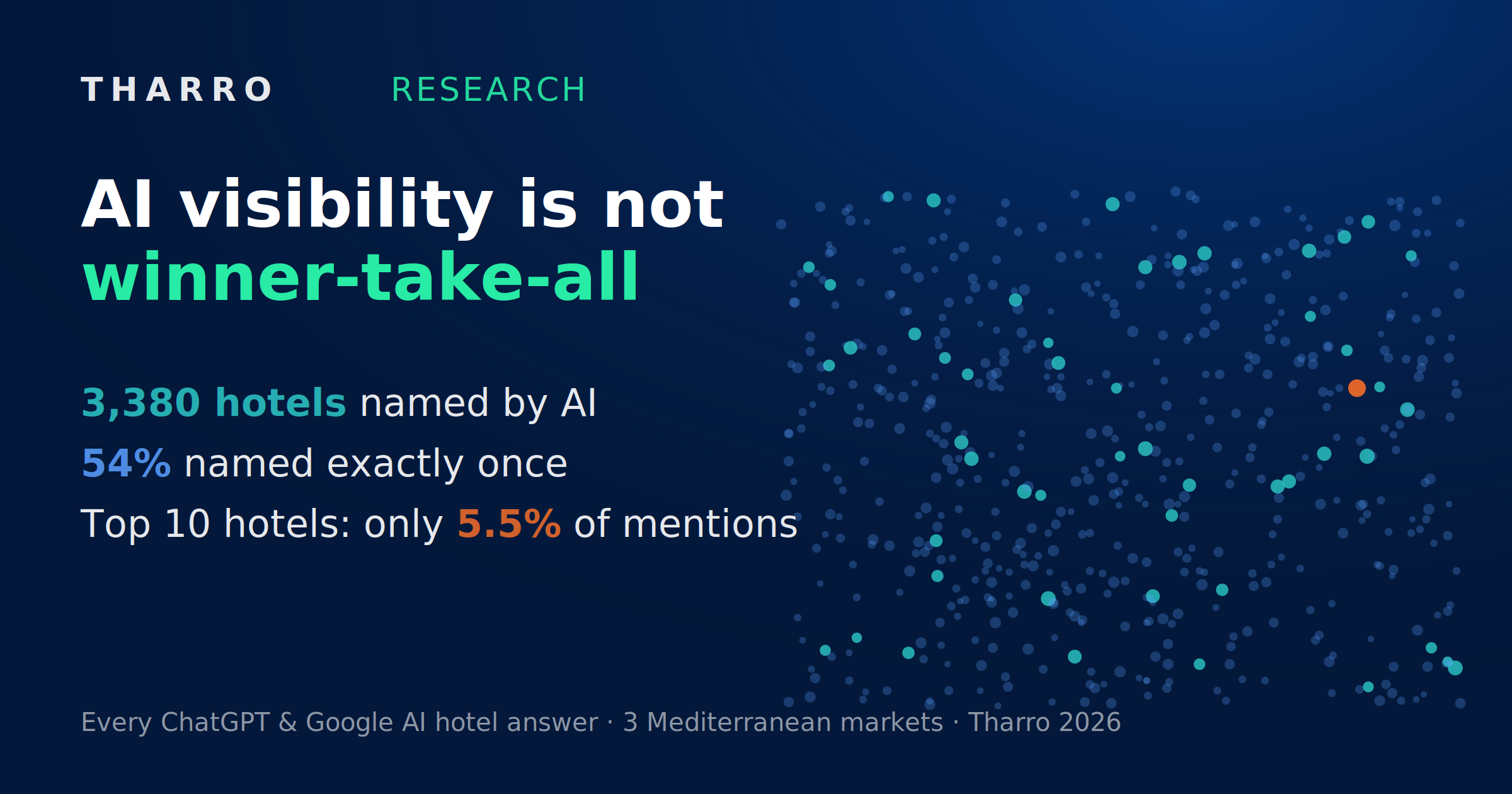
Methodology note: findings are drawn from Tharro's 2026 SERP-to-AI carryover research (matched Google organic results and AI answers for identical unbranded searches across Mediterranean markets; 3,380 named hotel entities; mentions and citations measured separately across Google AI Mode and ChatGPT, with the full study document available on request) and the Berlin AI booking-authority study (95 queries, 380 query executions across ChatGPT, Perplexity and Gemini; 4,085 recommendations covering 773 hotels and 46 OTAs). Relationships reported are cross-sectional and associational.