
Decide with the full picture, not a slice
German demand is rising, your Google visibility in Germany is flat, and AI barely mentions you to German travelers. Seen together, that's one clear action. Seen in three tools, it's three unread reports.
Demand, Google visibility, AI visibility, and reputation intelligence for your hotel — connected, benchmarked against your comp set, and turned into a ranked weekly action plan.
Hotel marketing intelligence is the practice of connecting every signal that shapes a hotel's bookings — search demand, Google visibility, AI visibility, price position and reputation — into one benchmarked view, and turning that view into decisions. A hotel marketing intelligence platform does what a rank tracker, a review monitor and a rate shopper cannot do separately: it shows the signals in relation to each other, against the competitive set you actually lose bookings to, and answers the only question that matters on Monday morning — what should we do this week, and why?
Rankings in one dashboard. Reviews in another. Rate comparisons in a third. AI visibility in none of them. Every tool describes its own slice — none of them answers the Monday-morning question: what should we do this week, and why?
Meanwhile the intermediaries you compete with see the whole board. OTAs connect demand signals, price signals, and visibility signals in real time. Most hotels are competing against connected intelligence with disconnected reports.
German demand is rising, your Google visibility in Germany is flat, and AI barely mentions you to German travelers. Seen together, that's one clear action. Seen in three tools, it's three unread reports.
Hotel competitive intelligence means every metric — visibility, reputation, demand capture — is read against the hotels you actually lose bookings to, not against abstract industry averages.
A competitor climbing your keywords, a review-score gap opening, a feeder market cooling — weekly signals surface changes months before they show up in RevPAR.
SERP ownership and AI-visibility data show where OTAs are entrenched and where you have a real shot — so budget moves from ego metrics to winnable ground.
One connected view answers the owner's question — "are we visible where travelers decide, and is it improving?" — with benchmarks, not anecdotes.
Every week, the signals become a ranked action plan — and you can ask Claude anything in between, grounded in your own data.
Who owns your SERPs — you or the OTAs? Keyword positions, SERP domain ownership, brand-defence gaps.
How ChatGPT, Gemini and Perplexity recommend hotels in your market — and whether you're in the answer.
Which feeder markets are searching, when they book, and where demand is heading 2–8 weeks out.
Review scores, sentiment and segment performance vs your comp set — the inputs AI reads about you.
Every module runs against your competitive set by default. You don't just see your AI visibility — you see it next to the five hotels a traveler compares you with. That's the difference between data and intelligence: context you can act on.
The two terms get used interchangeably, but they answer different questions. Hotel market intelligence describes the market around you: demand by feeder market, booking windows, rates, supply, seasonality — the conditions you operate in. Hotel marketing intelligence describes your performance inside that market: whether travelers find you on Google and in AI answers, how you compare with your comp set, and where your next booking is most winnable. You need both — market intelligence without marketing intelligence tells you demand exists but not whether you're capturing it. Tharro's Demand Intelligence module covers the market side; the platform connects it to your visibility.
01

One view connecting spend to visibility to demand. Know which investments moved which needle — and what to shift next quarter.
02

Demand signals, price position and visibility in one place. Adjust rates and distribution while the window is still open.
03
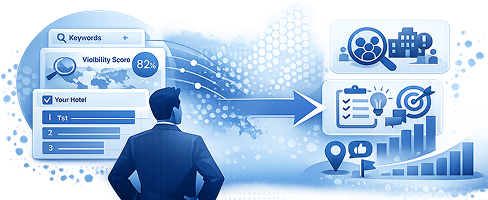
The straight answer: are we visible where travelers decide, is it improving, and what's being done about it — no jargon required.
Software that connects the signals shaping a hotel's bookings — search demand, Google visibility, AI visibility, pricing context and reputation — into one benchmarked view, and turns them into prioritized actions. It differs from single-purpose tools (rank trackers, review monitors, rate shoppers) by connecting the signals rather than reporting them separately.
Reading every metric against your actual comp set: which hotels win the keywords, AI recommendations and guest segments you're targeting — and where the gaps are. Without competitive context, a "good" score is meaningless.
RMS tools optimize price against demand you already receive. Tharro works upstream: whether travelers find you at all — in search, in AI answers, in their planning window — and which markets to capture next. They're complementary.
Generic tools don't understand hotel distribution — they can't separate OTA competition from hotel competition, and they see one channel at a time. Tharro is hotel-specific and connected across channels.
Both. Independents get the intelligence layer big brands build in-house; groups get portfolio-level comparison across properties and markets.
Minutes. Name and description — no integrations required for the first visibility snapshot.
Hotel market intelligence covers the conditions around you — demand, feeder markets, rates, booking windows. Marketing intelligence for hotels covers your performance within those conditions — visibility on Google and AI, competitive position, and demand capture. Tharro connects the two, because a demand spike you're invisible to is a competitor's booking, not yours.
The research behind the platform: how discovery is fragmenting across search, OTAs and AI, what a visibility report actually tells you, and why demand ownership is the problem underneath all of it.
See your visibility, demand and reputation position vs your comp set — free trial, no credit card.