Research
The Language AI Uses to Describe Luxury Hotels Across Europe
We analysed 1.3 million words of AI hotel recommendations across 8 European markets: how ChatGPT and Perplexity describe luxury hotels, and what drives it.

A sentiment analysis of 1.3 million words of AI-generated hotel recommendations — and what the language reveals about how upper-market properties are being framed.
A note on scope before we begin.
This study covers the luxury and upper-market hotel segment specifically. All 2,814 prompts we ran were designed to reflect how a traveller interested in 4- and 5-star hotels searches for accommodation. About 51% contained explicit luxury or 5-star language ("best luxury hotels in Santorini," "best 5-star hotels in Istanbul"). The remaining 49% were upper-market framed without stating a star category — boutique hotels, award-winning hotels, iconic properties, romantic breaks, honeymoon hotels, "money no object" queries.
There were exactly 10 prompts in the entire dataset with budget-adjacent language. This was deliberate: Tharro tracks independent luxury hotels, and we built the prompt set to mirror how their guests search.
What follows is an analysis of how AI talks about hotels within this segment — not a representation of AI hotel recommendations overall.
The five words AI uses to describe every luxury hotel
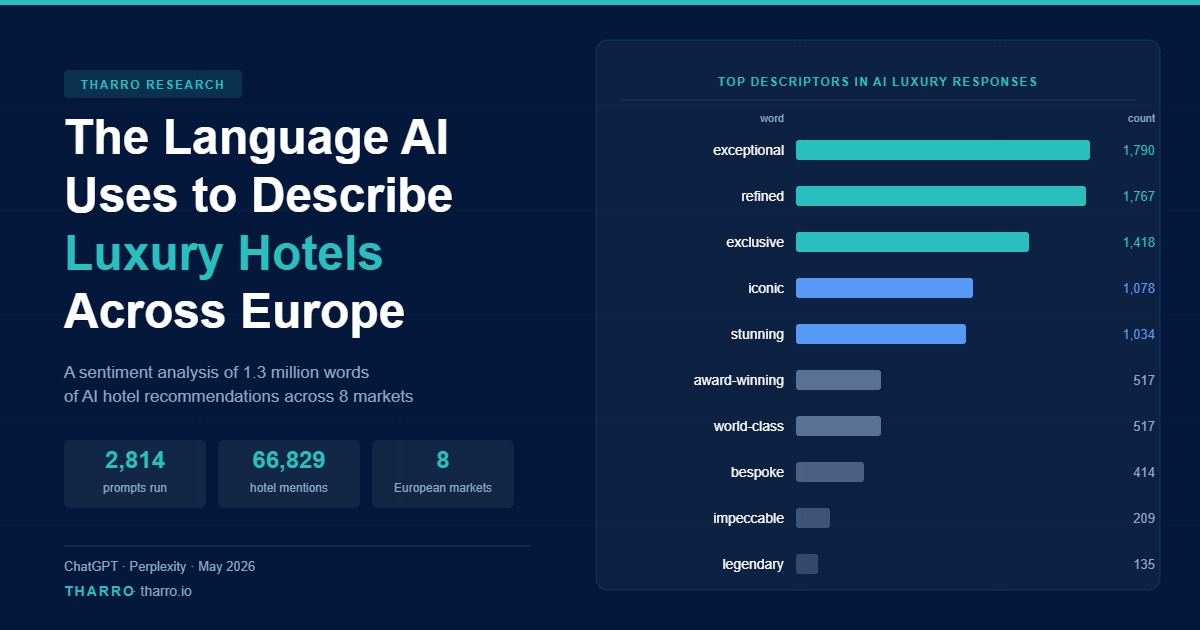
Across 66,829 hotel mentions and 1,335,415 words of response text, the dominant sentiment vocabulary is narrow and deeply repetitive:
| Word | Appearances |
|---|---|
| exceptional | 1,790 |
| refined | 1,767 |
| exclusive | 1,418 |
| iconic | 1,078 |
| stunning | 1,034 |
| top-rated | 719 |
| award-winning | 517 |
| world-class | 517 |
| curated | 482 |
| opulent | 420 |
| bespoke | 414 |
| timeless | 332 |
| unmatched | 230 |
| impeccable | 209 |
| legendary | 135 |
These words appear applied to almost every property in almost every response. "Exceptional" — 1,790 uses across 2,814 responses — appears in the majority of responses, usually multiple times, usually applied to multiple hotels simultaneously.
The effect is complete sentiment inflation within the luxury segment. Being described as "exceptional" by an AI is not a differentiator among luxury hotels — it is the baseline. The differentiation happens in other ways: in structure, in specificity, and above all in position.
The sentiment gradient by list position
The most important finding in the language analysis is the relationship between list position and language temperature. Within luxury hotel responses, we measured descriptor density across four warmth tiers at each list position:
| Position | "Hot" descriptors / 1,000 words | "Warm" descriptors / 1,000 words |
|---|---|---|
| 1 | 2.7 | 7.2 |
| 2 | 3.1 | 5.6 |
| 3 | 2.8 | 4.7 |
| 5 | 2.2 | 4.1 |
| 7 | 2.0 | 3.6 |
| 10 | 1.8 | 3.2 |
Warm descriptor density at position 1 (7.2 per 1,000 words) is more than double that at position 10 (3.2). All the properties being described are in the luxury segment — no budget hotel is pushing down a list and diluting the language. The gradient is entirely about position within a luxury ranking.
A guest reading an AI list of luxury hotels in Santorini does not consciously perceive this. They do not think: this hotel is being described with lower-temperature language than the one above. The effect registers as a feeling — the earlier hotels feel more compelling, more certain, more definitively worth it. The later hotels read like fine print. All of them are luxury properties. The language makes them feel like they're in different leagues. That gradient has a commercial counterpart in booking authority: findings from 20,000+ AI hotel recommendations, where position and emphasis are what turn a mention into a booking.
How AI introduces the number-one luxury pick
Across all markets, the phrases AI uses immediately before naming its top recommendation in a luxury query:
- "consistently ranked" — 99 instances
- "widely regarded" — 77 instances
- "the pinnacle" — 25 instances
- "benchmark" — 17 instances
- "gold standard" — 5 instances
- "the best" — 463 instances (used frequently but much broader)
These are consensus statements. AI is reporting what multiple sources agree on — it is summarising a pre-existing hierarchy, not generating one.
The most powerful framing device in the entire dataset is not a superlative — it is a uniqueness claim. The Gainsborough Bath Spa, which topped 34 separate Bath luxury hotel responses, was introduced with: "the only hotel in the UK with direct access to the city's natural thermal waters." There is no counter-argument to "the only." No other luxury property can outscore it on that dimension regardless of how good it is.
Every independent luxury hotel has something that is genuinely the only in its category. The question is whether AI has encountered that claim in the sources it reads.
How AI introduces specific #1 picks
The Elysium, Paphos: "Often described as Paphos' most iconic 5-star luxury hotel, Elysium sets the benchmark for grandeur, impeccable service, and serene elegance. Nestled within beautifully landscaped gardens, it features multiple pools, a secluded sandy cove, and the renowned Opium Health Spa."
Three moves: the frequency attribution ("often described as"), a benchmark claim, then named physical specifics. Specificity after superlative is what makes this read as credible.
Baur au Lac, Zurich: "A family-run 5-star hotel in its seventh generation, Baur au Lac sits in a private park right on Lake Zurich with stunning views of the lake and Alps. It belongs to The Leading Hotels of the World and Swiss Deluxe Hotels, and has received accolades such as multiple Guide Michelin 'three keys' awards."
Authority markers stacking: seven generations, private park, Leading Hotels, Swiss Deluxe Hotels, Michelin three keys. No single marker is decisive; the convergence is.
Four Seasons Limassol (the independently owned Cypriot property, not the global chain): "Consistently ranked as the #1 5-star hotel in Limassol on TripAdvisor (4.8/5 from 4,611 reviews) and hailed as 'the best hotel in Cyprus' across multiple sources."
Different luxury markets get different narrative frames
Not all AI responses about luxury hotels are structured the same way. The dominant opening framework — 30% of all responses — names its sources before naming a single hotel. This is AI establishing epistemological credibility for its luxury recommendations.
Greece is the exclusivity market. At 9.6 exclusivity-related terms per 1,000 words — the highest of any market — Greece's luxury AI coverage is built around "each with its own private pool," "cliffside," "cave-hotel," "intimate," "serene."
Turkey carries a value counter-narrative. The Istanbul section opens repeatedly with: "Istanbul's hospitality scene is exceptional — offering a blend of historic grandeur and modern opulence, often at more competitive prices compared to other major European capitals." Even the Çırağan Palace Kempinski is framed alongside Turkey's price advantage.
Switzerland has the most chain-dominated language: global chain brands mentioned 3.8x more frequently than independent luxury properties. Turkey: 6.7x.
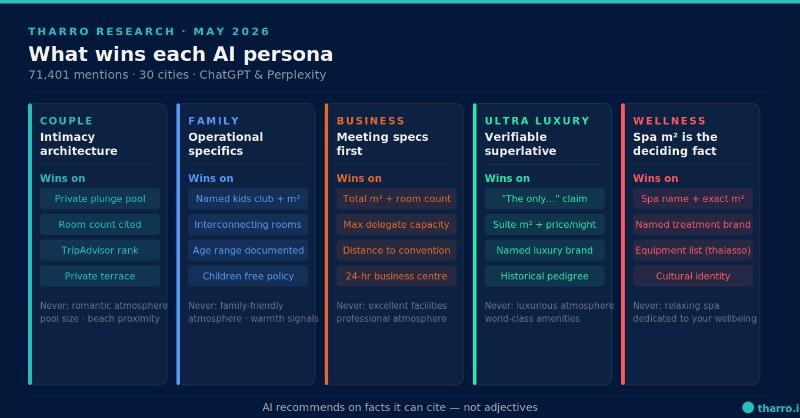
The UK shows a sharp regional split. Bath is almost entirely wellness-defined: 37.5 wellness terms per 1,000 words — four times the UK average. Any luxury hotel in Bath without a specific, editorially validated wellness proposition is competing against a narrative AI has already built for the entire city. Markets set the frame; personas set the vocabulary inside it, which we break down as the language patterns that win each persona.
The vocabulary gap between Ultra Luxury and Budget Luxury
Even within the luxury segment, the vocabulary AI uses varies dramatically based on which persona a query activates.
| Ultra Luxury: more frequent | Budget Luxury: more frequent |
|---|---|
| bespoke (27×) | affordable (73×) |
| elite (25×) | deals (23×) |
| privacy (14×) | value (19×) |
| suite (14×) | quality (18×) |
| villa (9×) | price (14×) |
| michelin (4×) | great (9×) |
These are not tone adjustments. They are two different documents written for two different guests — both searching for luxury hotels, described in entirely different vocabularies. If your luxury property's editorial coverage skews toward the value-luxury register, that is the persona AI will send to you.
The comparison queries
We ran 30 destination comparison prompts. These force AI to declare explicit verdicts and reveal how entire markets are framed competitively. The same unbranded-intent approach at larger scale sits behind AI hotel visibility: what 695 searches reveal.
Santorini vs Mykonos: Santorini gets "intimate," "serene," "private plunge pools," "honeymoon." Mykonos gets "vibrant," "cosmopolitan glamour," "nightlife." A luxury hotel in Mykonos trying to attract the intimate-honeymoon guest faces an AI market frame assigned to its competitor island.
Istanbul vs Athens: "Istanbul is the superior choice over Athens. It offers greater historical depth and diversity." Athens is "more compact," "best absorbed in 3–4 relaxed days." Luxury hotels in Athens inherit a competitive framing that positions their city as second-best.
Bodrum vs Mykonos: Bodrum is positioned as "the St Tropez of Turkey" — sophisticated, somewhat exclusive, the less-discovered version. "Serene sophistication, ancient heritage, and upscale leisure" versus Mykonos's "cosmopolitan glamour."
Verbier vs Zermatt: Verbier is social and design-forward; Zermatt is technically elite. W Verbier appears at position 1 in 15 separate Verbier luxury responses — it has effectively fused with the destination's AI-assigned personality.
High-intent luxury query types
"Money no object" queries
For London: "Regarded as the most expensive suite in London, the Manor House Suite at Rosewood London can cost up to £44,000 per night. It spans approximately 6,295 sq ft, features its own private postcode, private elevator, seven rooms including a library and dining room."
"Its own private postcode" is doing significant work — the suite is so large and separate that the postal service gave it its own identity. Hotels that have invested in writing about themselves at the extreme of the luxury spectrum appear with language unavailable to those that have not.
"Hidden gem" queries
For Larnaca: "Lokàl Boutique Hotel — a beautifully restored heritage building turned urban boutique hotel, blending traditional architecture — original wooden beams and arched features — with contemporary design. With only 17 bespoke rooms, this is a quietly luxurious and intimate retreat."
17 rooms. Original wooden beams. These details signal authenticity precisely because they are specific. They describe exactly one property.
Award queries
Michelin citations dominate award-query responses: 74 Michelin mentions vs 24 Forbes Travel Guide, 15 SLH, 10 Leading Hotels of the World, 8 Travel + Leisure. OTA awards (TripAdvisor, Booking.com) appear frequently in source citations but rarely generate the prestige language of editorial/gastronomy awards.
ChatGPT vs Perplexity — two different luxury guest experiences
| ChatGPT | Perplexity |
|---|---|
| 525 words average | 424 words average |
| Tables in 39% of responses | Tables in 71% of responses |
| Heritage/narrative language | Urgency language 2.5× more frequent |
| Award/Michelin-dense | Pricing-specific |
| Emotional: "unforgettable," "transformative" | "Book early," "limited availability" |
In ChatGPT, The Royal Crescent Bath: "a living piece of English history, where candlelit rooms overlook manicured lawns."
In Perplexity, the same hotel: "Royal Crescent Hotel & Spa | Historic Georgian landmark, spa | From £450/night | High demand; book early."
Both accurate. Constructing entirely different guest experiences. The ChatGPT luxury guest is buying a story. The Perplexity luxury guest is making a decision. You need to have supplied both.
Physical attributes that generate the richest language
Views
- Views of the Acropolis: 33 mentions
- Views of the Alps: 10
- Views of the Aegean: 9
- Views of the caldera: 7
- Views of the Bosphorus: 7
- Views of Lake Zurich/Geneva: 7
Views of the Acropolis lead substantially. When AI says a luxury hotel has "views of the Acropolis," it is connecting the property to 2,500 years of civilisation.
Pool categories
- Private pool: 1,231 mentions
- Infinity pool: 1,052 mentions
- Rooftop pool: 365 mentions
- Plunge pool: 299 mentions
- Heated pool: 213 mentions
"Private pool" is the dominant category — it signals individualised luxury: the pool belongs to you, not to the hotel. "Plunge pool" signals boutique intimacy. AI uses these distinctions to assign character to luxury properties.
Michelin credentialing
- "Michelin-starred restaurant": 487 uses
- "Michelin star": 156 uses
- "Michelin key": 140 uses
Hotels holding both Michelin restaurant stars and Michelin hotel keys appear in AI luxury responses with authority framing unavailable to hotels with neither credential.
What determines what AI says about your luxury hotel
1. What the sources say. AI's vocabulary for your hotel is borrowed directly from what it reads. "Consistently ranked #1" appears in responses because those exact words appeared in TripAdvisor listings or editorial coverage. Your AI description is a compression of your existing presence across credible sources.
2. Where the consensus places you within the luxury segment. If the last Telegraph luxury hotel best-of listed six properties before yours, AI will reflect that. Changing position in AI responses means changing position in the underlying source landscape. There is no workaround.
3. Which words appear in your indexed presence. If sources describe your luxury property as "excellent value for a 5-star," AI sends value-luxury guests. If sources use "bespoke," "privacy," "Michelin-recognised," AI sends ultra luxury guests. The persona AI assigns you is the persona your words have earned you.
The honest scope statement
This study is a picture of how AI navigates the luxury and upper-market hotel segment in eight European markets, based on prompts designed to reflect how guests interested in 4- and 5-star properties search. It does not cover budget or mid-market hotel searches.
The path from position 7 to position 1 within a luxury AI response is not a marketing campaign. It is a sustained effort to place specific, credentialed, persona-matched language into the sources that AI reads and trusts. Each Michelin key. Each SLH listing. Each editorial feature. Each review response that uses the vocabulary of your ideal guest persona.
Hotels doing this systematically are building AI visibility that compounds. Hotels that are not are watching it happen from progressively cooler prose.
Scope: 2,814 prompts across ChatGPT (GPT-4o) and Perplexity (Sonar Pro), all targeting luxury and upper-market hotel searches across Cyprus, Greece, UK, Portugal, Spain, Switzerland, and Turkey. Prompts ranged from explicit luxury/5-star queries (51%) to persona-driven queries (22%), boutique and award-focused (10%), and generic upper-market (49%). Budget hotel queries: <1%. Collected May 2026 with live web search enabled. 66,829 hotel mentions, 1,335,415 words of response text.
Tharro measures AI visibility, Google search share, and demand intelligence for independent luxury hotels.
Curious how AI talks about your property? Request your free Digital Visibility Report to see the language, sources, and ranking signals shaping your AI presence.