Research
Own Your Demand: Hoteliers' One Real Problem
152 independent European hoteliers named four problems: pricing, low season, new guests, direct bookings. They're one problem: you don't own your demand.

Own Your Demand
What 152 independent hoteliers told us about the real problem in hotel commercial strategy — and why every other problem is a symptom of it
We ran a study into what independent hoteliers actually struggle with.
Not a panel poll. Not a vendor survey with a product at the end of it. 152 structured, hour-long phone interviews with independent hotels across Spain, Italy, Greece, Croatia, Germany, Austria and Switzerland — and specifically with the people who own the decisions: revenue management, distribution, and software purchasing. Mid-market properties. 35+ rooms. Real hotels with real occupancy problems.
They gave us a list of pains.
- Setting the right price to maximise profit
- Filling rooms in low season
- Attracting new guests
- Getting more bookings on their own website instead of someone else's
It reads like a list of four problems. It is one problem, written four ways:
"I don't own my demand."
Everything below is the evidence for that claim, and what to do about it.
1. The tell is what they didn't complain about
Here is the finding that reframed the whole study for us.
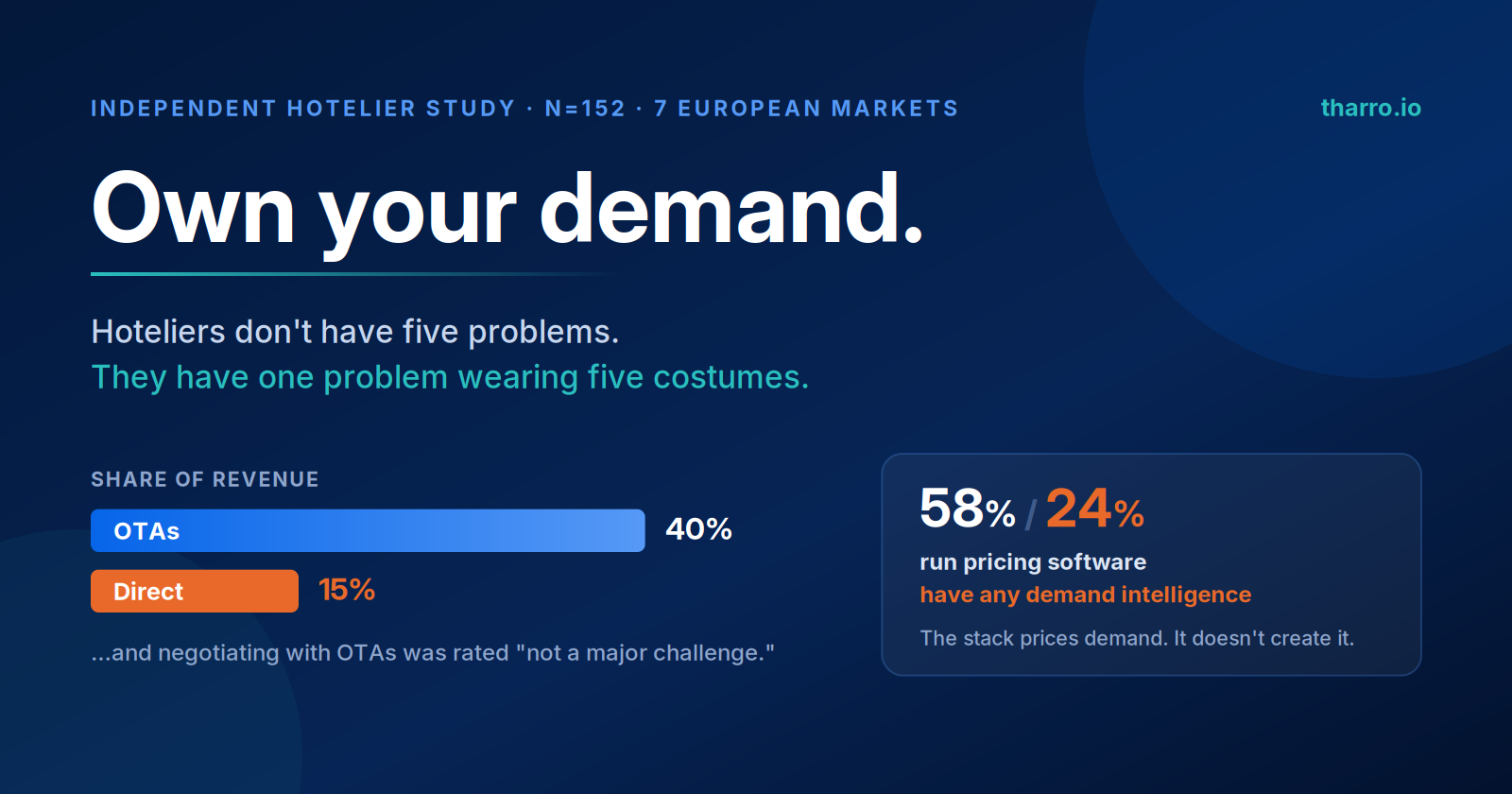
Asked to rate their challenges, hoteliers ranked negotiating with OTAs, bed banks and tour operators as not a major challenge. It barely registered on the list.
In the same survey:
| Channel | Share of revenue |
|---|---|
| OTAs | ~40% |
| Digital direct | 15% |
| Non-digital direct (single + group) | ~21% |
| Meta-search | ~9% |
| Travel agents / tour operators | ~9% |
| Wholesale | ~6% |
Four out of every ten euros arrive through an OTA, with Booking.com dominant inside that share. Add tour operators and travel agents, add wholesale, add meta — and roughly two euros in three arrive through demand that somebody else owned. Total direct is about a third of revenue, and only 15 points of that is digital direct.
And the relationship with the intermediaries carrying two-thirds of the business is not experienced as a problem.
That is not complacency. That is what dependency looks like once it has fully matured. It stops feeling like a decision and starts feeling like a climate. You don't complain about the weather; you dress for it.
The commission line has become a cost of doing business, like electricity. And costs of doing business don't get fixed, because nobody frames them as broken.
2. Pricing is the symptom that gets diagnosed as the disease
The number one pain, by a wide margin, was pricing. Setting the right prices to maximise profits. Then: setting the right prices to maximise revenue. Then: adjusting to volatile demand.
It makes sense. Price is the lever closest to your hand and it moves money today.
But consider what pricing actually is when you don't own your demand.
You are not setting a price. You are bidding for position inside a marketplace someone else runs, against a demand curve someone else can see far better than you can, competing with hotels whose relevance to that traveller was decided before you were ever consulted.
That is not revenue management. That is triage.
The hotelier who owns his demand still has a hard pricing job — but he prices from a position. The hotelier who doesn't prices from a queue. Same software, entirely different game.
This is why pricing feels permanently unsolved no matter how good the RMS gets. You cannot optimise your way out of a demand problem. You can only make a demand problem more efficient.
3. Low season is the same problem with the calendar changed
The biggest distribution challenge in the study wasn't parity, wasn't channel mix, wasn't extranet admin.
It was ensuring high occupancy of rooms in low season.
Look at what that is, mechanically. In high season, not owning your demand costs you margin — you pay commission on travellers who would have found you anyway. Out of season, it costs you the booking — because the intermediary's job is to fill a hotel in the destination, not your hotel. When demand thins, the platform doesn't fight for you. It routes what's left to whoever converts best that week.
Same root cause. In July it presents as commission. In November it presents as an empty floor. And "low season" is not a fixed date either — one country's soft summer is its neighbour's record year, which is what two opposite summers in the same sea found across Cyprus and Greece.
Two problems, two budgets, two software categories, two teams — one disease.
4. The stack is built downstream, and that's the whole story
Now the number that should have set off alarms across the industry:
58% of these hoteliers were running revenue or pricing software. Around a quarter had any form of demand or market intelligence.
Every hotel had invested in the machinery of monetising demand. Only a minority had invested in understanding where demand comes from.
Line up the typical independent hotel stack and ask what each tool actually does:
| Tool | Activates… |
|---|---|
| PMS | after the booking exists |
| Booking engine | after the traveller is on your site |
| Channel manager | after inventory needs distributing |
| RMS / rate shopper | after the traveller is already looking |
Not one of them has an opinion about whether the traveller ever hears your name.
The entire commercial stack is a downstream stack: increasingly sophisticated instruments for extracting maximum value from demand that somebody else created — and that somebody else is, 40% of the time, an OTA.
This is why the industry conversation has circled the same drain for a decade. Parity, commission, direct-booking conversion, loyalty discounts — these are all arguments about how to slice demand you didn't originate. None of them is an argument about originating it. We put numbers on what that slicing costs in OTA commissions and the visibility gap.
5. Hoteliers already told us they don't want another dashboard
When we asked them to rate technology features, two things came out clearly:
- Highest value: automation, and a single place to run commercial activity. Things that do work.
- Lowest value: descriptive dashboards. Reporting. Charts about the past.
Hoteliers ranked dashboards last — and they were right.
A dashboard that tells you your visibility dropped 12% is a weather report. It informs you about a condition you cannot change with the information itself. The industry has sold weather reports for fifteen years and hoteliers have correctly concluded that weather reports don't fill rooms.
It sets an uncomfortable bar for anyone building intelligence products, ourselves included: a diagnosis is not a product. Measurement is table stakes. The value is in what gets done with it, and in how much of the doing you take off the hotelier's plate.
And these plates are full. Lean teams. One or two marketing people. In many cases a local IT provider handling implementation. What they will pay for is not more insight — it's the labour that insight implies.
6. The front door keeps moving. The structure doesn't.
For years, hotel demand was created on Google and captured by OTAs. The hotelier's fight was for a blue link, in a list of blue links, on a page where at least everyone could see the board.
That page is dissolving.
A traveller now asks an assistant: "where should I stay in Rhodes for a quiet week in October?" — and receives an answer. Not ten options to evaluate. A short paragraph naming two or three hotels, with links attached.
In that moment the intermediary is no longer a channel you distribute through. The intermediary is the answer. Your name is either inside it, or it isn't. There is no page two.
Nobody wakes up in the morning with an "AI visibility problem." That's fine. They wake up with a commission problem and an October problem, and those problems now have a new address. Tracking that address as it moves — across search, AI assistants, OTAs and social — is what hotel marketing intelligence is for.
7. So what does "owning your demand" actually mean?
Let's be careful, because this space is crowded with people promising to end your OTA dependency by next quarter.
Nobody is taking 40% of your revenue away from Booking.com in a quarter. Anyone who tells you otherwise is selling.
Owning your demand is less dramatic and more durable than that. It is four disciplines:
1. Know where your demand is created — precisely. Not "we need more direct bookings." Which questions travellers actually ask. Which source markets are moving. Which traveller types your property genuinely wins. Which themes you're associated with, and which ones you've silently lost. Generality is what makes this problem feel unsolvable. Precision turns it into a task list.
2. Be present at the point of creation, under your own name. When the discovery moment happens — on a search page, inside an AI answer, in a comparison — the intermediary should have to compete for you rather than decide about you. That means your content, your listings and your descriptions have to be legible to the systems doing the recommending. Most hotels are invisible not because they are worse, but because they are unreadable.
3. Defend the demand that is already yours. The cheapest revenue in hospitality is the traveller who already typed your hotel's name and still ended up booking through someone else. Every hotel leaks this. Most leak it quietly, permanently, and without ever quantifying it. Fix this before you chase anything new.
4. Treat it as a compounding long game. This is inches. A term recovered here, a leak closed there, a listing made coherent, an answer engine that starts naming you where it used to name three competitors. None of it is a big bang. All of it compounds — and unlike a rate cut, none of it can be taken back from you next Tuesday.
The one-sentence version
The independent hotelier's problem was never pricing. It was never low season, never website conversion, never "we should do more marketing."
It was always ownership of demand. Everything else is a costume.
The costumes change — yesterday it was rate parity, today it's whether a machine mentions your name. The body underneath has never moved.
Start there.
Tharro shows hotels where their demand is actually created — across search, AI assistants, OTAs and social — and works it back, one closed gap at a time. If you want to see what the machines currently say about your hotel, that's where we start.