
Why Your Hotel Loses to a Competitor With a Worse Spa
What 71,000 AI hotel recommendations taught us about how guests actually choose where to stay
We ran 975 prompts through ChatGPT and Perplexity across 30 European cities. We tracked every hotel recommendation — position, category, platform, citation source. 71,401 rows of data.
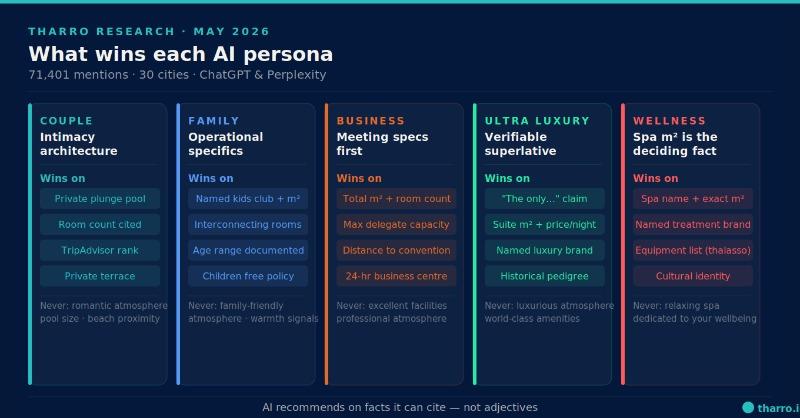
Then we went deeper. We pulled the actual paragraph text AI wrote when recommending hotels for five of the most commercially important traveller personas: Couple, Family, Business, Ultra Luxury, Wellness.
And we read it.
Not to count mentions. To understand the language. What AI actually says about the hotels it recommends. The specific words, phrases, and facts that appear in winning responses — and conspicuously don't appear in losing ones.
What we found is not what most hoteliers expect.
What makes hotels win each persona in AI — the actual language patterns
Couple
The core signal: AI doesn't recommend hotels for couples based on romance amenities — it recommends them based on intimacy architecture. The winning phrase isn't "romantic" — it's "discreet," "intimate scale," "tucked away," "private." Romance is assumed. Seclusion from other guests is the differentiator.
The language patterns AI uses:
- "cliffside hotel… private infinity pools, caldera-view terraces, serene, discreet service" — privacy is named before views
- "nestled in a medieval palace… peaceful courtyard… feels like a private garden… 'oasis'" — enclosure language dominates
- "individually designed rooms… intimate charm" — uniqueness per room signals that the hotel wasn't designed for mass
- "boutique… just 10 rooms/28 rooms" — small scale is explicitly cited as a positive attribute
- "outdoor bathtubs in select rooms… private soak under the stars" — specific features that enable privacy for two
- "discreet luxury with storied architectural setting" — luxury is qualified by discretion, not display
- "consistently ranked #1 for romantic hotels across multiple sources (TripAdvisor, Expedia, Vio.com)" — AI cites its ranking sources explicitly, which means your TripAdvisor romance category position is an input into AI recommendations
Attribute clusters:
- Scale signal — small room count, boutique designation, limited capacity
- Physical enclosure — courtyards, terraces, cliffside position, tucked-away location
- Per-room uniqueness — individually designed, specific suite features, private pools per room
- Third-party romance validation — explicitly ranked on romance/couple lists on major platforms
What AI never says: Size of the pool. Number of restaurants. Proximity to the beach. Conference facilities. These are present but never the reason a hotel wins the couple persona. Also notably absent: spa. Couples don't win through wellness, they win through privacy architecture.
The counter-intuitive finding: The biggest luxury beach resorts — Four Seasons Limassol, Parklane — appear in couple responses but not as the lead recommendation. They appear in the "if you want maximum pampering" frame, whereas boutique properties with private terraces or unique rooms appear in the "if you want intimacy" frame. AI has already parsed that distinction. A 5-star beach resort doesn't automatically own couples — a 20-room palace hotel in the Gothic Quarter competes on equal terms.
Family
The core signal: AI awards the family persona almost entirely on operational infrastructure for children — not ambience, not location, not price. The winning hotels are those where every functional family need has a named, specific solution. Vague "family-friendly" doesn't rank. "Explorers Kids Club — 3,000 m², pirate ship splash zone, supervised for ages 4 months to 12 years" does.
The language patterns AI uses:
- "one of Europe's largest kids' clubs — ~3,000 m² facility with themed castle play areas, a pirate ship splash zone" — scale and specificity of children's facilities
- "interconnecting rooms, family and master suites accommodating parents and up to two children under 12, with rollaway beds" — room configuration is cited precisely
- "children's check-in with a fun Red Carnation Hotels passport, Children's Afternoon Tea, cupcake decorating with the pastry chef" — named children's programming
- "children under 6 stay free" — concrete policies, not soft claims
- "balancing high-end amenities (spas, fine dining) with child-friendly features" — AI explicitly names the dual adult+child equation
- "flat, accessible grounds" — for island/city hotels, terrain is cited as a family consideration
- "Ritz Kids Club (ages 4–12), Teen Club (ages 13–17)" — age-segmented programming wins over generic claims
Attribute clusters:
- Named children's facilities — kids club with name, size, specific activities
- Room configuration — interconnecting rooms, family suites, cribs, rollaway beds
- Child-specific policies — ages that stay/eat free, cots provided, babysitting available
- Operational logistics — proximity to attractions, no-step access, pushchair-friendly terrain
What AI never says: "Welcoming atmosphere for families." "Children welcome." These phrases appear in losing hotels, not winning ones. AI specifically filters for quantified, named infrastructure. A hotel that says "children welcome" on its website loses to a hotel that says "Explorers Kids Club, 3,000 m², pirate ship zone, ages 4 months to 12."
The counter-intuitive finding: Location to attractions barely moves the needle — what matters is that the hotel itself is a complete destination for children. The Martinhal brand wins across Portugal not because of Lisbon or Algarve location but because Martinhal has built an identity as a purpose-built family brand. AI has absorbed that brand signal from travel media. One standalone "family-friendly" hotel competing against a known family brand is at a structural disadvantage regardless of actual facilities.
Business
The core signal: AI awards the business persona on a two-tier hierarchy: meeting capacity first, location second. Everything else — service, decor, prestige — is mentioned but not decisive. Hotels that state exact meeting room counts, total sqm, and maximum delegate numbers beat hotels that claim "excellent business facilities" without specifics.
The language patterns AI uses:
- "Conference Space: 4,000 m² across 16 multi-function venues. Capacity: up to 2,000 persons" — quantified, not described
- "a dedicated 24-hour business centre, extensive meeting rooms, high-speed WiFi, and executive lounges" — the 24-hour qualifier matters; AI reads "24-hour" as a business signal
- "Nespresso machines and Bang & Olufsen TVs" — specific in-room amenities that signal executive-grade rooms
- "two-minute walk from the Istanbul Convention & Exhibition Centre" — proximity to convention venues is cited with exact distance
- "consistently ranked #1 across major sources like Tripadvisor's business hotels list" — again, AI directly reads platform rankings
- "co-working space, private booths, printing facilities" — modern business signals go beyond "business centre" to specific co-working infrastructure
Attribute clusters:
- Meeting infrastructure — named number of rooms, total sqm, max capacity
- Location precision — specific distance to financial district, convention centres, major clients
- Connectivity signals — high-speed WiFi, 24-hour business centre, AV equipment listed
- Executive room standards — named in-room tech (B&O TVs, Nespresso), lounge access
What AI never says: Restaurant quality. Spa. Views. These may be present in the text but never appear as the reason a hotel wins the business persona. Strikingly, luxury credentials are mentioned almost as an afterthought after capacity and connectivity.
The counter-intuitive finding: Boutique hotels are almost entirely absent from business recommendations. This is the one persona where chain hotels — Swissôtel, Hilton, InterContinental, Four Seasons — have a structural advantage. Not because AI prefers chains, but because chains publish precise meeting room specifications in formats AI can read. A boutique hotel with excellent meeting facilities but vague website copy loses to a chain with a public MICE factsheet every time.
Ultra Luxury
The core signal: AI awards ultra luxury on verifiable superlatives — and it cites the source for each claim. The winning hotels aren't just luxurious, they are provably, specifically, uniquely extreme. "Most expensive suite in London: up to £44,000 per night." "Only Ottoman imperial palace converted into a hotel." "Independently owned, seventh generation." These aren't adjectives — they're facts that AI can verify and cite.
The language patterns AI uses:
- "the only Ottoman imperial palace converted into a hotel, directly on the Bosphorus" — singularity claim with physical evidence
- "The Manor House Suite… can cost up to approximately £44,000 per night, featuring its own postcode, private entrance" — price + unique physical attribute
- "consistently ranked #1 among Zurich's luxury hotels… LuxuryHotel.world gives it a perfect 9.3/10 (highest in their top 20)" — AI cites specific scores
- "The Royal Suite: spans a massive 334 m²… favored by royals and celebrities" — suite dimensions + social proof
- "6,295 sq ft… its own postcode, private entrance and elevator, seven rooms including a library and dining room" — room-level detail that proves superlative claim
- "Forbes 5-star… helicopter transfers… La Prairie treatments" — brand partnerships at the product level signal ultra-luxury tier
Attribute clusters:
- The singular claim — "only," "first," "most expensive," "largest," "highest-rated" with a cited source
- Historical or architectural pedigree — "1834 building," "seventh generation family-run," "genuine 19th-century Ottoman palace"
- Named treatment brands — La Prairie, ESPA, Augustinus Bader, 111Skin — brand partnerships signal tier
- Suite-level specificity — exact sqm, number of rooms within the suite, named unique features
What AI never says: "Luxurious atmosphere." "Exceptional service." "World-class amenities." These phrases appear in the texts but as supporting context, never as the lead signal. Ultra luxury is won by fact, not adjective.
The counter-intuitive finding: Price is cited directly and positively in ultra luxury responses — not as a warning but as evidence of status. AI repeats exact nightly rates as a credential. A hotel that doesn't have publicly available premium suite pricing may be disadvantaged because AI can't cite a price to validate the ultra-luxury claim.
Wellness
The core signal: AI awards wellness on facility specificity and named treatment brand. Size in m² is the single most repeated data point across all winning wellness texts. "3,000 m² spa" beats "award-winning spa" every time. But the second signal — the named product or method brand — is what separates the top from the next tier.
The language patterns AI uses:
- "only indoor/outdoor thalassotherapy spa in Europe" — singularity claim
- "Kalloni Spa, 3,000 m², 14 treatment rooms, three suites including Russian Banya" — named facility + size + room count + named sub-feature
- "Biologique Recherche, Augustinus Bader, and 111Skin" — named product brands as tier signals
- "4,000 m² destination spa… ranked #1 across sources… 'unbeatable' and a 'full destination spa'" — scale + editorial description
- "hydrotherapy pool, plunge pool, infrared sauna, steam cavern" — named equipment, not just "facilities"
- "Ottoman hammam traditions… traditional Turkish hammam, sauna, steam room" — cultural specificity wins in markets where wellness has a local identity (Turkey)
- "La Prairie/Margy's treatments" — treatment brand named alongside the facility
Attribute clusters:
- Named spa + size in m² — the spa needs a name and a published sqm figure
- Specific equipment list — hydrotherapy pool, thalassotherapy circuit, infrared sauna, named thermal features
- Treatment brand partnerships — La Prairie, ESPA, Biologique Recherche, Sisley — these are cited as evidence of tier
- Cultural/heritage wellness identity — in Turkey: hammam. In Cyprus: thalassotherapy. The wellness concept needs a local cultural anchor to be differentiated
What AI never says: "Relaxing spa." "Full wellness facilities." "Dedicated to your wellbeing." These phrases don't appear in winning texts. What appears instead is named equipment and brand partnerships.
The counter-intuitive finding: Hotels that win wellness in resort markets (Cyprus, Greece, Algarve) do so on thalassotherapy specifically — not general spa offerings. AI has learned that thalassotherapy is the prestige wellness signal in Mediterranean coastal markets. A hotel with a 500 m² spa and seawater thalassotherapy circuit beats a hotel with a 2,000 m² spa without one. The type of treatment matters more than the size alone.
The universal finding across all five personas
AI doesn't recommend hotels based on adjectives. It recommends them based on facts it can cite — rankings from named platforms, dimensions in m², capacity in delegates, prices in £, names of brand partners, and singular claims it can verify.
The hotels that lose these personas have the same facilities as the hotels that win. They just haven't published the right facts in a findable format.
Want to see how your hotel performs across these five personas?
Book a 30-minute call with Tharro or explore your AI Visibility Score at tharro.io.