Research
Does Google Rank Predict AI Hotel Visibility? 695 Searches
How much Google rank carries into ChatGPT and Google AI Mode answers across 695 searches, which sources AI actually cites, and what gets a hotel recommended.

The next decade of hotel discovery may not be decided by who ranks first — but by who AI trusts enough to recommend
The next decade of hotel discovery may not be decided by who ranks first. It may be decided by who AI trusts enough to recommend — and those aren't always the same hotels.
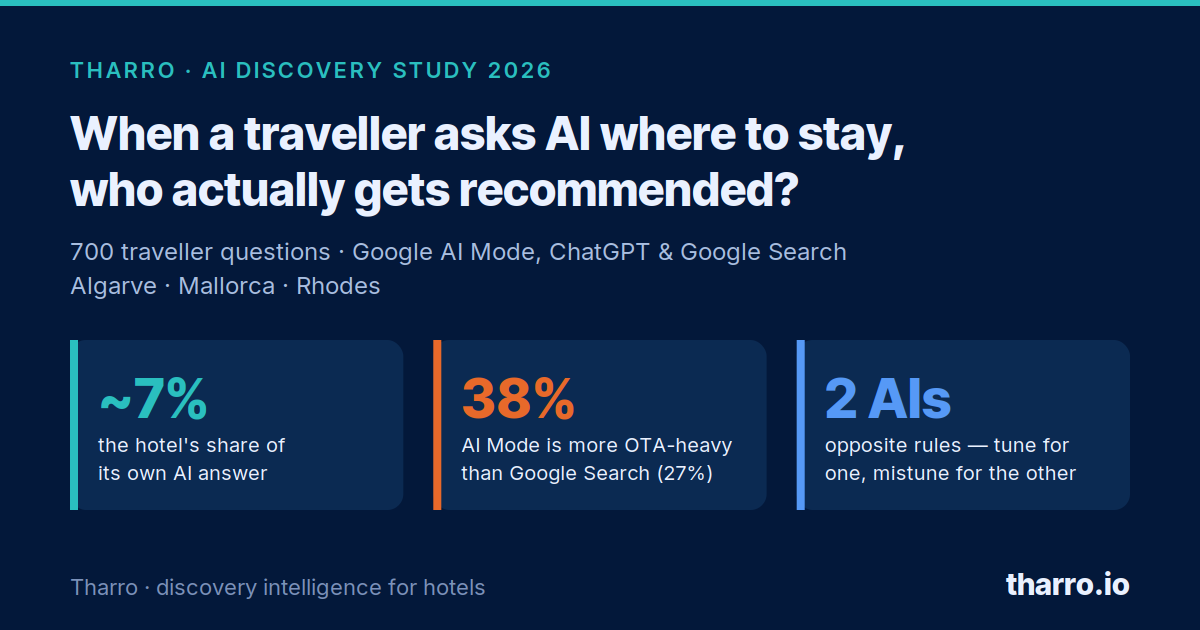
Travellers are changing how they search. Instead of typing "hotels in Mallorca" into Google and scrolling, a growing share now open ChatGPT, or use Google's AI Mode, and ask in plain language: where should I stay? They read the four or five hotels the assistant hands back, and most stop there. That short list is the new front desk — and AI hotel visibility, whether your property shows up in those answers, is fast becoming as important as your search ranking ever was.
So we ran the numbers. This article lays out what we found across 695 searches, two AI engines and three markets — a blend of hard data and what it means for your hotel.
📊 The full study is now published: From Google's Top 3 to AI's Answer — every table, the complete methodology and the downloadable data
What "AI hotel visibility" actually means: mentions vs citations
Before the findings, one distinction matters, because most discussions of AI hotel visibility blur it.
- A mention is your hotel being named in an AI answer. It's the recommendation itself — the thing a traveller reads and acts on.
- A citation is a link the answer points to as its source. AI assistants footnote where their information comes from, and those links drive a small amount of referral traffic.
The two are not the same, and a hotel can be mentioned without its own site ever being cited. Keeping them separate is the only way to understand how AI search really works for hotels — and, as you'll see, they behave very differently.
How we tested it
At Tharro we wanted to answer one question: does your Google ranking predict whether AI mentions or cites you?
We built clusters of the unbranded searches travellers actually make — "family hotels in Mallorca," "where to stay in Rhodes," "hotels in Albufeira" — across the Algarve, Mallorca and Rhodes. We turned each cluster into the exact question a guest would put to an AI assistant: one keyword cluster, one prompt, a clean 1:1. Then we ran all 695 through both ChatGPT and Google's AI Mode, and matched every answer against 293,925 ranked Google and Bing results for those same searches.
The result was nearly 10,000 hotel recommendations, naming 3,626 distinct hotels, with 14,129 citations across 1,604 domains. Big enough that the patterns aren't noise. (It's a single June 2026 snapshot, so the relationships are associational, not causal — but they were consistent across all three markets and both engines.)
Does Google ranking predict AI hotel visibility?
Partly — but far less than the industry assumes.
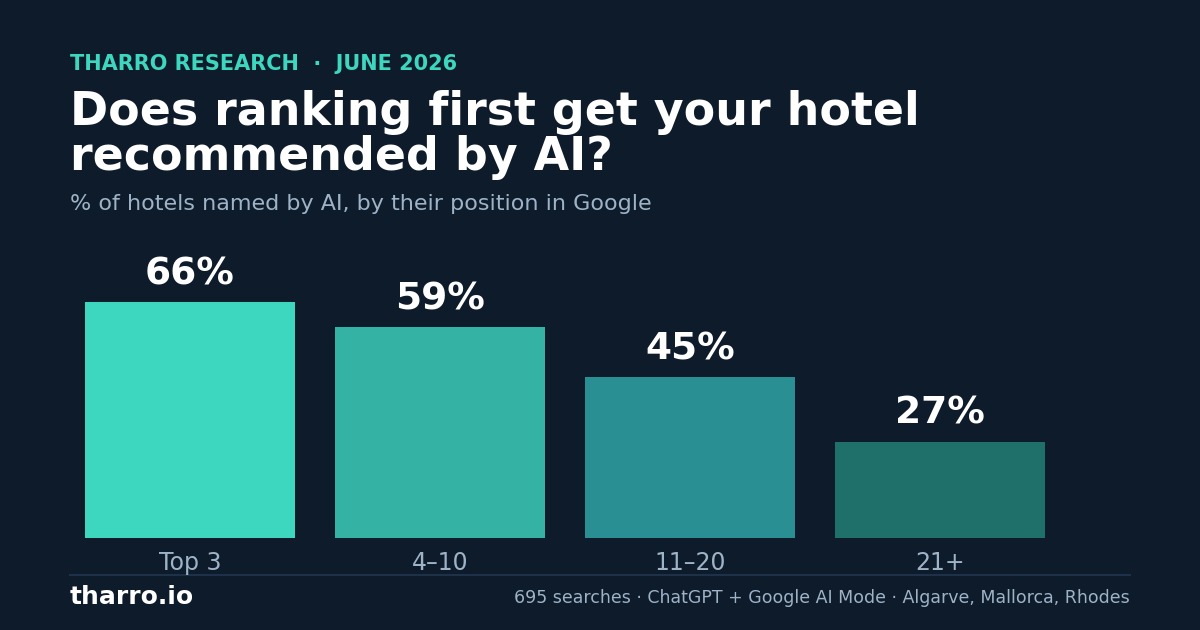
On specific searches, a hotel whose own website ranked in Google's top 3 was named by AI about 66% of the time. The gradient from there:
- Top 10: named ~61% of the time
- Positions 11–20: ~45%
- Below position 20: ~27%
- Beyond position 30: ~24%
So ranking does carry into AI answers — top-10 hotels are named more than twice as often as those further down. But two things complicate the picture.
First, presence is not sufficient. Even in the top 10, roughly four in ten well-ranked hotels were passed over.
Second, and more striking: across the whole study, about half the hotels AI recommended (48–56%) didn't appear in Google's organic results for that same search at all. In Albufeira, for example, around a dozen hotels were ranking on the first two pages of Google with their own websites — and AI named just two of them. A large share of what AI tells travellers to consider is invisible on the search page for the identical query.
The takeaway: your SEO scoreboard and your AI hotel visibility scoreboard are measuring different games. Strong rankings help, but they neither guarantee nor fully explain whether AI recommends you.
Why ranking your own site doesn't get you cited
Here's where mentions and citations split apart.
When AI named a hotel that was ranking its own website in Google, it cited that hotel's own site as the source only about 20% of the time — and even for hotels in the top 10, only 37%. Across all recommendations, a hotel's own domain was the cited source under 10% of the time.
Where did the citations go instead? To third parties: OTAs like Booking and Expedia, review platforms like Tripadvisor and Oyster, and editorial guides like Travelmyth and regional "best hotels in X" roundups. AI learns which hotels to recommend by reading intermediaries, not hotels' own websites.
This is the single most important lesson for anyone working on AI hotel visibility: the answer is assembled from sources you don't own. Polishing your own site, while it still matters for the guest who scrolls, is not what gets you into the AI answer. That is a separate question from whether you can beat the OTAs in ordinary search — can a hotel outrank Booking.com? answers that one with its own data.
ChatGPT vs Google AI Mode: two different answers
For an industry treating "AI visibility" as one problem, our clearest structural finding is that it isn't.
ChatGPT named 3,151 distinct hotels. Google's AI Mode named 1,286. Only 691 appeared on both lists — an overlap of just 18%.
The two engines draw on different supply. Google's AI Mode returns what is effectively a Maps-driven carousel, shaped by prominence and proximity. ChatGPT assembles an editorial list built from travel guides and roundups. (Bing's results, which more plausibly feed ChatGPT, surfaced individual hotels in only about 1% of listings, versus roughly 8% on Google.)
Practically: being recommended by one engine tells you almost nothing about the other. You have to measure and work on each separately.
What actually makes AI recommend a hotel
We expected guest rating to be the deciding factor. It wasn't.
When we looked at what made a hotel get named more often, no single attribute was decisive — every correlation was modest. But the relative order was clear: review volume and star class mattered most, price next, and guest rating least. In fact, review score barely moved the needle at all: hotels rated 4.8 and above were named no more often than hotels rated below 4.3.
The hotels AI recommends skew established and upper-tier — roughly three-quarters were four- or five-star, with a median of around 600 reviews. A large, well-known property with a moderate score and thousands of reviews tends to get named more than a small, excellent one with few reviews. If there's a pattern, it's that being established edges out being highly rated.
How to improve your AI hotel visibility
The data points to a short, practical list. None of it replaces the classic work in the hotel SEO guide — it runs alongside it.
-
Measure both surfaces, separately. Don't assume your SEO performance reflects your AI hotel visibility. Open ChatGPT and Google's AI Mode, ask the unbranded questions your guests ask — "best hotels in [your town]," "where to stay in [your area]" — and read the answers as a guest would. See whether you're in them.
-
Get into the sources AI reads. Since AI cites OTAs, review platforms and editorial guides far more than hotel sites, your presence and accuracy on those sources is the supply the answer is built from. Make sure the regional guides, "best of" roundups and OTA listings describe you fully and correctly.
-
Build review volume, not just score. Chasing a higher rating while ignoring volume optimises the thing AI weights least. Keep the score honest, but grow the number of guests reviewing you, across multiple platforms.
-
Treat each engine as its own channel. AI Mode rewards Maps prominence; ChatGPT rewards editorial presence. Check both, and don't generalise from one to the other.
-
Don't rely on your own site for citations. It's rarely the cited source. Referral traffic from AI will mostly flow through the intermediaries — so own your presence there.
FAQ
Does SEO help with AI hotel visibility? Somewhat. A hotel ranking in Google's top 10 was named by AI about 61% of the time, versus 27% below position 20. But around half of AI-recommended hotels didn't appear in Google's results for the same search at all, so SEO is a partial signal, not a guarantee.
How do I get my hotel recommended by ChatGPT? ChatGPT builds its lists largely from editorial guides, roundups and OTA listings rather than hotels' own sites. Being present and accurately described on those third-party sources is the most direct route into its answers.
Is being recommended by Google's AI Mode the same as ranking on Google? No. AI Mode behaves like a Maps-driven carousel shaped by prominence and proximity, and only about half the hotels it recommends rank organically for the same query.
Does a high guest rating improve AI hotel visibility? Surprisingly little. In our study, hotels rated 4.8+ were named no more often than those rated below 4.3. Review volume and star class were stronger signals than review score.
The bottom line
Being found first and being the hotel AI recommends are drifting apart. AI search reads a different set of sources than Google's results, rewards establishment over ratings, and — depending on which assistant the traveller opens — recommends a different hotel.
The good news is that AI visibility for hotels is now measurable. You can see what AI says about your destination today, whether you're in the answer, and which sources it's reading to build it — and put your next effort where it counts, before those answers settle into habit.
Want to see how your hotel performs in AI search?
Explore your AI Visibility Score at tharro.io or book a 30-minute call with Tharro.