Research
Who Gets Recommended When a Traveller Asks AI Where to Stay?
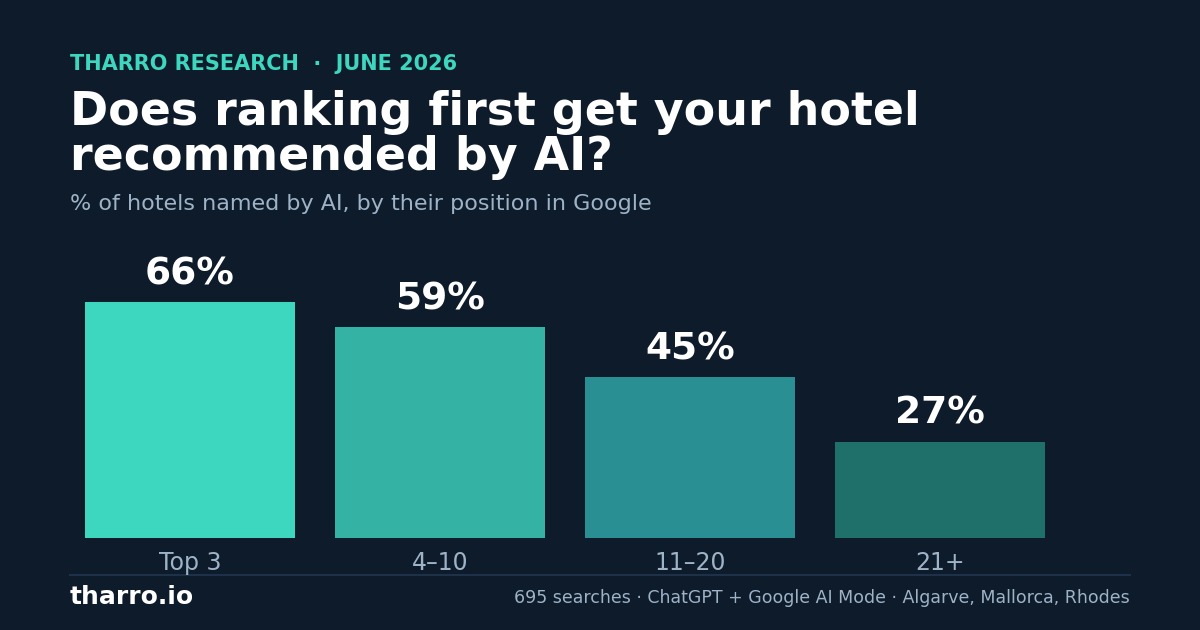
We ran 700 traveller questions through Google AI Mode, ChatGPT and Google Search across three markets to see who AI recommends, and who owns the answer.

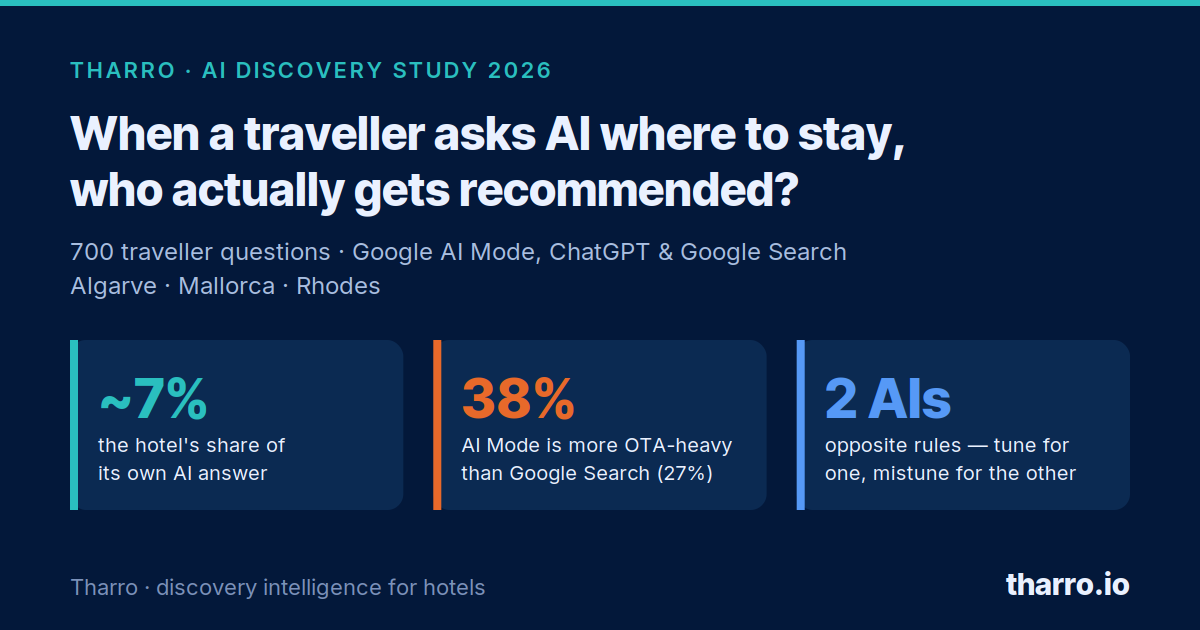
A study of the hotel discovery surface across Google AI Mode, ChatGPT and Google Search — in three Mediterranean markets.
📊 Read the full study: From Google's Top 3 to AI's Answer — every table, the complete methodology and the downloadable data
The short version
We took nearly 700 of the questions real travellers ask when they're choosing where to stay — "best family resort in the Algarve," "adults-only hotel near Rhodes Town," "where to stay in Mallorca for a quiet week" — and ran every one through Google's AI Mode and through ChatGPT, in three markets: the Algarve, Mallorca and Rhodes. We captured every hotel each engine named and every source it leaned on. Then we ran the same questions through ordinary Google Search and compared.
Three things came back clearly, and none of them match what the industry tends to assume about AI.
AI mirrors the market — and these markets belong to independents. Independent hotels take 60–80% of the hotels named, on both engines. Not because AI favours the little guy, but because global chains barely operate here — industry data puts branded hotels at just 8% of supply in Greece, ~30% in Portugal and ~38% in Spain, with domestic groups, not global flags, leading the branded segment.
Hotels barely own the answer about themselves. A hotel's own website is only about 7% of what AI Mode cites, and 12–17% of what ChatGPT cites. The rest is OTAs, review sites, tour operators and travel blogs.
The AI answer is not the Google result — and the two AIs pull in opposite directions. AI Mode is a more OTA-heavy version of Google. ChatGPT is a less OTA-heavy, far more editorial version. A hotel set up to win on Google is not set up to win on either of them.
Why we ran this
For twenty years, being "found" by a traveller meant ranking on Google. That craft is now being quietly rewired. A growing share of travellers no longer scroll ten blue links — they ask a question and read one answer. And that one answer is assembled by a machine deciding, on the traveller's behalf, which hotels are worth naming and which sources are worth trusting.
If you don't know what that machine is saying about you, you've lost the part of the race that happens before anyone reaches your website. So we set out to measure it — not with opinions about AI, but with the actual answers, at scale, in real markets.
What we did
The questions. We built a set of 695 traveller intents across the three markets — the genuine, unbranded questions people ask when they don't yet know which hotel they want: by trip type, traveller, location, season and feature. These are the moments where a hotel is won or lost, because the traveller hasn't picked anyone yet.
The engines. We ran every question through two AI surfaces — Google AI Mode and ChatGPT — and, for comparison, through Google organic Search. Same questions, same markets, three different surfaces.
The capture. For every answer we recorded two things: every hotel named in the response, and every source cited to support it. That gives two complementary lenses — who gets recommended (hotels) and who owns the answer (sources).
The classification. Every cited source was sorted into a type — OTA, metasearch, tour operator, affiliate-directory, editorial/blog, rental, or a hotel's own website. Every recommended hotel was sorted into independent, domestic/regional group, or global chain. High-frequency names were verified by hand; a long tail of one-off mentions was assigned by rule and has no material effect on the shares.
The unit. Shares are calculated within each market and then averaged — never pooled — so a big market can't drown out a small one. Each hotel and source is counted once per answer.
Finding 1 — AI mirrors the market, and these markets belong to independents
The loudest fear about AI is that it will do to discovery what the OTAs did to distribution: hand it to the giants. In these markets, it doesn't. But the honest reason is not that AI champions the underdog — it's that the giants are barely here.
Share of hotel recommendations, by hotel type (within market):
| Engine | Market | Independent | Domestic / regional | Global chain |
|---|---|---|---|---|
| AI Mode | Algarve | 73.0% | 19.2% | 7.7% |
| AI Mode | Mallorca | 60.0% | 36.9% | 3.1% |
| AI Mode | Rhodes | 79.1% | 16.5% | 4.4% |
| ChatGPT | Algarve | 74.6% | 16.7% | 8.7% |
| ChatGPT | Mallorca | 60.7% | 32.2% | 7.1% |
| ChatGPT | Rhodes | 79.5% | 15.2% | 5.3% |
Independents take a clear majority everywhere; the chain presence that exists is almost entirely domestic and regional groups, and global flags never break 9%.
Checked against actual supply (independent industry data): in Greece branded hotels are just 8% of all hotels (GBR Consulting); in Portugal ~30%, led by domestic groups; in Spain ~38%, led by Melía, Barceló and Eurostars (Horwath HTL). So AI is reflecting an independent-dominated market where the dominant chains are domestic — not editorialising about it.
What it means. AI is not structurally rigged against independents the way a commission-sorted OTA page is. But don't over-read it into "AI loves independents" — it mirrors a market that already happens to be yours. The real contest is your name versus the comparable independent down the road, and whether AI reaches for you or for them.
Finding 2 — Hotels barely own the answer about themselves
We measured which kinds of sources AI cites. The hotel's own website is almost never the spine of the answer — and which intermediary fills the gap depends on the engine.
Share of cited sources, by type (within market):
| Engine | Market | OTA | Editorial | Tour op. | Meta | Directory | Hotel own |
|---|---|---|---|---|---|---|---|
| AI Mode | Algarve | 31.8% | 25.0% | 14.1% | 9.0% | 2.2% | 6.5% |
| AI Mode | Mallorca | 35.5% | 26.2% | 8.6% | 10.0% | 5.4% | 7.2% |
| AI Mode | Rhodes | 46.3% | 17.3% | 12.6% | 9.2% | 3.0% | 6.5% |
| ChatGPT | Algarve | 16.6% | 35.3% | 11.0% | 8.7% | 9.0% | 17.3% |
| ChatGPT | Mallorca | 18.5% | 35.2% | 5.6% | 9.1% | 17.0% | 12.6% |
| ChatGPT | Rhodes | 24.2% | 25.1% | 12.3% | 12.3% | 13.1% | 11.6% |
AI Mode is OTA-grounded. OTAs are the single biggest source in every market, peaking at 46% in Rhodes. The hotel's own site is around 6.5–7%. When Google's AI describes your hotel, it is overwhelmingly reading the OTAs and review sites — not you.
ChatGPT is editorial-grounded. It leans on travel blogs and "best hotels in…" listicles (25–35%), pulls in affiliate-directories heavily (up to 17% in Mallorca), and uses OTAs far less. It gives the hotel's own site more room — 12–17%.
What it means. The answer the traveller reads about you is written, in effect, by other people's content — the OTA on one engine, whichever blogger or directory published on the other. Either way, the story of your hotel is told by the intermediary, and you mostly can't see it happening. It is the AI-era version of a problem hotels already carry in search — how OTAs win your name on Google.
Finding 3 — The AI surface is not the search surface, and the two AIs reward opposite things
We compared each AI surface to ordinary Google organic results for the exact same questions.
Share of the surface by source type — Google Search vs the two AIs (averaged across markets):
| Surface | OTA | Editorial | Tour op. | Directory | Meta | Hotel own |
|---|---|---|---|---|---|---|
| Google Search | 26.7% | 22.7% | 17.5% | 4.6% | 12.4% | 8.6% |
| AI Mode | 37.9% | 22.8% | 11.8% | 3.5% | 9.4% | 6.7% |
| ChatGPT | 19.8% | 31.9% | 9.6% | 13.0% | 10.0% | 13.8% |
AI Mode concentrates harder toward OTAs than Google itself — +11 points on average, and 46% vs 28% in Rhodes. It also gives hotels less of their own surface than plain Google. It doesn't soften the OTA tax; it intensifies it.
ChatGPT swings the other way — away from OTAs (−7) and tour operators (−8), toward editorial (+9) and directories (+8), and it is the friendliest surface to a hotel's own site (+5 vs Google).
Google Search sits in the balanced middle — and is the only surface where tour operators carry real weight (~18% vs ~10% in AI).
What it means. There is no single "AI strategy." A hotel optimised for Google is not optimised for AI Mode, and what wins on AI Mode is close to the opposite of what wins on ChatGPT. Treating them as one channel — or as "Google, but newer" — gets you out-positioned on all three.
What this means for a hotel
The part of the journey that decides where a guest stays has moved upstream of your website, and you can't see it. A traveller asks a question; a machine answers it using OTAs and bloggers; your name either makes the list or it doesn't; and you find out nothing — no impression, no click, no line in a report. You've already won or lost before anyone lands on a page you control.
The good news inside the data is that the door is open. AI isn't rigged against independents — in these markets it names them constantly, because the markets are theirs. Your own site, where it appears, performs. The question is not whether AI can recommend you — it's whether, today, on the specific questions your guests are asking, the answer is you, an OTA, or the hotel next door — and what's moving that answer. Our Cyprus AI visibility study runs exactly that question across a single market, hotel by hotel.
Knowing where you stand on each surface — your AI visibility for hotels — on the questions that actually drive your demand, is the first step to owning that demand instead of renting it back from the intermediaries who currently narrate it for you.
Want to see how your hotel performs across these surfaces?
Book a 30-minute call with Tharro or explore your AI Visibility Score at tharro.io.