Research
Cyprus AI Visibility Study 2026: Which Hotels AI Names
We analysed 720 AI answers across ChatGPT and Google AI Mode for Paphos, Limassol and Ayia Napa. Hotels get recommended; they just don't own the answer.

We analysed 720 AI answers across ChatGPT and Google AI Mode for Paphos, Limassol and Ayia Napa. The hotels get recommended. They just don't get to speak.
The Cyprus AI Visibility Study 2026 — by Tharro
Somewhere in Manchester, a couple planning a September honeymoon opens ChatGPT and types: "best adults-only hotel in Paphos for a romantic week." In Berlin, a family asks Google's AI Mode for "a good all-inclusive near Ayia Napa with a kids' pool." In Warsaw, someone wants "a quiet beachfront hotel in Limassol, not too expensive."
Each of them gets a clean, confident answer in seconds. A few hotels, named and described, ready to book. What none of them sees is where that answer came from — and that is the whole story.
We ran 720 of these questions through both engines and pulled apart every answer to see who the AI actually listens to when it recommends a Cyprus hotel. The short version: the machines are happy to recommend hotels. They almost never cite them.
Key findings at a glance
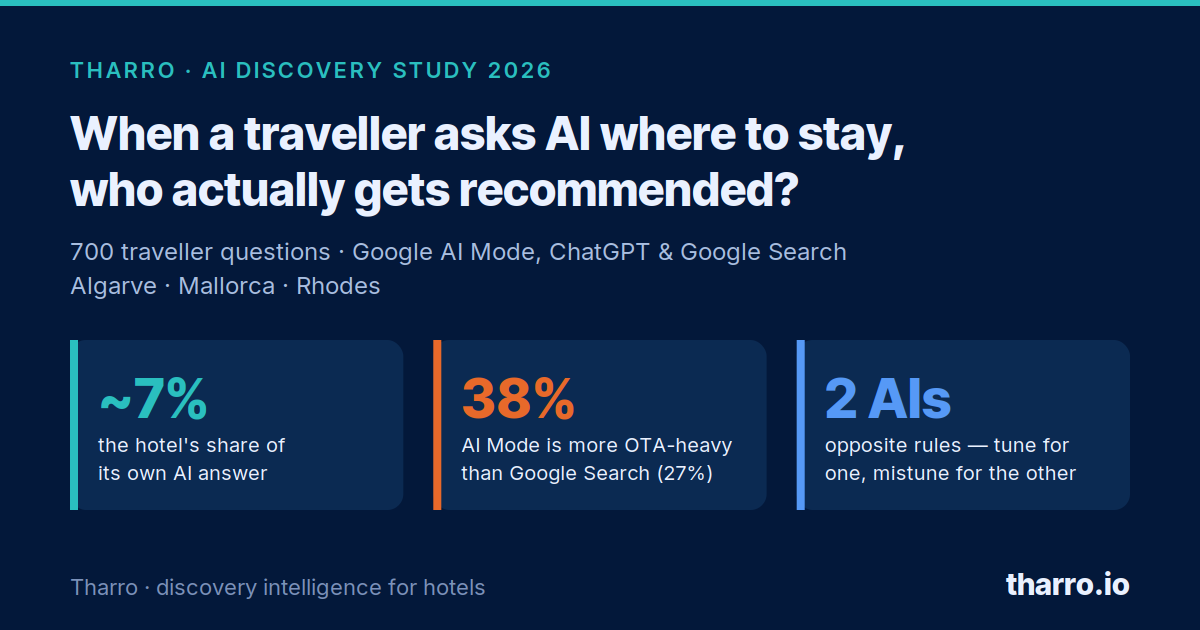
- Hotels own just 7% of the sources AI cites about them. Across both engines, a hotel's own website accounted for only 7.0% of all cited sources. Intermediaries — OTAs, tour operators, metasearch and listing aggregators — accounted for 62%.
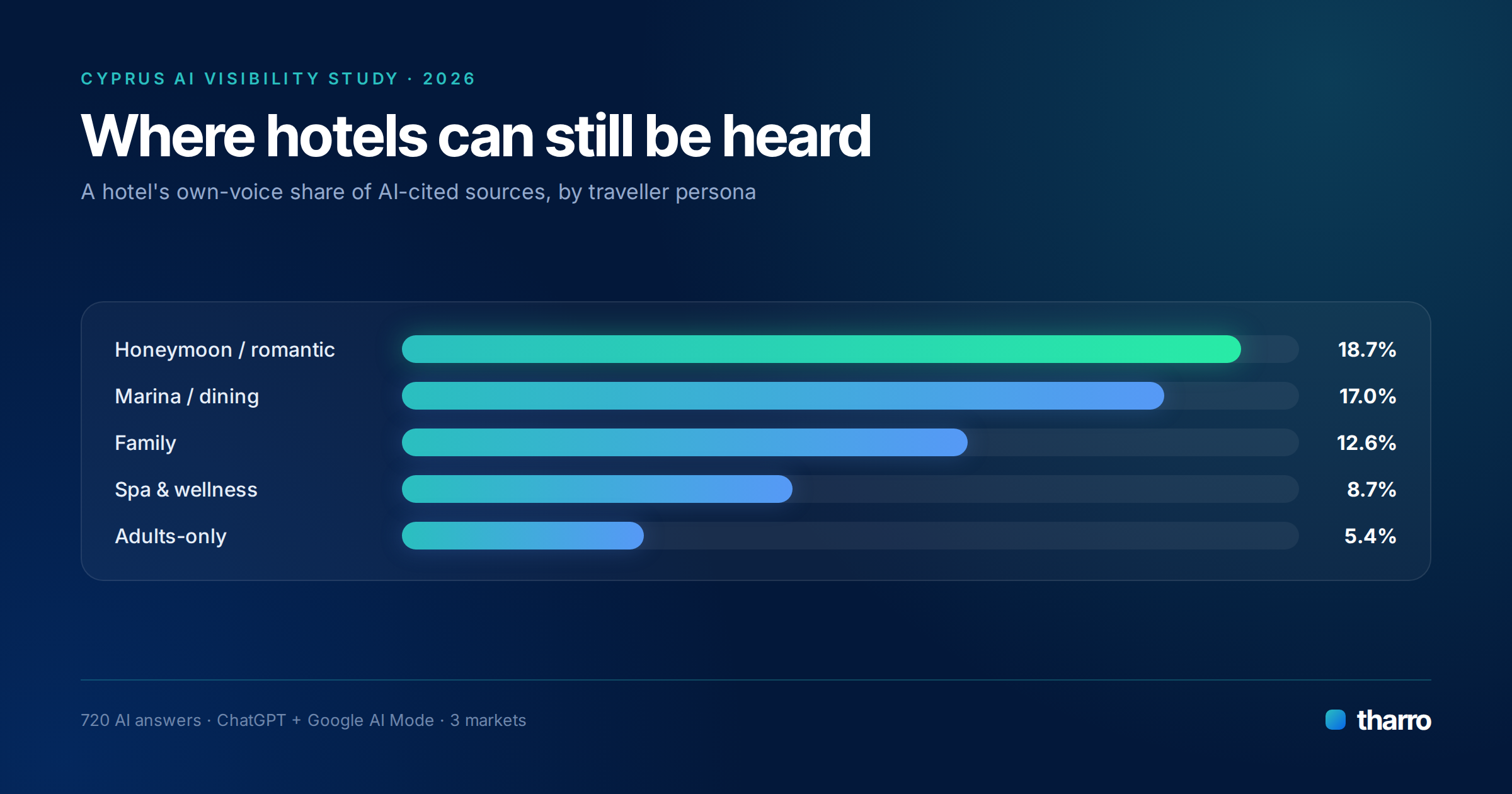
- The persona you compete on changes your visibility by up to 180×. A hotel's own voice made up 18.7% of citations on "honeymoon" queries and 0% on "nightlife" and "all-inclusive" queries.
- ChatGPT and Google AI Mode are two different games. They recommended the same hotels only 42% of the time, and they read completely different sources: ChatGPT leans on reviews and communities (Tripadvisor alone is 31.8% of its citations); AI Mode leans on booking rails (OTAs + operators + metasearch = 61%).
- No Cyprus hotel dominates. The most-mentioned hotel on the island held just 2.1% share of voice. Visibility is wide open.
- Visibility doesn't travel. 53% of hotels appeared in fewer than three of the study's markets — being visible to a British traveller says almost nothing about being visible to a German or Polish one.
Why this matters now
This is not a future problem. ChatGPT reached roughly 900 million weekly users in early 2026 and passed a billion monthly by mid-year, handling about 2.5 billion prompts a day (OpenAI / Reuters). Google's AI Mode — one of the two engines we tested — crossed a billion monthly users about a year after launch, with queries more than doubling every quarter (Google I/O, May 2026).
And travellers are using it to choose hotels. Phocuswright's 2025 research found roughly a third of US travellers now use generative AI to plan or experience trips — a shift it called "seismic" — with adoption already at about 22% in the UK and 15% in Germany, the exact markets in this study. Finding accommodation is the single most common use case.
For a Cyprus hotelier, the implication is blunt: a large and growing share of your guests now meet the destination through an AI answer before they ever reach Booking, Google Maps or your website. Whatever that answer says becomes the shortlist. This study measures who is inside it.
How we ran the study
We wrote 360 unbranded traveller questions — the kind real people type, in their own language — covering 14 personas (honeymoon, family, adults-only, all-inclusive, beachfront, spa, luxury, value, nightlife and more) across three destinations (Paphos, Limassol, Ayia Napa/Protaras) and three source markets (UK/English, Germany/German, Poland/Polish).
We ran every question through two AI engines — ChatGPT Search and Google AI Mode — for a total of 720 answers. Then we extracted two things from each answer: every hotel mentioned, and every source cited. That gave us 5,047 hotel mentions and 1,481 classified source citations to work with. No hotel was told in advance; nothing was branded. This is simply what the machines say when a stranger asks. It is the same unbranded-question method behind AI hotel visibility: what 695 searches reveal, widened here to two engines and three source markets.
Do Cyprus hotels control how they appear in AI answers?
No. Across both engines, the hotel's own website made up only 7.0% of the sources AI cited (6.8% on ChatGPT, 7.2% on AI Mode). Everything else — the material the AI actually reads to build its recommendation — came from somewhere else.
And even that 7% is misleading. It is concentrated almost entirely in a handful of sophisticated groups that run proper web infrastructure — Constantinou Bros, Amathus, Kanika, Four Seasons, Louis, Leonardo, Marriott. The typical independent Cyprus hotel contributes zero own-site citations. It is recommended, described and ranked entirely through other people's words.
This is the OTA Paradox in its purest form: the hotel gets the mention, but someone else owns the authority behind it. It is a visibility problem, not a marketing problem — and you cannot fix a visibility problem with a better ad.
Who does AI cite instead — and why do the two engines disagree?
Here is where it gets interesting, because ChatGPT and Google AI Mode are not two flavours of the same thing. They are two different economies.
| Source type | ChatGPT | Google AI Mode |
|---|---|---|
| Metasearch (Tripadvisor etc.) | 38.9% | 23.7% |
| OTAs (Booking, Expedia) | 11.0% | 25.5% |
| Tour operators | 2.5% | 12.2% |
| Editorial / blogs | 7.8% | 18.0% |
| Social / community | 9.7% | 5.9% |
| Hotel's own site | 6.8% | 7.2% |
ChatGPT is a reputation surface. Tripadvisor alone accounts for 31.8% of everything it cites about Cyprus hotels; add Reddit (9.7%) and the press, and you have an answer built from reviews, opinion and community — not booking pages. OTAs are only 11%. This is an earnable surface: it responds to your reputation.
Google AI Mode is a transaction surface. OTAs, tour operators and metasearch together make up 61% of its citations. Tour operators barely register on ChatGPT but jump to 12% here, pulled in by the German and Polish package-holiday markets. This is a more structural surface: it favours whoever owns the distribution rails.
The consequence is measurable. The two engines recommended the same hotels only 42% of the time. This isn't a Tharro quirk, either — Ahrefs found in 2026 that even Google's own AI Mode and AI Overviews cite the same URLs just 13.7% of the time. There is no single "AI visibility." There are surfaces, and they disagree.
Does the persona a hotel competes on change whether it's seen?
This is the most important finding in the study, so read the table slowly. It shows how much of the answer a hotel's own voice can occupy, depending on the persona being searched.
| Persona searched | Hotel's own-voice share |
|---|---|
| Honeymoon / romantic | 18.7% |
| Marina / dining | 17.0% |
| Family | 12.6% |
| Spa & wellness | 8.7% |
| Adults-only | 5.4% |
| Luxury 5-star | 5.2% |
| Value / affordable | 1.9% |
| Beachfront | 1.4% |
| All-inclusive | 1.3% |
| Nightlife / party | 0.0% |
The same hotel, the same island, the same engines — and its ability to be heard swings from nearly a fifth of the answer to literally nothing, based purely on which persona it's competing on.
The pattern is clear. Experiential, relationship-led personas — honeymoon, dining, family — leave room for a hotel's own story to surface. Commodity personas — all-inclusive, beachfront, value, nightlife — are pure intermediary territory, where the hotel disappears behind OTAs and operators and the answer is assembled entirely from booking platforms.
Which means the choice of what you're famous for is not a branding exercise. Your persona is your visibility strategy. A hotel fighting to be the best "all-inclusive beachfront value" option in Cyprus is fighting on the one battlefield where it structurally cannot win the AI. The same hotel, positioned and content-built around "honeymoon" or "family," has a real share of the answer to claim. Choosing the field is step one; what wins each AI traveller persona covers what it takes to win once you are on it.
Which Cyprus hotels does AI mention most?
Here is the current share-of-voice leaderboard — the hotels AI names most often across both engines. One caveat before you read it: this measures how often AI mentions a hotel, not how good the hotel is. Share of voice is visibility, not quality, and should never be read as a ranking of the properties themselves.
| # | Hotel | Share of voice |
|---|---|---|
| 1 | Elysium | 2.1% |
| 2 | Amavi | 1.7% |
| 3 | Amathus Beach Hotel | 1.6% |
| 4 | Asimina Suites | 1.5% |
| 5 | Parklane | 1.5% |
| 6 | Royal Apollonia | 1.5% |
| 7 | Almyra | 1.4% |
| 8 | Four Seasons | 1.4% |
| 9 | Nyx | 1.3% |
| 10 | Ivi Mare | 1.3% |
The headline here is what's not in it: dominance. No Cyprus hotel breaks 2.1% share of voice. There is no default recommendation the AI reaches for every time — which, for any hotel willing to do the work, is an open door rather than a closed one.
Does the traveller's country change the answer?
Yes — dramatically. The same hotel is surfaced through completely different machinery depending on where the traveller is sitting:
- Germany is OTA country. Booking and Expedia dominate (OTAs 19.5% of citations, the highest of any market). This is the hardest market to be seen in without strong distribution presence and rate parity.
- Poland is the most earnable market. It has the highest hotel-own share (7.9%), the most tour-operator citations (8.6%) and the most editorial — Polish travel blogs at 14.8%. You win Poland with operator relationships and local-language content, not paid rails.
- The UK is community country. Reddit, forums and Tripadvisor set the tone (social/community at 11.9%, the highest of any market). You win the UK on review standing and traveller-community presence.
And crucially, this visibility does not transfer. 53% of the hotels we tracked appeared in fewer than three markets — over a third showed up in only one. A hotel that owns the British AI answer can be completely absent from the German one. National visibility is a myth; you build it market by market, or not at all.
Who is a hotel actually competing against inside the answer?
When two hotels are named in the same AI answer, the machine is quietly telling you its comp set. Two tight clusters dominate the island:
- Limassol luxury: Amathus, Parklane, Four Seasons, Royal Apollonia, Crowne Plaza, Mediterranean Beach — consistently named together.
- Paphos luxury: Elysium, Almyra, Amavi, Asimina, Ivi Mare, Annabelle.
Ayia Napa and Protaras — despite being the largest destination in the study by volume — form a much looser cluster. That's a signal in itself: no consolidated "default set" has formed there yet, which makes it the most contestable stretch of the Cyprus coastline in AI. These are the comparisons your future guests are being handed, and they often don't match the comp set a hotelier would draw themselves.
What Cyprus hotels can actually do about this
Every recommendation below comes straight out of the data above; our AI visibility audit of a real hotel: the branded visibility trap runs the same exercise for a single property.
- Pick your field of play. Decide which source markets you actually compete for and build for each one specifically. UK visibility buys you nothing in Germany.
- Pick a persona you can win. Don't fight for "all-inclusive value," where the hotel is structurally invisible. Compete on the experiential personas — honeymoon, family, dining, spa — where your own voice can occupy a real share of the answer.
- Match the market to its driver. Germany rewards distribution and rate parity; Poland rewards operator ties and local-language content; the UK rewards reviews and community presence.
- Treat the two engines as two jobs. Earn ChatGPT through reputation — reviews, Reddit, press. Earn Google AI Mode through distribution and structured presence. Optimising "for AI" as one thing is the wrong frame.
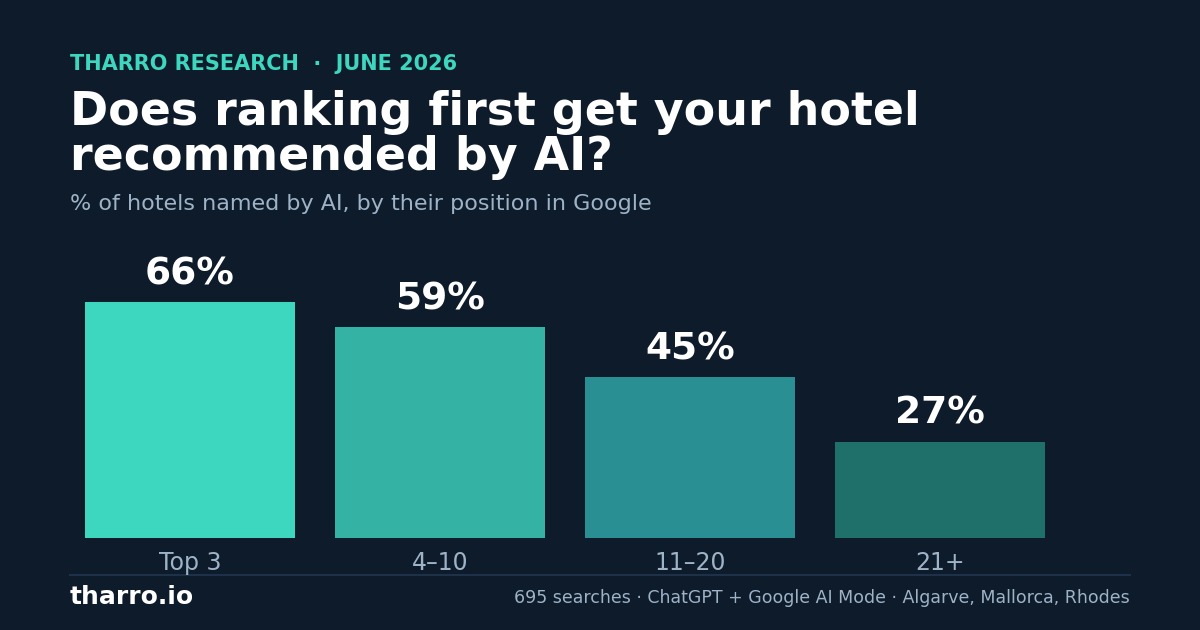
- Stop assuming AI visibility is SEO. Ranking first on Google no longer guarantees a mention in the AI answer — the overlap between AI-cited sources and Google's organic top ten has collapsed over the past year. This is a separate discipline — and it starts with tracking your AI visibility.
- Own the 7% almost nobody owns. A factual, well-structured hotel website — plus getting named in the reviews and editorial the AI actually reads — is the cheapest lever most Cyprus hotels are simply not pulling.
FAQ
How do Cyprus hotels appear in AI answers like ChatGPT? They are frequently recommended by name, but the sources feeding those recommendations are overwhelmingly third parties. In this 2026 study, hotels' own websites made up just 7% of cited sources, while OTAs, tour operators and metasearch made up 62%.
Which sources does AI use to recommend hotels in Cyprus? ChatGPT relies heavily on Tripadvisor (31.8% of its citations) plus Reddit and press. Google AI Mode relies on OTAs like Booking and Expedia, tour operators, and metasearch, which together account for about 61% of its citations.
Do ChatGPT and Google AI Mode recommend the same Cyprus hotels? No. They agreed on the recommended hotel only 42% of the time. They read different sources and should be treated as two separate visibility channels.
Which Cyprus hotel is most visible in AI answers? By share of voice across both engines, Elysium led at 2.1%, followed by Amavi, Amathus, Asimina and Parklane. No hotel exceeded 2.1%, meaning visibility across the island is highly fragmented. This reflects frequency of mention, not hotel quality.
Does the type of trip change which hotels AI recommends? Significantly. A hotel's own-voice share of citations ranged from 18.7% on honeymoon queries down to 0% on nightlife and all-inclusive queries — the persona a hotel competes on is one of the biggest factors in whether it can be seen at all.
Does the traveller's home country affect the AI answer? Yes. German travellers get OTA-dominated answers, Polish travellers get more operator- and blog-driven ones, and UK travellers get more community- and review-driven ones. Over half of hotels appeared in fewer than three markets.
Methodology: The Cyprus AI Visibility Study 2026 analysed 720 AI answers (360 unbranded, native-language traveller questions run through ChatGPT Search and Google AI Mode) across Paphos, Limassol and Ayia Napa/Protaras for the UK, German and Polish markets, in mid-2026. Source citations were classified into a ten-type taxonomy at 99.5% coverage; hotel mentions were consolidated and de-duplicated. "Share of voice" reflects frequency of mention in AI answers, not an assessment of hotel quality. Individual market-by-engine cells are directional given single-run sampling. External adoption and platform figures are third-party mid-2026 snapshots (OpenAI/Reuters, Google, Phocuswright, Ahrefs) included for context. Study produced by Tharro.