Research
Can Google Searches Predict Tourist Arrivals? We Tested It
We tested whether Google search demand predicts tourist arrivals in Cyprus, Greece and Spain. Not the way most people use it, and where it earns its keep.

Everyone selling hotel search demand data implies the same promise: searches today, arrivals tomorrow. We put that promise through a three-country test — and the honest answer is more useful than the sales pitch.
If search interest predicts travel, then a country's Google searches should forecast its tourist arrivals better than simply extrapolating the arrivals themselves. That's a testable claim. So we tested it — across Cyprus, Greece and Spain, using daily Google destination and flight searches by origin country on one side, and official arrivals statistics (CYSTAT, the Bank of Greece and INSETE, and Spain's INE) on the other.
We went in expecting search to win. It mostly didn't — and the places where it lost, and the places where it decisively won, turn out to be the whole story of how hotels should actually use hotel search demand data.
The test
For each country we built two kinds of forecasts for monthly arrivals:
- Baselines that ignore search entirely — a naive forecast (next month looks like the same month last year, adjusted for momentum) built purely from the arrivals series itself.
- Search-based forecasts — models that translate Google destination and flight searches from European origin markets into expected arrivals.
Then we scored both against what actually happened, month by month. The metric is MAPE — mean absolute percentage error; lower is better. European origin markets only, and we controlled for two things that would otherwise poison the data: Google's gradually shrinking share of travel search, and the shock that hit Eastern-Mediterranean travel when the Iran war started in March 2026.
Result one: in normal months, search lost
Not narrowly — clearly.
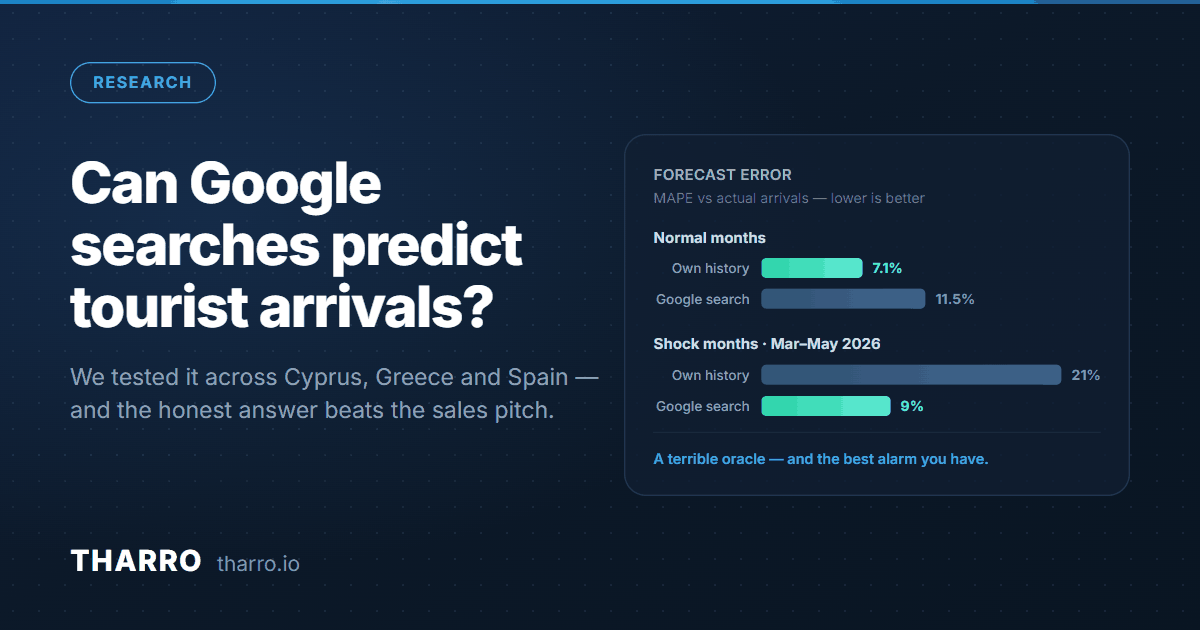
- Cyprus: the momentum baseline missed by 7.1% on average. The search-based model missed by 11.5%.
- Spain: the naive baseline missed by just 2.7%. Search missed by 7.0%.
- Greece: the arrivals data is quarterly, and at quarterly granularity the search signal dissolves entirely — there is nothing left to forecast with by the time the quarter closes.
Read that again if you're being pitched search volumes as a crystal ball: in stable conditions, last year's arrivals predicted this year's arrivals better than this year's searches did. Tourism demand is heavily seasonal and habitual; the arrivals series already contains most of its own future.
There's a structural reason too. Search data sees intent expressed on Google — and misses everything else. Road-trip corridors barely register: Portuguese travelers driving into Spain, or Spaniards holidaying domestically, produce arrivals with almost no matching flight-search footprint. Package travel booked through tour operators skips the search phase Google can see. The map is not the territory.
Result two: when the world broke, search won — by a mile
March 2026, the Iran war begins, and Eastern-Mediterranean travel demand lurches. In exactly that window, the ranking flips:
- Cyprus, March–May 2026: the search-based forecast missed by 9%. The momentum baseline — which by construction assumes the future resembles the past — missed by 21%.
This is the asymmetry that matters. Historical baselines are excellent right up until the moment they're catastrophically wrong, because they cannot see a shock coming. Search data can: travelers stop searching weeks before they stop arriving. When the pattern breaks, search is the only instrument on the dashboard still telling the truth.
Result three: the trap nobody talks about — platform drift
Our favorite finding came from a control we almost didn't build. Spanish domestic searches — a corridor with essentially no exposure to the war — dropped 10–16 percentage points in March 2026 anyway. That wasn't demand falling. That was Google's own flight-search volume stepping down platform-wide, hidden inside the same weeks as the geopolitical shock.
If we hadn't had a low-exposure control corridor, we would have read a platform artifact as a collapse in travel demand. Anyone consuming absolute search volumes without a control is exposed to exactly this error — and as travelers migrate discovery to AI assistants, platform drift in Google's numbers will only get noisier. The valid signal is relative: your feeder market versus a control corridor, this origin versus that origin — never the raw level.
Result four: used correctly, search does beat the baseline
The naive test — "convert search volumes into arrival volumes" — fails. But that's not the only way to use the data. When we smoothed the search signal into a 3-month ratio and let the model switch regimes, the picture changed:
- Normal months: the smoothed search-ratio model missed by 5.6%, beating the 7.1% momentum baseline.
- Shock months: the immediate, unsmoothed search signal remained the best instrument available.
So the model that wins overall is a regime-switching one: momentum and smoothed search share the wheel in calm conditions, and raw search takes over the moment an anomaly appears. Search data's job is not to replace your history — it's to tell you when your history has stopped applying.
What this means for a hotel
You are not running a national statistics office, but the same logic scales down to a property:
- Forecast volume from your own history. Your pace, your pickup, your seasonality. In normal months, nothing beats it.
- Use search demand as your early-warning system. Watch feeder-market search changes, not levels — a German search drop against a stable control market is a real signal; a uniform drop across all markets is probably the platform.
- Read the mix, not the total. Search data's most reliable output in our test wasn't volume at all — it was composition: which origin markets are growing, which are cooling, and when each one plans. That's the input your pricing and media timing can actually use.
- Respect the booking-window clock. In the Cyprus data, January stays were 79% booked more than a month out; October stays only 42%. The same search signal means completely different things depending on how far ahead that market books — UK and Cypriot travelers, for instance, plan on entirely different clocks.
We've written before about why fewer searches can coexist with more tourists — this study is the systematic version of that lesson. Search demand data is a powerful instrument and a terrible oracle.
The predictions we locked
To keep ourselves honest, we locked three forecasts in July 2026, before the June arrivals statistics were published: Spain non-resident arrivals +8–11% year on year, Greece international air arrivals +4–7% (roughly 4.2–4.3M), and Cyprus −2 to −7%. We'll score all three publicly once the full set of June releases is out.
FAQ
Can Google search data predict hotel demand? Not as a volume forecast — in our three-country test, simple momentum baselines beat search-based forecasts in normal months. Where search data wins is early warning (it detected the March 2026 shock weeks ahead, missing by 9% while historical baselines missed by 21%) and feeder-market composition: which origin markets are growing, cooling, and when they plan.
What is hotel search demand data? The aggregated record of who is searching for a destination — which source countries, for which dates, how far ahead of arrival. It's the earliest demand signal available to a hotel, but its reliable use is relative comparison across markets and time, not absolute volume prediction.
Why did search-based forecasts lose to naive baselines? Tourism is seasonal and habitual, so the arrivals series largely predicts itself. Search data also misses whole demand channels — road corridors, package travel — and carries platform noise: we measured a 10–16pp platform-wide step-down in Google flight searches in March 2026 that had nothing to do with real demand.
How should a hotel actually use search demand data? Forecast volumes from your own pace and history; use search demand for what history can't do — detecting shocks early, comparing feeder markets against each other, and timing campaigns to each market's planning window.
Want to see which feeder markets are searching for your destination — and which are going quiet? Explore Demand Intelligence at tharro.io or book a 30-minute call with Tharro.