Research
One Hotel, Four Shop Windows: AI Answers in UK vs Germany
We asked ChatGPT and Google AI Mode 3,600 hotel questions as a UK and as a German traveller. The two markets are not shown the same hotels, links or prices.

A British family and a German family ask an AI assistant the same question about the same resort on the same day. We did this 3,600 times. They are not shown the same thing, and the difference is bigger than language.
There are four windows: ChatGPT and Google AI Mode, each for the UK and for Germany.
| UK traveller | German traveller | |
|---|---|---|
| ChatGPT | Searches in English, reads English pages | Answers in German, but searches in English and reads English pages |
| Google AI Mode | Hotel card with price, rating, call, directions and website | Plain text. Card in 1 answer in 20 |
ChatGPT: a German answer made from English pages
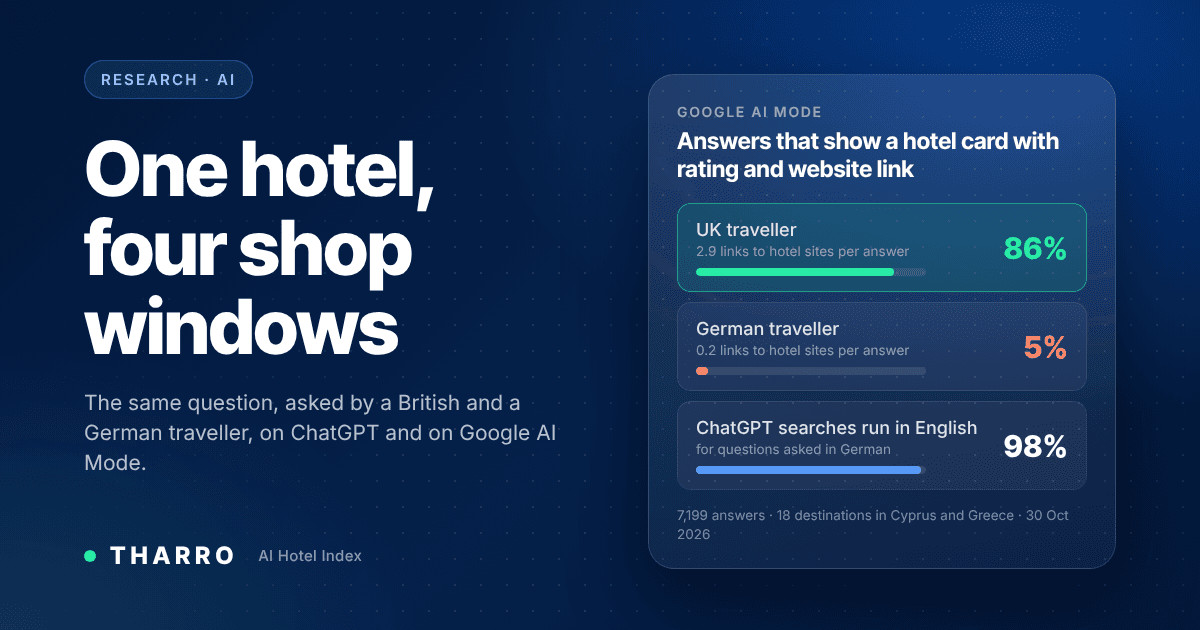
To answer the German questions, ChatGPT ran 2,023 web searches. 1,976 of them were written in English. 25 were in German.
So a question typed as "Gutes Preis-Leistungs-Hotel in Paphos für ein Paar" is looked up as "best value hotels in Paphos Cyprus couples reviews". The reply comes back in German. The material behind it does not.
- 14.8% of the pages ChatGPT read for German travellers were German.
- HolidayCheck, the review site German travellers use most, was 1.7% of those pages.
- 26% of German answers showed hotel photos credited to Jet2holidays, and 23.5% photos credited to On The Beach. Both are British tour operators.
- 6% of German answers quoted prices in pounds.
For a hotel this means its German reviews and German pages are close to unread on ChatGPT. Its English footprint decides what the German guest is told.
Google AI Mode: German sources, but the shop window is gone
Google does the opposite on sources. For German questions, 37% of the web pages it referenced were German. HolidayCheck was its most cited website in 7 of the 18 destinations. The vocabulary changes too: "Halbpension" appears in 21% of German answers, "half board" in 0.5% of UK ones.
What changes most is the format.
In the UK, 86% of Google's answers contain hotel cards: a photo, the name, the star class, the Google rating, and buttons to call, get directions and open the hotel's website. We counted 5,204 cards, 2.9 per answer. 2,487 of them show a nightly price.
In Germany, 4.8% of answers contain a card. We counted 276 cards in total, 71 with a price, and almost none with the call or website buttons.
The effect on the hotel's own website is direct. A UK answer links to a hotel's own site 2.9 times on average. A German answer does it 0.2 times. 81% of UK answers carry at least one such link, against 12% of German answers.
Google has not said that its changes to European hotel results under the EU Digital Markets Act extend to AI Mode. Our data cannot prove the cause. It does show that the hotel card, the price and the direct link are present for the British traveller and largely absent for the German one.
The lists are different too
We compared, question by question, the hotels named to each market.
- On ChatGPT, the UK list and the German list share 46% of their hotels.
- On Google AI Mode they share 25%. In Santorini it is 11%, in Rhodes 14%.
- In 8 of the 18 destinations, the number one hotel for UK travellers is not the number one for Germans.
What a hotel should take from this
- There is no single "AI visibility". There are four positions, and a hotel can be strong in one and missing in another.
- For German guests on ChatGPT, English-language pages do the work.
- For German guests on Google, German reviews and German pages count, but the answer hands over fewer direct links, so being named matters even more.
- For UK guests on Google, the card is the product. The price, rating and website link shown on it come from the hotel's Google Business Profile and rate feed, and they are worth checking as carefully as the homepage.
The method behind these numbers is on the methodology page. Two companion pieces from the same data: how stable AI hotel recommendations are and who AI recommends to each traveller type.
FAQ
Does ChatGPT give German travellers different hotel recommendations than British travellers? Partly. In our test the UK and German lists for the same question shared 46% of their hotels on ChatGPT. ChatGPT answered in German but ran 1,976 of its 2,023 web searches in English, so both markets are served largely from the same English-language pages.
Why does Google AI Mode show fewer hotel cards in Germany? In our data 86% of UK answers contained hotel cards with rating, call, directions and website buttons, against 4.8% of German answers. Google has changed hotel results in the EU under the Digital Markets Act, but it has not said whether this applies to AI Mode, and our data cannot prove the cause.
What should a hotel do to be visible to German travellers in AI answers? Treat the two engines separately. On Google AI Mode, German-language pages and HolidayCheck reviews are read and cited. On ChatGPT, English-language pages do most of the work even for German questions.
See where your hotel stands. Search your hotel in the AI Hotel Index and see how often ChatGPT and Google AI Mode name it, by market and by traveller type.