Growth
Measuring Hotel AI Visibility: Four Metrics, Three Mistakes
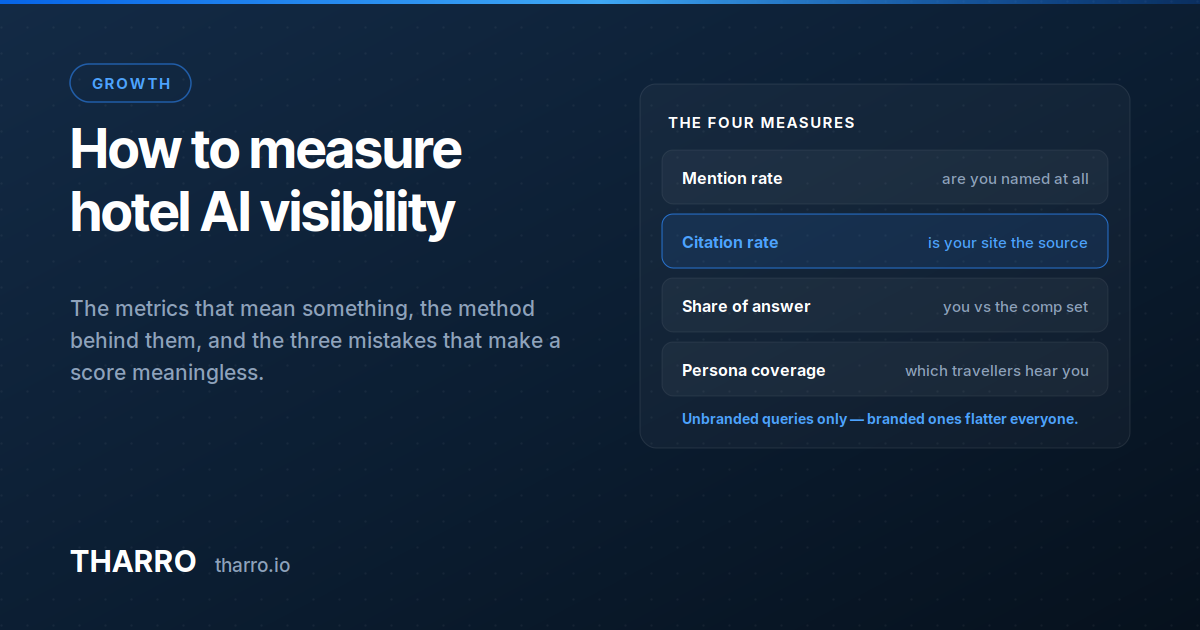
Four measures that mean something: mention rate, citation rate, share of answer, persona coverage. And the three mistakes that void a score.

Asking ChatGPT about your hotel and screenshotting the answer is not measurement. Here is what measurement looks like.
Most hotels have now done the obvious experiment. Open an assistant, type the hotel's name, read what comes back, feel briefly reassured or briefly alarmed.
That experiment is worth exactly one afternoon, and it teaches almost nothing — because you asked the wrong question, once, on one engine, with no comparison. This is what to do instead.
Mistake one: asking about yourself
Type your hotel's name into an assistant and you will get a broadly accurate, broadly positive summary. So will your competitors. Branded queries flatter everyone, because the model has been handed the answer inside the question.
Nobody discovers a hotel that way. Discovery sounds like "best adults-only hotels in Limassol with a good spa" or "where should I stay in Rhodes for a quiet week in October". Unbranded queries are the only ones that measure competition, because they are the only ones where the model has to choose.
Everything below assumes unbranded queries only. A score built on branded prompts is a vanity number and should be labelled as one.
Mistake two: measuring once
A single answer is a sample of one from a system with real variance. Ask the same unbranded question twice and you can get different hotels — assistants are non-deterministic, and answers shift with the sources retrieved at that moment.
Measurement means a fixed prompt set, run repeatedly, on a schedule. One run is an anecdote. A trend across runs is a signal.
Mistake three: measuring one engine
The assistants do not agree with each other. Our research comparing recommendations across engines found substantial disagreement about which hotels get named for the same query. Strong standing in one is not standing in general.
This matters commercially because they have different audiences. Google's AI Mode sits inside the search box where most travel research still starts. ChatGPT is where the longer planning conversations happen. Perplexity skews toward users who want sources. Measuring one and generalising is measuring a third of the problem.
The four measures
Once the method is right, four numbers carry the meaning.
Mention rate
Across your prompt set, how often is your hotel named at all?
This is the floor. If you are not mentioned, nothing else applies. Read it as a percentage of runs, and always against the comp set — 30% mention rate means nothing until you know the leading hotel in your market is at 70%.
Citation rate
When you are mentioned, is your own website the cited source?
This is the measure most tools skip, and it is the one that separates AI visibility from AI dependency. Being recommended with an OTA cited underneath is a booking that arrives through a commission. Our analysis of AI hotel recommendations found hotel websites cited in under 10% of cases — a gap sitting directly on your margin.
A hotel can be highly visible and barely cited. Those two numbers should be read together or not at all.
Share of answer
Of the hotels named across your prompt set, what proportion are you?
Mention rate tells you whether you appear. Share of answer tells you how much of the available attention you hold against the specific hotels you lose bookings to. It is the closest AI equivalent to share of voice, and the only one of the four that is genuinely zero-sum.
Persona coverage
Which kinds of traveller hear about you?
A prompt set should span the personas your market actually contains — couples, families, business, wellness, groups, luxury, budget. Aggregate scores hide the useful finding, which is almost always uneven: strong with couples, invisible to families, or named for the wrong reasons entirely.
This is the measure that converts into action fastest, because a persona gap points at a specific content and reputation problem rather than a general one.
What a defensible method looks like
If you are building this in-house or evaluating a vendor, these are the things that determine whether the number means anything:
A fixed prompt set, documented. Same questions every run. If the prompts change, the trend is worthless. It should be written down and you should be able to read it.
Unbranded only, with branded run separately. Both are interesting. Mixing them into one score is not.
A real comp set. The four to six hotels a traveller actually compares you against — not a chain average, not "luxury hotels in Europe".
Multiple engines, same prompts, same day. Otherwise you are comparing engines to each other rather than measuring yourself.
Mentions and citations recorded separately. Including whether a citation is your domain, an OTA, a review platform or an editorial site. This is where the diagnosis lives.
A stated cadence. Weekly is enough. Daily is noise. Quarterly misses the movement.
Ask any vendor for those six. The answers are more revealing than the demo.
What the number is for
A score is only useful if it changes what you do on Monday.
Low mention rate is a presence problem: the sources assistants read barely describe you. That work is off-site — listings, reviews, editorial coverage.
High mentions with low citations is an authority problem: the web knows you, your own site isn't the reference. That work is on-site — readable pages, substantive content, structured data.
An uneven persona picture is a positioning problem: you are being described accurately for one guest and invisibly for another.
Three different diagnoses, three different budgets. Which is the whole reason to measure properly rather than screenshot.
FAQ
What is a good AI visibility score? There isn't a universal one. The only meaningful reading is relative to the comp set you lose bookings to, in your market, on the same prompt set.
How often should we measure? Weekly. Frequent enough to catch movement, infrequent enough that the movement means something.
Can we do this manually? For a first look, yes — write ten unbranded prompts, run them on three engines, record who gets named. It will take an afternoon and tell you whether you have a problem. It will not give you a trend.
Does AI visibility affect bookings directly? It affects discovery, which sits upstream of bookings and is hard to attribute cleanly. The clearer commercial signal is the citation gap: recommendations routed through intermediaries carry a commission.
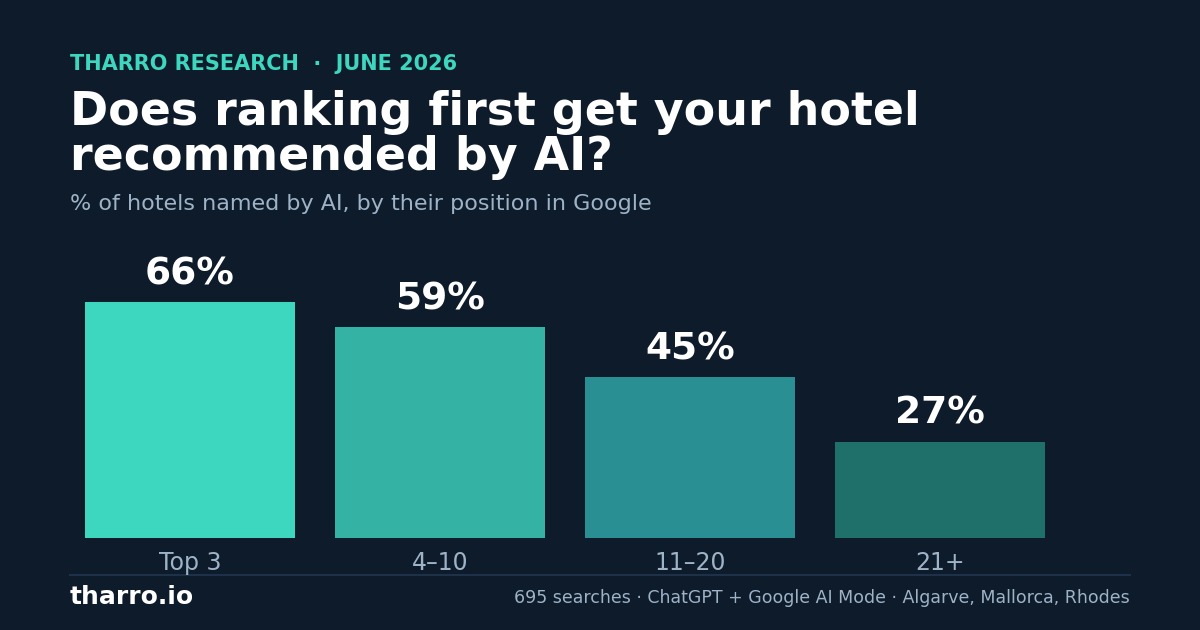
Is this the same as SEO? Related but distinct. Google rank carries into AI answers only partially — strong search visibility helps and does not guarantee anything.
Want the four measures for your hotel, against your comp set, tracked weekly? See how Tharro measures AI visibility or book a 30-minute call.