Research
Hotel Demand 2026: Cyprus vs Greece, Two Opposite Summers
Arrivals, advance bookings, seat capacity and occupancy: how demand intelligence reveals two opposite summers for hotels in Cyprus and Greece.

One Mediterranean, two very different summers: what demand intelligence reveals for hotels in Cyprus and Greece.
Most hotels read their market once a year, at budget season, from reports describing a season that already ended. Meanwhile the demand underneath them moves monthly: source markets swap places, airlines add and cut seats, booking windows compress, and a headline arrivals number hides more than it reveals.
That gap — between how fast demand changes and how slowly hotels get to see it — is what hotel demand intelligence exists to close. This month we published the first editions of our Forward Demand Barometers for two markets sitting in the same sea and living in opposite realities: the Cyprus Forward Demand Barometer and the Greece Forward Demand Barometer.
Read together, they tell a story neither could tell alone.
Two headlines, one sea
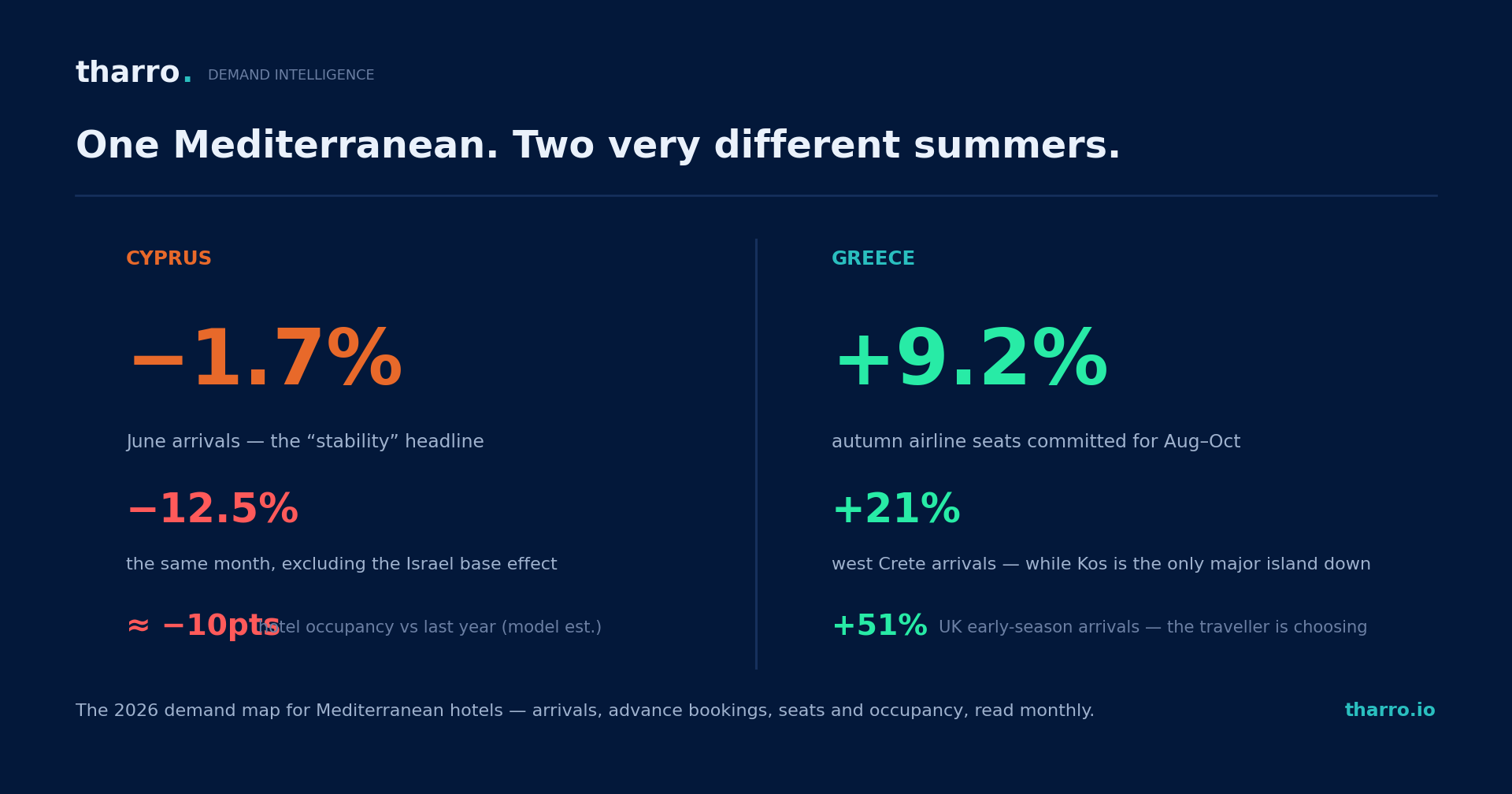
Cyprus printed −1.7% in June — its best month of 2026, widely read as a return to stability. Greece is up +5% in international air arrivals through May, with airlines committing 9.2% more seats for the autumn.
Same Mediterranean, same geopolitics, same fuel prices. Opposite years. And in both cases, the headline number is the least informative thing in the report.
Cyprus: stability that doesn't survive decomposition
The core exercise in demand intelligence is decomposition — asking who is inside a number. Decompose Cyprus's June and the stability disappears: Israel contributed +10 percentage points to the month, because June 2026 compares against the war-suppressed June of 2025. Strip that base effect out and the underlying market was −12.5%, worse than May. One third of the market — the UK — fell double digits. Germany dropped 19%. The full decomposition, month by month and market by market, is in the Cyprus report.
The report goes further than arrivals: our occupancy model — visitor-nights measured against registered hotel capacity, calibrated on official anchors — estimates Cypriot hotel occupancy ran roughly ten points below last year in May and June. A −1.7% arrivals month and a −10-point occupancy month can be the same month. That's why arrivals alone are the wrong unit for hotel demand forecasting.
Greece: growth that doesn't land evenly
Greece's problem is the opposite — a good national number hiding a rotation. The Greek island board is built on observed, per-airport data, and it splits the country in two: west Crete up 21% year-to-date with the biggest autumn capacity increase in the country, the Ionian compounding, small airports booming (Kalamata +27%, Samos +25%) — while Kos is the only major island shrinking, Athens cools into a late-window market, and Santorini's capacity growth for autumn is just +1%, the plateau signal made visible.
For a hotelier, "Greece +5%" is useless. "Your island, your source markets, your autumn seats" is a strategy input. That's the difference between tourism statistics and hotel market intelligence.
The travellers didn't disappear — they're choosing
Here is the finding that only a multi-market view can produce, and the reason we run these barometers as one framework.
Looked at from Cyprus alone, the British market appears to be evaporating: down 10.8% in June, down 13.8% for the half-year. Looked at from Greece, the same market grew +51% in early-season arrivals, with +107% growth in travel receipts — British visitors to Greece aren't just more numerous, they're spending roughly a third more per trip. Germany shows the same shape: shrinking in Cyprus, growing in Greece (though arriving there with materially lower spend per trip — volume and value are diverging by market, a detail from the Bank of Greece data covered in the Greek report).
The conclusion matters strategically: European travellers are not travelling less — they are choosing between destinations more actively than at any point in recent years. For a hotel, that changes the diagnosis from "wait out a weak market" to "compete for a decision that is being made right now, largely on digital surfaces." Demand intelligence tells you where the traveller went; visibility intelligence tells you whether you were even considered. Underneath both sits the argument we made at length in own your demand: the one problem underneath every hotel complaint.
And some swings are basin-wide: Poland is growing in both countries at once — up in Cyprus arrivals through the half-year, and backed by +92% more Polish seats to Rhodes this autumn — while Danish and wider Nordic demand surges across the map. Markets like these reward the hotels that spot them a season early.
Seats versus bookings: reading forward demand properly
Neither barometer leans on search interest alone, for the reason our Spanish feeder-market analysis set out: search volume alone is a misleading signal. Both reports instead use a two-signal method for forward demand that we'd argue every hotel should adopt. Advance bookings measure traveller intent — but they skew negative when booking windows compress, and this year they're compressed everywhere. Scheduled seat capacity measures what airlines, who watch booking curves daily, actually committed. Crossing the two sorts every market into one of three buckets:
- Capacity-backed growth — seats and relative bookings both up (Denmark, Poland, Switzerland into Cyprus; Poland and the Nordics into Rhodes and Crete). These swings are real and airline-underwritten.
- Conversion fights — seats held or added against a weak book. The UK keeps 634,000 near-flat autumn seats to Cyprus; Kos gets 15% more UK seats against a UK book that's down by half. Airlines are betting on the late window — meaning the demand gets decided in August–September, on price and visibility, in exactly the channels where travellers compare.
- Structural retreat — seats withdrawn (France and Czechia from Cyprus, for instance). No marketing recovers a market whose aircraft aren't coming; knowing this early is what stops hotels wasting budget on it.
The Cyprus report's seats check and the Greek per-airport version run this analysis market by market.
What this means if you run a hotel
Three practices follow from everything above, and they are the working definition of demand intelligence for hotels:
Read demand monthly, in your unit. Arrivals are a national statistic; your business runs on nights, occupancy and rate, by source market, in your location. Both barometers publish district- and island-level reads because that's the level decisions are made at.
Time your effort to booking windows, not calendar quarters. Most of October's Mediterranean stays are still unbooked a month out; the winter book is being written in August. A market in its decision window is worth ten times the same market outside it, and those windows barely overlap — UK vs Cyprus planning cycles correlate at just 0.43, with the British one opening in January.
Pair demand with capture. Knowing German demand is rotating or British travellers are actively choosing is only half the equation — the other half is whether your hotel appears when they search, compare, and increasingly when they ask an AI assistant. In our Cyprus research, no hotel holds more than 2.1% share of voice in AI-generated recommendations, and hotels control roughly 7% of what AI says about them. The demand that remains is contested harder; the discovery surface is where it's won.
Both barometers publish monthly, per market, with forward reads reviewed against official figures in every edition. Read the current editions here — Cyprus and Greece — and if you want your own hotel's demand and visibility position mapped the same way, that's what Tharro does.