Growth
Social Share of Voice for Hotels
Follower counts are inherited. Share of engagement is earned. What to measure instead, and the collection traps that corrupt social benchmarks.

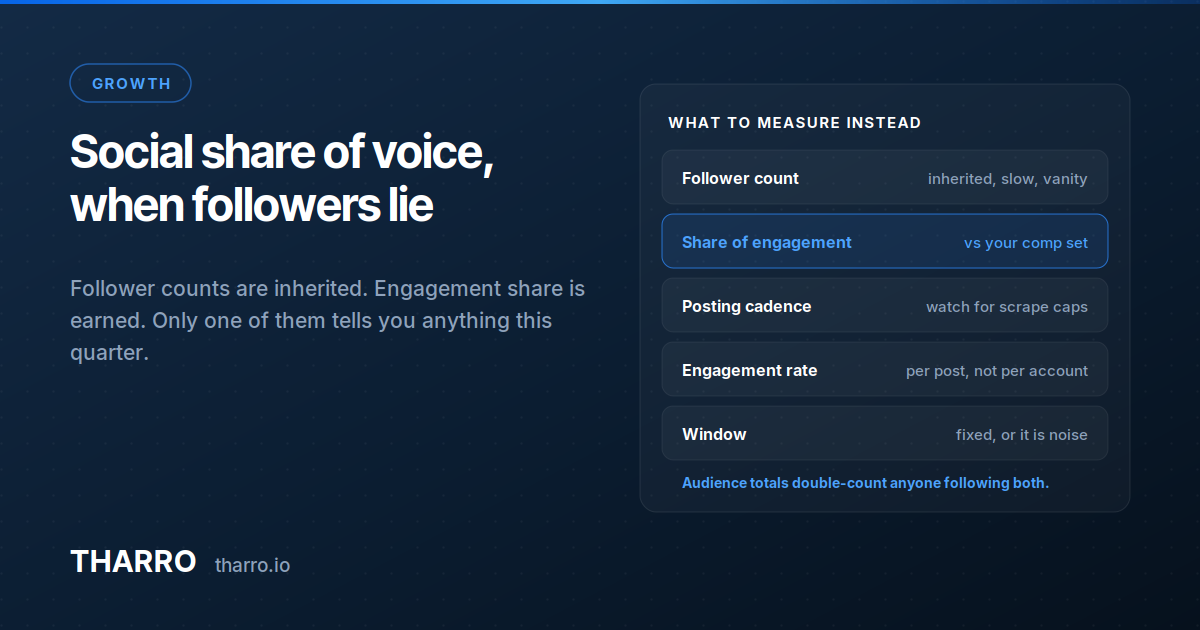
A follower count tells you what a hotel did over five years. Share of engagement tells you what it did this quarter.
Hotel social reporting tends to lead with followers, because followers are easy to find and pleasant to look at when the number goes up.
They are also close to useless as a competitive measure. A follower count is accumulated, largely inherited, and moves too slowly to reflect anything you changed. A hotel that ran good campaigns in 2019 and nothing since still has the followers.
Measure share, not size
The useful question is not "how many followers do we have" but "of all the engagement happening across our competitive set, how much is ours?"
That reframes social the way share of voice reframes search. It is relative, zero-sum, and it moves when you do something.
It also survives the awkward comparison problem. A 300-room resort will always have more followers than a 40-room boutique. Share of engagement across a defined comp set is comparable in a way raw counts never are.
Four collection traps that make social benchmarks wrong
If you are buying or building this, these are the failure modes. Every one of them produces a plausible-looking number.
1. Post caps. Many collection tools capture a fixed number of posts per run — often ten. A hotel posting fifteen times a week is silently truncated to ten and appears quieter than it is. Unless the cap is disclosed, cadence comparisons are meaningless. Ask what the cap is.
2. Engagement maturity. Engagement is captured at scrape time. A post from three weeks ago has finished accumulating; a post from yesterday has barely started. Compare them without adjusting and you systematically penalise whoever posted most recently — which is usually whoever is trying hardest.
3. Uneven coverage. If your property has been scraped for thirteen weeks and a competitor for twelve, your totals are inflated by an entire week. Coverage windows must match, and be stated.
4. Double-counted audience. "Total audience" figures that add Instagram followers to Facebook followers count everyone following both, twice. It is a bigger overlap than most people assume and it is usually labelled as reach.
What to actually track
Share of engagement across the comp set, in a fixed window. The headline number.
Engagement rate per post, not per account. This separates "posts a lot" from "posts things people respond to" — the two get conflated constantly, and only one of them is a content signal.
Posting cadence, with the collection cap disclosed. Useful mainly as context for the other two.
Content-type mix. Which formats earn engagement for you versus for the comp set. This is where social benchmarking becomes actionable rather than merely diagnostic.
Your own trend. As with reviews, your figure against your figure last quarter has no comparability problem at all.
Where social fits in the wider picture
Social is one of the surfaces where travellers form an impression of your property, alongside your listings, your reviews and your website. It is worth measuring for that reason rather than for its direct booking contribution, which is usually small and hard to attribute honestly.
It also feeds discovery indirectly. Social content contributes to the general impression of a property that assistants assemble from across the web, though far less than reviews and listings do. Treat it as part of your presence layer, not as a demand channel — and be sceptical of anyone claiming a clean line from social engagement to room nights.
FAQ
Which platforms should a hotel benchmark? The ones your comp set actually uses. For most European hotels that is Instagram and Facebook; adding platforms where competitors are absent produces noise, not insight.
How large should the comp set be? The same four to six properties you use everywhere else. Consistency across modules matters more than the exact number.
Is follower count worthless? Not worthless — it is a reasonable measure of accumulated brand reach. It is just a poor measure of current performance, and it is almost always used as the latter.
How often should this be measured? A rolling 90-day window, refreshed weekly. Shorter windows are dominated by whether someone happened to post.
Want your social share of voice measured against your comp set — with the collection limits disclosed? See how Tharro does it or book a 30-minute call.