Research
Do Your OTA Listings Decide What AI Says About You?
AI assistants read your OTA listings as source material. We checked one resort across 27 factual dimensions and found contradictions on half of them.

Your OTA listing was written to sell rooms. It is now also being read as a reference document about your hotel.
Most hoteliers think of an OTA listing as a shopfront: it exists to convert someone already on Booking.com. That was true. It is now only half true, because the same listing is source material for whatever an AI assistant says about you.
And unlike your website, you did not write all of it.
What we checked
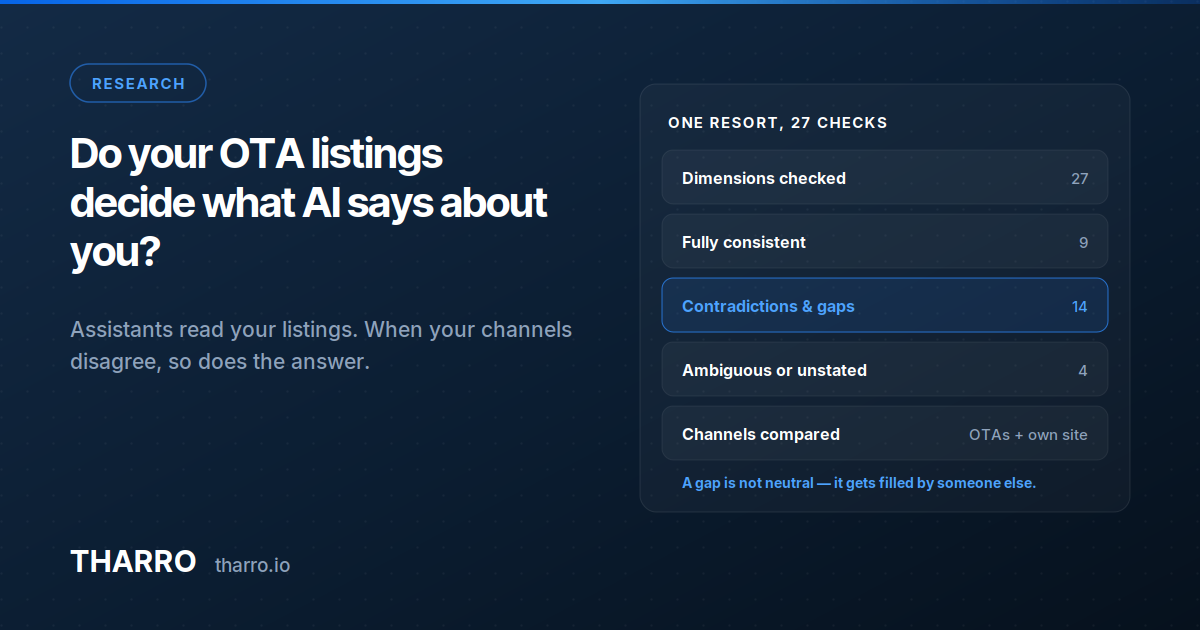
We took a five-star Mediterranean resort and compared its factual claims across its OTA channels and its own website — 27 dimensions covering room counts and sizes, facilities, dining, spa, location descriptions, policies, and what is and isn't included.
Nine agreed across every channel. Fourteen carried a contradiction or a gap. Four were ambiguous.
Not one of the fourteen was a lie. They were the ordinary residue of a listing written in 2021, a website rebuilt in 2024, and a metasearch profile nobody has opened since it was created.
Why a contradiction matters more than it used to
A guest who notices your website says 78 rooms and your listing says 74 shrugs and books anyway. A retrieval system does not shrug. It has to resolve the disagreement, and it resolves it in one of three ways, all bad for you:
It picks the more authoritative source — which, on volume and freshness, is usually the OTA and not you.
It hedges — producing the vague, non-committal description that makes your hotel sound interchangeable with the four others in the answer.
It omits the claim entirely. This is the quiet one. If your channels disagree about whether you are adults-only, the safest thing a model can do is not mention it. So the single most decisive fact about your property — the one that would have made you the obvious answer for one traveller and the wrong answer for another — silently disappears from every recommendation.
Gaps are worse than contradictions
A contradiction gets resolved badly. A gap gets filled — by whatever the model can infer from your competitors, your location, your star rating and your review text.
If nothing you publish states your position on children, an assistant will still answer a question about children at your hotel. It will just answer it from context rather than from you.
This is the part hoteliers underestimate. Silence is not neutral. It is an invitation for something else to speak on your behalf.
What to fix, in order
1. The facts that decide a booking. Adults-only or not. Distance to the beach, stated in metres. Whether the restaurant takes non-resident bookings. Parking. Accessibility. Pets. Opening months. These are the claims that appear in traveller questions, and they are the ones that most often differ between channels.
2. Anything numeric. Room counts, room sizes, distances, opening hours. Numbers are the easiest contradictions for a system to detect and the most damaging to your credibility as a source.
3. What you are not. "No conference facilities", "adults-only", "closed December to February" are among the most valuable statements you can publish. They prevent you being recommended to the wrong guest, which is a worse outcome than not being recommended at all.
4. Then the descriptive copy. Tone and positioning matter, but only after the facts agree. A beautifully written listing that contradicts your website is worse than a plain one that doesn't.
The part that makes this tractable
Unlike most AI visibility work, this is entirely within your control and takes an afternoon per channel. You own the listings. You can edit them today. And listing coherence is measurable — you can check whether your channels agree, fix the ones that don't, and watch the number.
It is the cheapest lever in AI visibility, and it is the one almost nobody pulls, because a listing feels like a distribution task rather than a marketing one.
FAQ
How many channels should I check? Every channel you appear on that a traveller or a crawler can reach — your main OTAs, metasearch profiles, your own site. Three or four covers most of the exposure.
How often do they drift? Continuously. Rooms get renovated, restaurants get rebranded, policies change. Anything not checked on a schedule is out of date within a year.
Does an OTA listing outrank my own website as a source? Often, yes — on density and freshness rather than on any deliberate preference. Which is why the fix is to agree with yourself, not to compete with your own listing.
What if an OTA won't let me change a field? Then state your version clearly on your own site and in the fields you do control. Consistency across three of four channels beats a contradiction across all four.
Want to see whether your channels agree — and where they don't? See how Tharro checks listing coherence or book a 30-minute call.