Growth
What Hotel Marketing Intelligence Is, and What It Is Not
Hotel marketing intelligence, defined: how it differs from market intelligence, rank trackers and rate shoppers, and why connected signals beat dashboards.

A term is spreading through hotel tech, and — as usual — it's being used to mean five different things. Here is a working definition, and a test for whether a tool actually deserves it.
Ask five vendors what hotel marketing intelligence is and you'll get five answers, each one shaped suspiciously like the product they sell. So let's define it properly, from the hotelier's side of the desk.
The definition
Hotel marketing intelligence is the connected, benchmarked view of every signal that shapes your bookings — search demand, Google visibility, AI visibility, price position and reputation — turned into decisions.
Three words in that sentence carry all the weight:
- Connected. The signals must be read together. German search demand rising, your German Google visibility flat, and ChatGPT never mentioning you to German travelers is one finding with one action — not three lines in three separate reports.
- Benchmarked. Every number is read against the competitive set you actually lose bookings to. A "good" AI visibility score in isolation is meaningless; the only question is whether the five hotels a traveler compares you with score better.
- Decisions. The output is not a dashboard. It's an answer to the Monday-morning question: what should we do this week, and why?
If a tool gives you data without competitive context, or context without a recommended action, it's reporting — useful, but not intelligence.
Hotel marketing intelligence vs hotel market intelligence
The two phrases are one letter apart and constantly confused, so it's worth being precise.
Hotel market intelligence describes the market around you: demand by feeder market, booking windows, rate levels, supply, seasonality. It answers "what are the conditions?" — and it's the domain of demand intelligence tools.
Hotel marketing intelligence describes your performance inside that market: whether travelers find you on Google and in AI answers, how your reputation compares, whether the demand that exists is reaching you or an intermediary. It answers "are we capturing it?"
You need both, in one view, because each is dangerous alone. Market intelligence without marketing intelligence tells you demand is up 25% — and lets you assume you'll get your share. Marketing intelligence without market intelligence tells you your visibility improved — in a feeder market that stopped searching two months ago.
What it is not
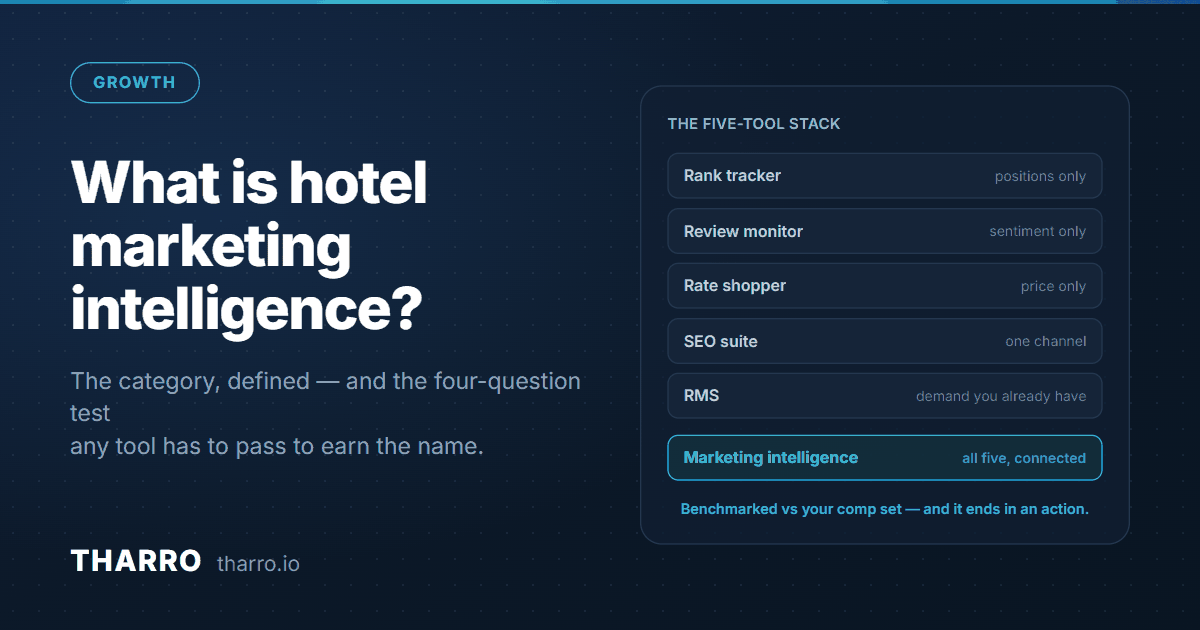
The category is best understood by what it replaces — the five-tool stack most hotels quietly run today:
- A rank tracker shows keyword positions, but can't tell OTA competition from hotel competition — and in hotel search, who owns the SERP matters more than where you rank on it.
- A review monitor shows sentiment, but not that reviews are also an input AI assistants read when deciding whom to recommend.
- A rate shopper shows price position, but nothing about whether travelers ever see you at the moment they'd compare prices.
- A generic SEO suite sees one channel, with no concept of hotel distribution.
- A revenue management system optimizes the demand you already receive — marketing intelligence works upstream, on whether you're found at all. The two are complementary, not substitutes.
Each tool describes its slice honestly. None of them can see that the slices are the same story. Meanwhile the intermediaries you compete with — the OTAs — run connected demand, price and visibility signals in real time. Most hotels are bringing disconnected reports to a fight against connected intelligence.
Why the category is emerging now
Two shifts made a connected view necessary rather than nice-to-have.
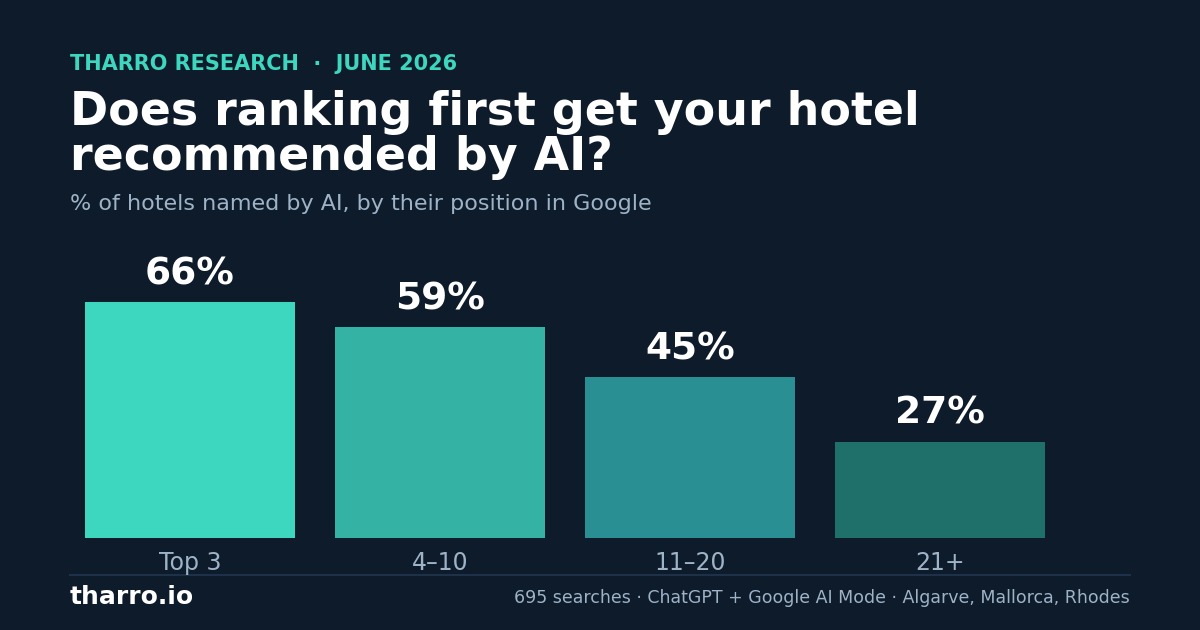
First, discovery fragmented. Travelers now find hotels across classic search, OTAs, metasearch, social and AI assistants — and the surfaces disagree with each other. Our research across 695 searches found that Google rank only partially predicts whether AI recommends a hotel, and the AI engines barely agree among themselves. No single-channel tool can even see this problem, let alone manage it.
Second, the OTA asymmetry got expensive. Intermediaries don't just take a commission on the booking — increasingly they capture the visibility itself, then sell it back. Deciding where to fight and where to concede requires seeing demand, visibility and competitive position on one board.
The test to run on any "marketing intelligence" pitch
Four questions separate the category from the label:
- Does it connect at least demand, search visibility and AI visibility? One channel = a point tool wearing a bigger name.
- Is every metric benchmarked against my actual comp set — not an industry average?
- Does it understand hotel distribution — can it separate OTA competition from hotel competition, branded from unbranded?
- Does it end in a prioritized action, or does it end in a chart?
A hotel marketing intelligence platform is whatever answers yes to all four. Everything else is a dashboard with ambitions.
FAQ
What is hotel marketing intelligence in one sentence? The connected, competitively benchmarked view of the signals that shape your bookings — demand, Google visibility, AI visibility, price position and reputation — turned into weekly decisions.
How is marketing intelligence for hotels different from business intelligence? BI looks inward at your own operational data (occupancy, ADR, channel mix). Marketing intelligence looks outward at the market and your position in it — and specifically at the discovery phase, before a booking exists for BI to count.
Do independent hotels need a marketing intelligence platform? Arguably more than groups do: chains build this intelligence layer in-house with analyst teams. For an independent, a platform is the only realistic way to see demand, visibility and competitive position on one board.
Is hotel marketing intelligence just SEO reporting with extra steps? No — SEO is one input. The defining feature is connection across channels: search, AI answers, demand and reputation read together against your comp set. An SEO report can't tell you that the market you're optimizing for stopped searching.
Want to see your hotel's connected picture — demand, Google, AI and reputation on one board? Explore the platform at tharro.io or book a 30-minute call with Tharro.