The Mediterranean Pulse · Reading 6 · August 2026 · Tharro Research
The Mediterranean, According to AI
Reading 4 showed the volume draining out of the search box. Reading 5 read what remains inside it. This reading goes where the deciding moved.
Reading 4 showed the volume draining out of the search box. Reading 5 read what remains inside it. This reading goes where the deciding moved.
We asked the AI engines the same questions travellers ask them: where in the Mediterranean to go for a family holiday, for luxury, on a budget, for a wedding, as a couple, alone. Ten holiday themes and three traveller personas, phrased four ways each, in the language of five source markets — the UK, Germany, Poland, Sweden and Israel — put to the two engines now sitting between travellers and destinations: ChatGPT and Google's AI Mode. 520 answers, collected in one August week.
The answers draw a map. It is not the map searchers draw — and it is nobody's idea of a fair one.
Three countries own the map
Greece appears in 94% of all answers. Italy in 88%. Spain in 87%. Then the map falls off a cliff: the fourth most-recommended destination, Croatia, appears in 59% — a twenty-nine point drop — and the rest of the Mediterranean shares what's left: Portugal 43%, France 37%, Turkey 34%, Cyprus 31%, Malta 30%.
Position is even more concentrated than presence. Ask which destination an answer opens with and the big three take 77% of everything: Italy leads 32% of all answers, Greece 24%, Spain 21%. Cyprus opens two answers out of 520. Malta opens one.
When a challenger destination does appear, it appears late — Cyprus's average position is fifth or sixth in the list, Malta's closer to sixth. In a medium where most travellers will read three names and act on one, there is presence, and there is being the answer. The Mediterranean's big three have the second. Everyone else is negotiating for footnotes.
The distortion table: AI's favourites vs real demand
Set each destination's share of AI recommendations against its share of what travellers in the same four markets actually search for (Israel's search side remains this study's declared gap), and AI's thumb on the scale becomes measurable:
Destination
Share of search demand
Share of AI mentions
Distortion
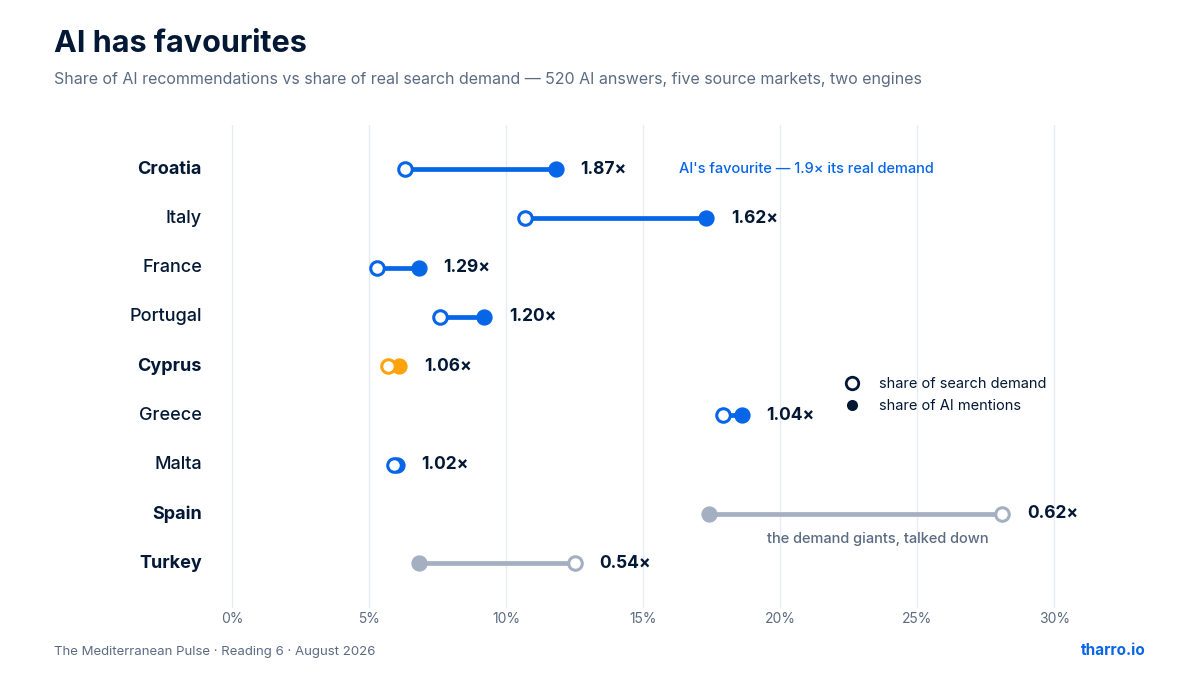
Croatia is AI's favourite: nearly twice the presence its demand commands — and this for one of the slowest-growing destinations in the set on the ground, with summer seat capacity up 2.5% against a Mediterranean average of 7%. Italy runs at 1.6×. Meanwhile the two demand giants get talked down: Spain carries more search demand than any destination in the study and gets recommended at 0.6× its weight; Turkey, the second-biggest search destination in Germany and Poland, at half.
AI compresses the giants and inflates the boutique.
Engines trained on travel editorial reproduce travel editorial's tastes — and editorial has spent a decade telling readers to skip the crowds and go to Istria. If your budgets follow demand, note that the AI your guests consult does not.
Cyprus: the footnote destination
On volume, AI treats Cyprus almost fairly — 6.1% of mentions against 5.7% of search demand. The problem is not how often Cyprus appears. It is where, and as what.
Cyprus is first in 0.4% of answers. Its average position, when it appears at all, is 5.2 — deep in lists most readers never finish. And it is locked out of the themes where the money is: it makes 7 of 40 luxury answers, 7 of 40 food-and-wine, 9 of 40 culture, 5 of 40 “authentic” — while being carried almost entirely by the package suit: 27 of 40 all-inclusive answers, 24 family, 23 beach. Ask the engines about couples, friends or solo travel and Cyprus nearly vanishes: 10, 6 and 5 answers of 40.
One theme is untouchable: winter sun, where Cyprus appears in 40 answers out of 40 — though it now shares that perfect score with Spain, whose Canaries own the same season. AI's Cyprus, in short, is a package island for families in summer and anyone in winter — present as an option, almost never as the answer, and invisible to the traveller who isn't booking a board basis.
Who owns what in AI's answers
Raw theme leadership is monotonous — Greece and Italy top nearly every list simply by being everywhere. The revealing measure is specialization: a destination's presence in a theme set against its presence overall. That is what AI thinks each place is for.
Theme
AI's specialist
Also over-indexes
Turkey is the most typecast destination on the map: cheap packages, full stop — 2.7× on budget and all-inclusive alike, near-zero on food and wine (3 answers in 40) and weddings (5). AI knows exactly what Turkey is for and recommends it for nothing else. Cyprus is the second-most typecast, and typecast entirely package-and-season: winter sun, nightlife, all-inclusive, family, beach. France is the only challenger AI files upmarket.
The big three specialize in nothing — their indices sit at 1.0–1.2 across every theme, because they don't need a lane; they are the road. And one theme has no owner at all: “authentic”, one of the larger search pools of Reading 5, over-indexes for nobody — the widest open lane on AI's map.
Cross the themes with the asking language and the ownerships acquire addresses. Turkey's typecast is universal — six to eight budget and all-inclusive answers of eight in every language. Cyprus's themes are not: all-inclusive Cyprus lives in Polish (7 of 8) and Swedish (6 of 8) answers — precisely the two markets whose searchers type the package first; family Cyprus lives in Hebrew answers (7 of 8, level with the big three); wedding Cyprus in Polish and Hebrew, not British (2 of 8). The UK void has a shape too: British luxury answers contain Cyprus zero times in eight — as do British friends and solo answers. Croatia's inflation turns out to be market-specific vibes: every German family answer names it, every British couples answer names it. Even Israel's odd French tilt resolves here — French culture appears in six Hebrew answers of eight, versus one or two everywhere else.
Five markets, five maps
The frame of this series is five source markets, and this is the layer where the fifth finally enters: Israel's search demand can't be measured reliably, but its AI answers can — 104 of them, asked in Hebrew.
Each market's AI draws a different map. Cyprus's presence runs from 44% of Polish answers down to 25% of German and 24% of British — and that last number is the sharpest paradox in this reading: the UK is Cyprus's largest search market and its worst AI market. The market that types “cyprus” more than any other is the one whose AI answers mention it least.
Israel's debut map has its own tilt: Cyprus appears in 36% of Hebrew answers — its second-best market — while France is strangely favoured at 48%, far above its standing anywhere else. And the per-market distortions run to extremes the pooled table hides: Polish AI answers recommend France at four times what Poles search for it; British answers run Croatia at 2.9× British demand; German answers double Malta while Polish ones halve it — in the one market where Malta's search momentum is strongest.
AI's map vs the searcher's map
Reading 5 ended with a question: does AI's picture of each destination match its searchers'? Now we can answer it — and the answer explains the market gaps.
Where the two maps agree, presence follows. Poles type “all inclusive” before any geography, and AI's Cyprus isall-inclusive-shaped — so Poland is Cyprus's best AI market. Turkey owns budget in every market's search box, and AI agrees, putting Turkey in 37 of 40 budget answers even while halving it overall.
Where the maps disagree, presence collapses. To British searchers Cyprus is a villa by a beach — the highest villa share Cyprus has in any market — but villas belong to Croatia and Greece in AI's world, and Britain is where Cyprus's AI presence bottoms out. Malta is being searched upmarket in three of four markets; AI hasn't noticed, still filing Malta under culture and winter sun and giving it 7 luxury answers in 40.
AI doesn't answer with what your market types. It answers with what the internet wrote.
When those diverge, the destination falls out of the conversation exactly where its demand is strongest.
Which engine matters
The two engines do not draw the same map. ChatGPT writes long lists — 5.7 destinations per answer on average — and challengers live in the tail of them. Google's AI Mode writes short ones, 4.3 names, and the compression lands entirely on the challengers: from ChatGPT to AI Mode, Cyprus falls from 38% of answers to 25%, Turkey from 49% to 19%, Croatia from 79% to 39%, Malta from 44% to 16% — while the big three barely move.
The extreme case: in German Google AI Mode answers, Cyprus appears in fewer than one answer in ten. The engine bolted onto the world's default search box is the one with the least room on the page — and the least patience for destination number six.
What AI destination visibility means for hotels
Benchmark against AI's comp set, not your own. In AI answers your destination's rival is whoever AI inflates — Croatia, in most markets — not whoever you rate-watch. If a 1.9× destination sits next to your 1.1× destination in every list, that is the gap your guests see.
Fight for position, not presence. Getting mentioned is not the game; 77% of answers open with three countries, and the first name gets the click. Content, citations and reviews that push a property — or a destination — up the list beat those that merely get it onto the list.
Enter through the themes where your destination has standing. A Cypriot hotel cannot ride its destination into luxury answers AI doesn't write; it can dominate the all-inclusive, family and winter-sun answers AI writes constantly. Publish where the door is already open — then widen it.
Know which engine your market uses. If your source market lives in Google, your bar is AI Mode's four-name list, not ChatGPT's seven. Presence that survives the short answer is the only presence that scales.
Reading 5
What each country types when it dreams of the Mediterranean
Poles type all-inclusive, Brits type villas, Germans type beaches — the same destination is a different product in every language.
Read itReading 4
The demand that vanished
Search volume fell in 32 of 36 corridors while arrivals rose. Search has become a one-way instrument.
Read itNext in the Pulse
The series closes where the layers meet: the destinations winning on every instrument at once — and the ones whose maps don't agree with each other.