Research
Who Gets the Click in AI Hotel Recommendations? New Data
We traced 13,680 links inside real AI hotel answers. Hotels' own websites got under 9%. Who owns the click layer, and how to fight for it.

When AI Recommends a Hotel, Who Gets the Click? We Traced 13,680 Links to Find Out.
There are two currencies in an AI answer. The first is your name. The second is the link — the thing the traveller actually taps. Most of the industry conversation is about the first. The money is in the second.
We collected the full AI answers — ChatGPT and Google AI Mode — for 695 unbranded hotel searches across Mallorca, the Algarve and Rhodes, and traced every external link inside them: 13,680 citation occurrences pointing at 1,587 different websites.
Here's who owns the click layer.
Hotels get named. Someone else gets linked.
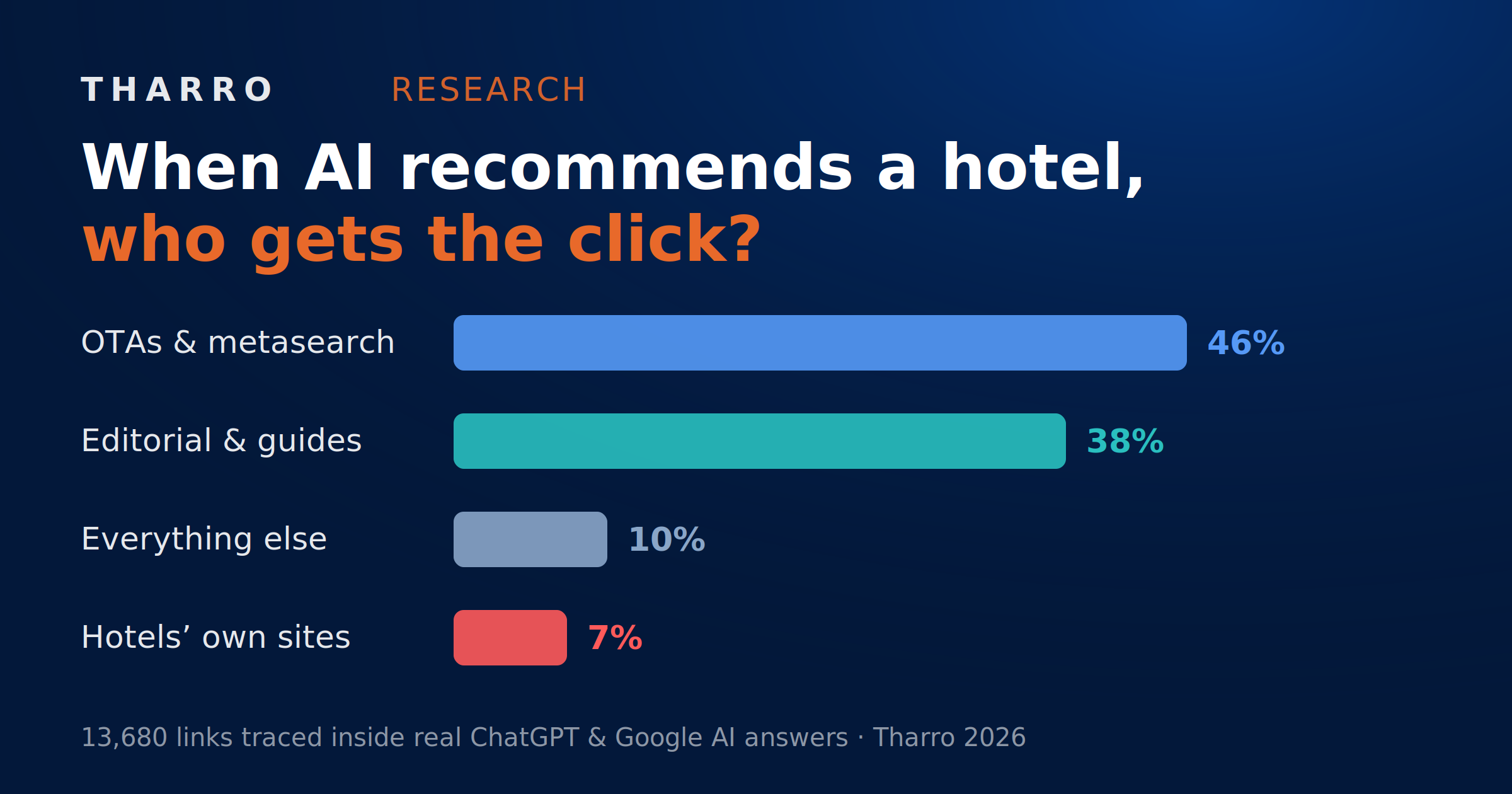
Across both engines, hotels' own websites received less than 9% of all citations — 5.8% on Google AI Mode, 8.3% on ChatGPT. The other 91%+ of clickable authority went elsewhere:
The most-cited websites in AI hotel answers: booking.com (820 occurrences), expedia.co.uk (682), tripadvisor.co.uk (499), travelmyth.co.uk (402), tripadvisor.com (335), expedia.com (313), travelmyth.com (310), agoda.com (248).
The AI names your hotel — then hands the traveller a link to an OTA, a review platform, or an aggregator. The recommendation is yours; the relationship is theirs. This is the OTA capture problem in its newest form: even when discovery happens outside Google, the booking authority routes back through intermediaries.
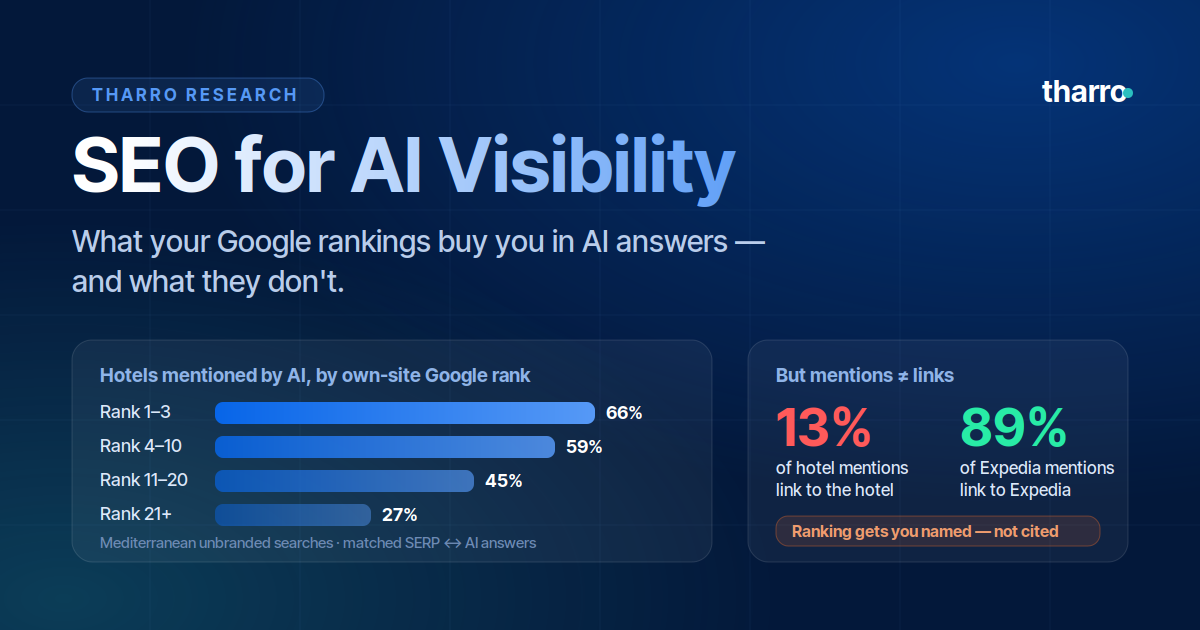
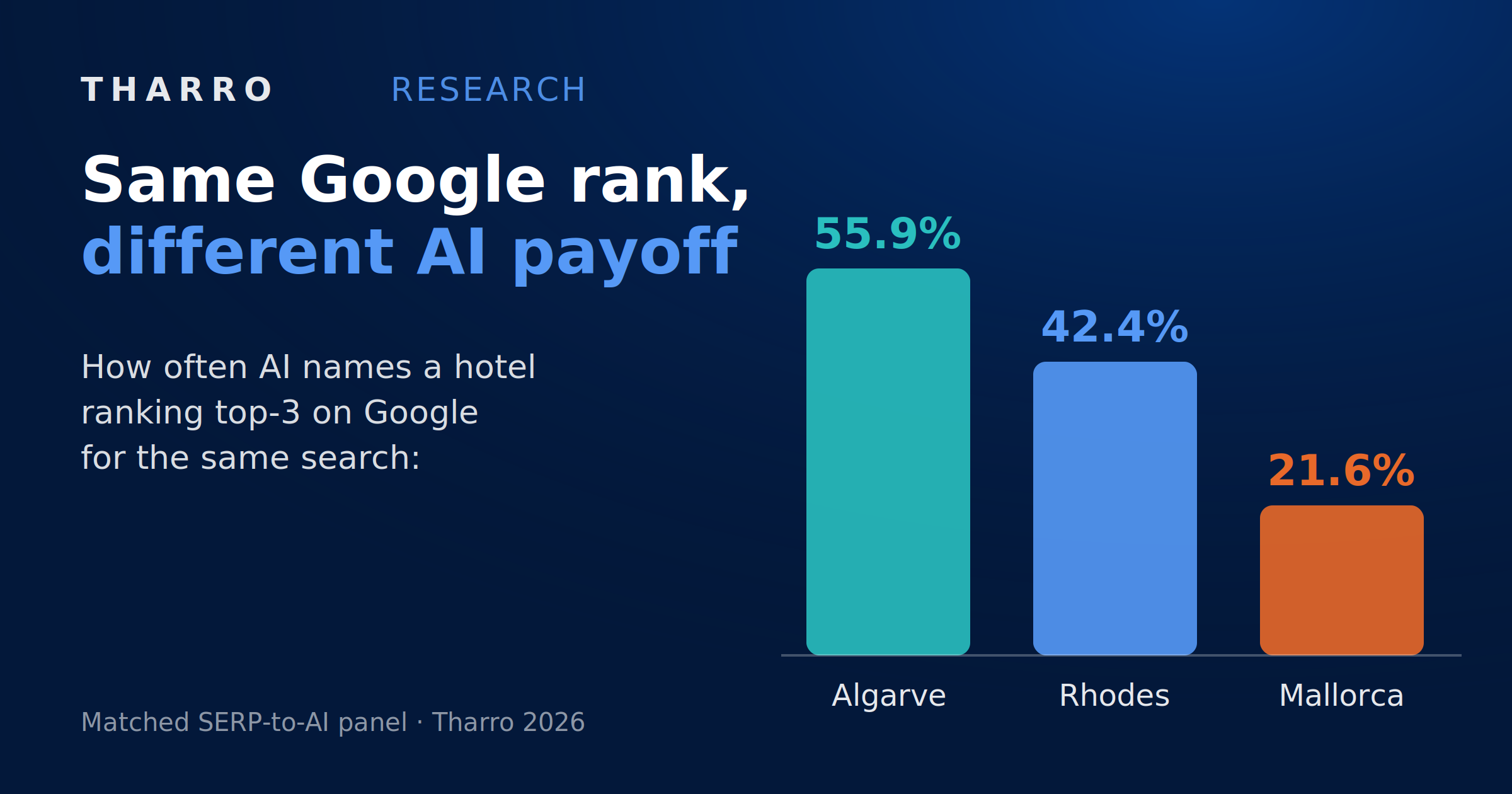
And ranking doesn't fix it. In our matched panel, even hotels whose own websites rank in Google's top 3 for a search saw their own site cited in the AI answer for that search only about one time in five. Below the top ranks, citation rates fall toward one in twenty. You cannot rank your way into being the link.
Two engines, two link economies
The 91% doesn't flow to the same intermediaries on both engines:
- Google AI Mode routes clicks to the transaction layer: 36.2% of its citations go to OTAs, another 15.2% to metasearch. It's an extension of the booking funnel.
- ChatGPT routes clicks to the editorial layer: 48.9% of its citations go to travel media, guides and destination editorial — abc-mallorca.com alone was cited 234 times, more than agoda. OTAs take just 14%.
The strategic difference is enormous: you can't buy your way into either, but the editorial layer is earnable — a hotel can appear in the guides and roundups ChatGPT trusts. The OTA layer is only rentable.
The quiet winners nobody is watching
The leaderboard holds a surprise: travelmyth, a niche hotel-categorisation aggregator, collected 712 citations across its two domains — ahead of agoda, hotels.com and every hotel chain on earth. Specialist aggregators and local editorial sites (seemallorca.com, algarvetravel.guide, golfbreaks.com) punch wildly above their web-traffic weight inside AI answers. The engines are not citing the internet by size; they're citing it by structural usefulness — categorised, comparable, list-shaped content about hotels.
What hotels can actually do
Measure mentions and citations as separate outcomes. A dashboard that counts "AI mentions" without counting whose link sits next to your name is measuring applause, not revenue.
Fight the citation battle off your own website. Since the engines cite OTAs, review platforms, aggregators and editorial, presence there is the citation strategy: an OTA profile complete enough to be the machine's source of truth, review-platform depth, and — for the ChatGPT side — genuine editorial coverage in the outlets AI already trusts.
Know which intermediary owns your answers. Whether your AI presence is mediated by booking.com, tripadvisor or a local guide changes what you fix first. Seeing the actual citations behind your mentions is the starting point.
Treat the earnable layer as the opportunity. The OTAs' citation share is structural and defended. The editorial and aggregator share — half of ChatGPT's link economy — is open to any hotel that gives those sources something worth writing about.
Methodology: 695 unbranded search intents across Mallorca, the Algarve and Rhodes; full ChatGPT and Google AI Mode answers collected June 2026; every external citation extracted (13,680 occurrences, 1,587 domains) and classified by source type using the same taxonomy applied to 288,051 organic search results in the companion analysis. Rank-band citation rates from the matched SERP-to-AI panel. Findings are cross-sectional. Part of Tharro's 2026 SERP-to-AI carryover research.