Research
ChatGPT vs Google AI Hotel Recommendations: 1-in-5 Overlap
We asked ChatGPT and Google's AI Mode the same 695 hotel questions. They agreed on one hotel in five. The overlap data, and why AI visibility is two games.

ChatGPT and Google AI Recommend Different Hotels. We Measured Exactly How Different.
Ask a hotelier about "AI visibility" and you'll hear it discussed as one channel — one new surface to win, next to Google and the OTAs. Our data says that framing is already wrong.
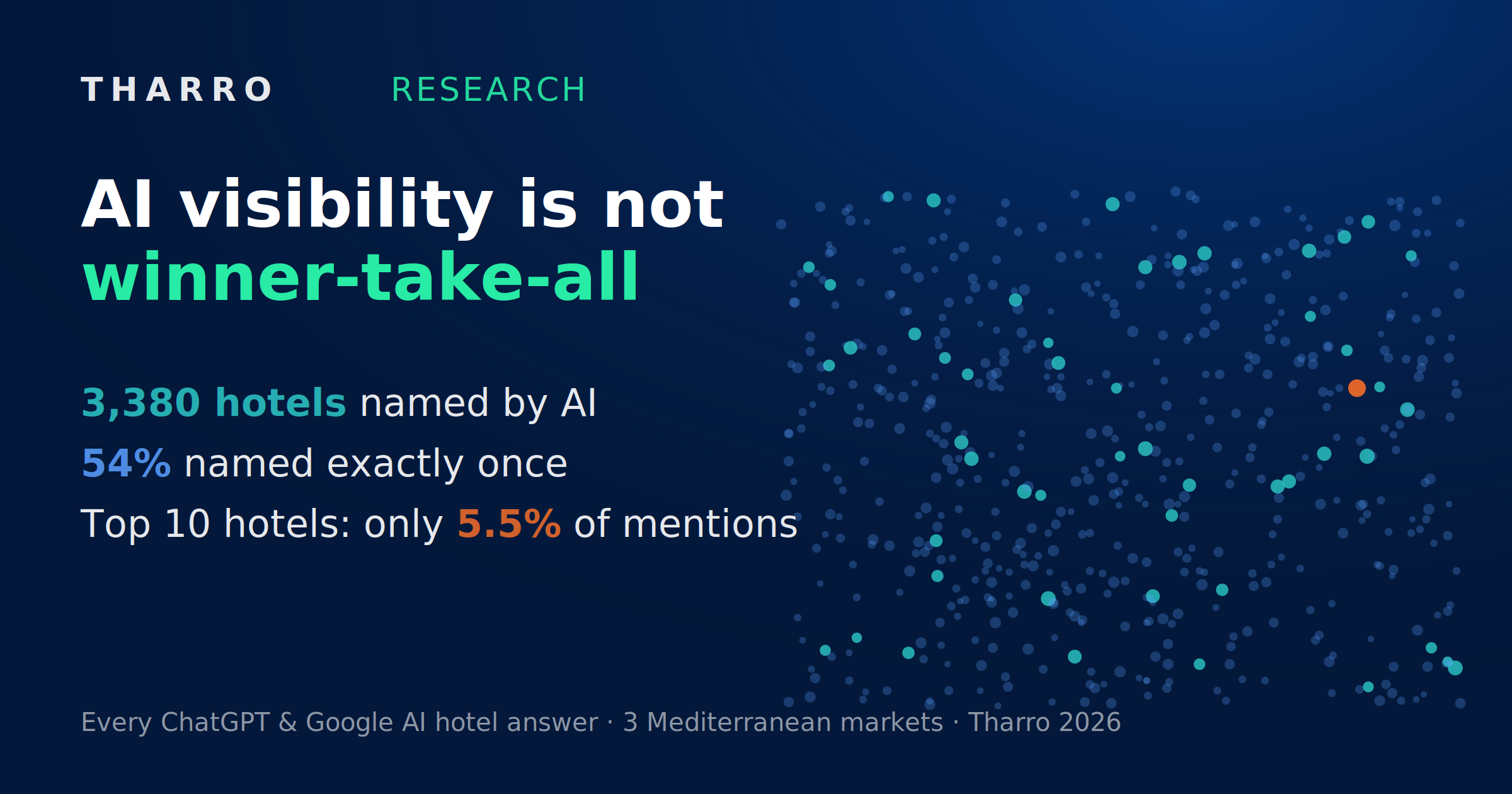
We put the same 695 unbranded traveller questions — "recommend a few hotels in Palma," "best family hotels in Albufeira," and hundreds more — to both ChatGPT and Google's AI Mode, across Mallorca, the Algarve and Rhodes, and recorded every hotel each engine named. 3,380 distinct hotels were recommended at least once.
Then we checked the overlap.
One hotel in five
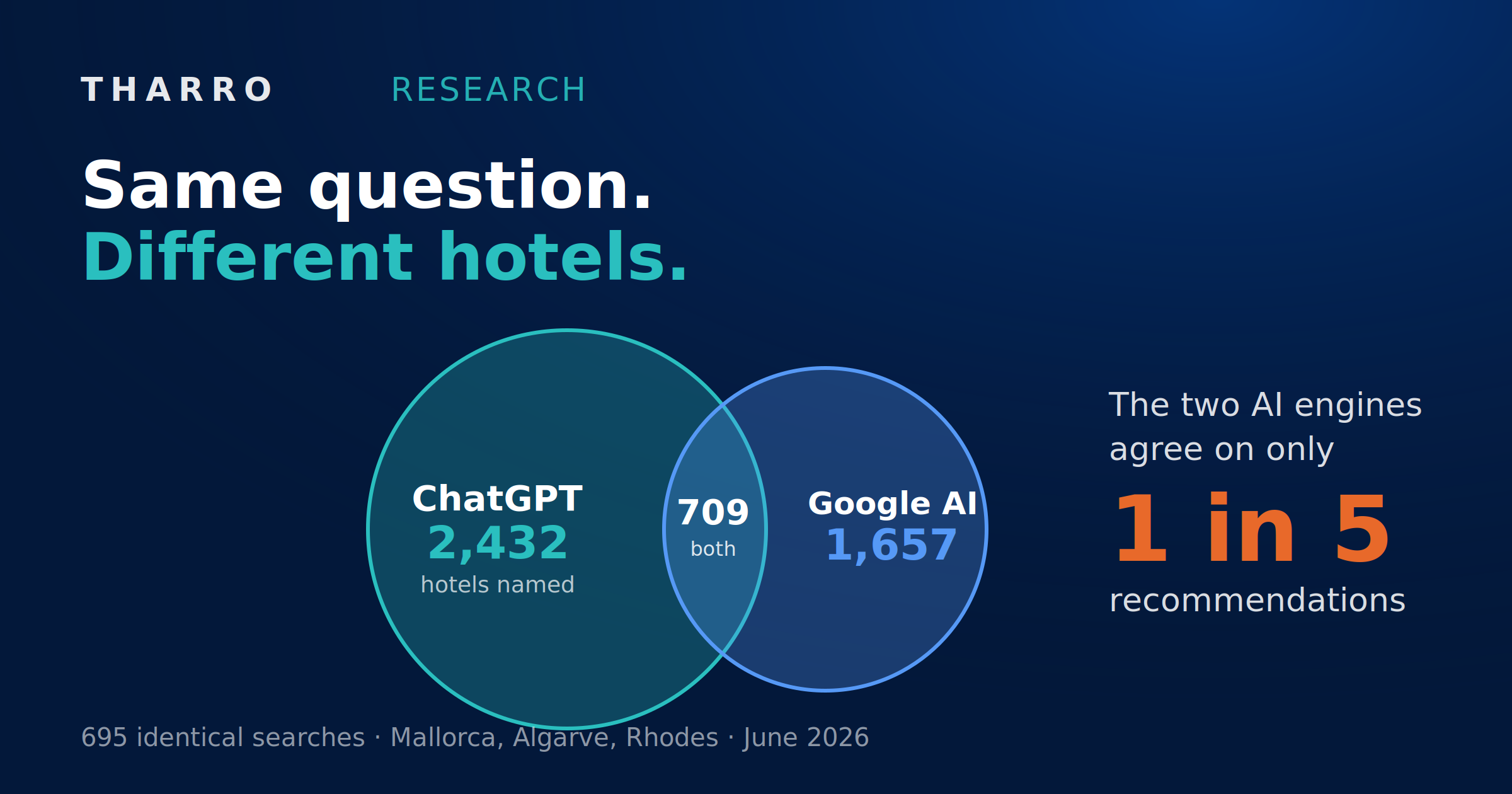
ChatGPT named 2,432 distinct hotels. Google's AI Mode named 1,657. Only 709 hotels were named by both engines.
That's a Jaccard similarity of 0.21 — for the same questions, in the same markets, in the same month, the two engines agreed on roughly one hotel in five. For individual searches the divergence can be total: the two answers to the same question can share no hotels at all.
If a traveller asks ChatGPT, they meet one set of hotels. If they ask Google, they meet a substantially different one. A hotel that is "visible in AI" on one engine can be effectively invisible on the other — and most are.
Why: the engines trust different internets
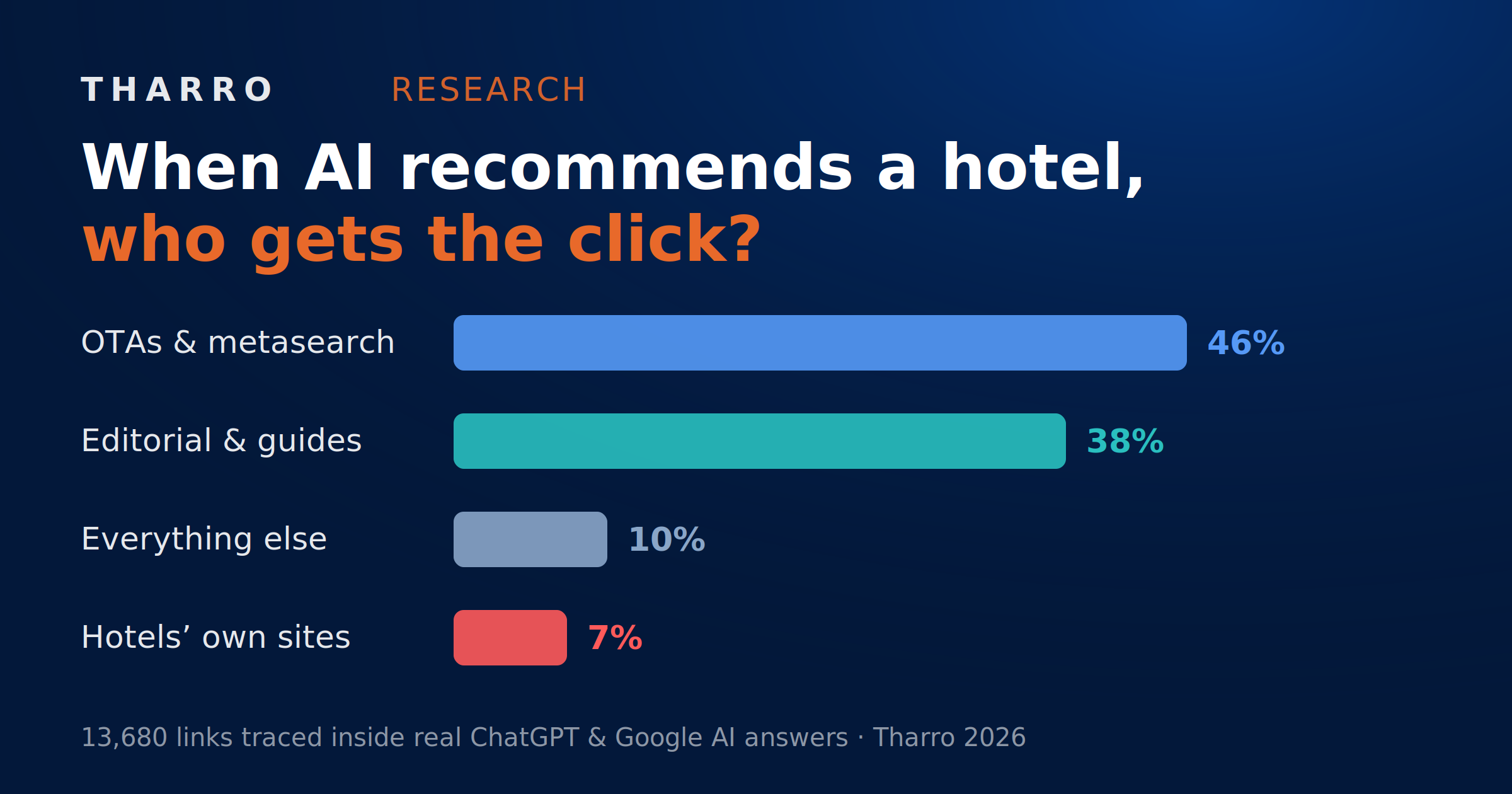
The divergence isn't noise. It follows directly from where each engine sources its answers. We classified every external source the engines cited — 13,680 citation occurrences across 1,587 domains:
| Share of citations | Google AI Mode | ChatGPT |
|---|---|---|
| OTAs | 36.2% | 14.0% |
| Editorial / travel media | 29.2% | 48.9% |
| Metasearch & aggregators | 15.2% | 12.7% |
| Hotels' own websites | 5.8% | 8.3% |
Google's AI Mode is a structural surface: it leans on bookable inventory — OTAs, metasearch, its own hotel entity system — and its recommendations skew toward established, heavily reviewed properties. ChatGPT is a reputation surface: nearly half its citations point at editorial coverage — travel guides, roundups, destination media — plus review platforms. It also spreads its recommendations far wider (2,432 hotels vs 1,657, with two-thirds of its picks named just once).
Same traveller question. Two different source economies. Two different winner lists.
What this means in practice
Stop measuring "AI visibility" as one number. A single AI-mention score hides which engine you're winning and which you're absent from. Track them as separate channels, because they are.
Split the playbook. For Google AI Mode, the levers are structural: a complete Google Business Profile, OTA listing quality, review volume, presence in bookable channels. For ChatGPT, the levers are earned: editorial mentions, destination-media roundups, community presence, review-platform strength. Budget and effort allocated to one buy almost nothing on the other.
Pick the engine that matches your guest. If your bookings skew to travellers who plan inside Google's ecosystem, AI Mode presence is the fight. If your guests are researchers and long-form planners, ChatGPT's editorial-driven answers matter more. Few independent hotels can win both at once — choosing is a strategy, not a failure.
Watch both, because you can't infer one from the other. With 0.21 overlap, your position on one engine tells you almost nothing about your position on the other. The only way to know is to look at the answers themselves, continuously, on both.
Methodology: 695 unbranded search intents across Mallorca, the Algarve and Rhodes; one Google AI Mode and one ChatGPT (web-enabled) answer per intent, collected June 2026 from a UK profile; 10,681 hotel mentions parsed and consolidated into 3,380 named hotel entities; 13,680 external citations across 1,587 domains classified by source type. Findings are cross-sectional. Part of Tharro's 2026 SERP-to-AI carryover research.