Research
AI Hotel Visibility: Mallorca vs Algarve vs Rhodes Compared
Same Google rank, different AI payoff: top-3 hotels get named by AI 56% of the time in the Algarve, 22% in Mallorca. Market-by-market AI visibility data.

Same Google Rank, Different AI Payoff: How AI Treats Mallorca, the Algarve and Rhodes Differently
Every finding about "AI visibility" hides an assumption: that the rules are the same everywhere. They aren't. We ran the identical study across three Mediterranean markets — the same question set, the same engines, the same month — and the same achievement buys dramatically different AI outcomes depending on the island.
The rank-to-AI exchange rate varies by market
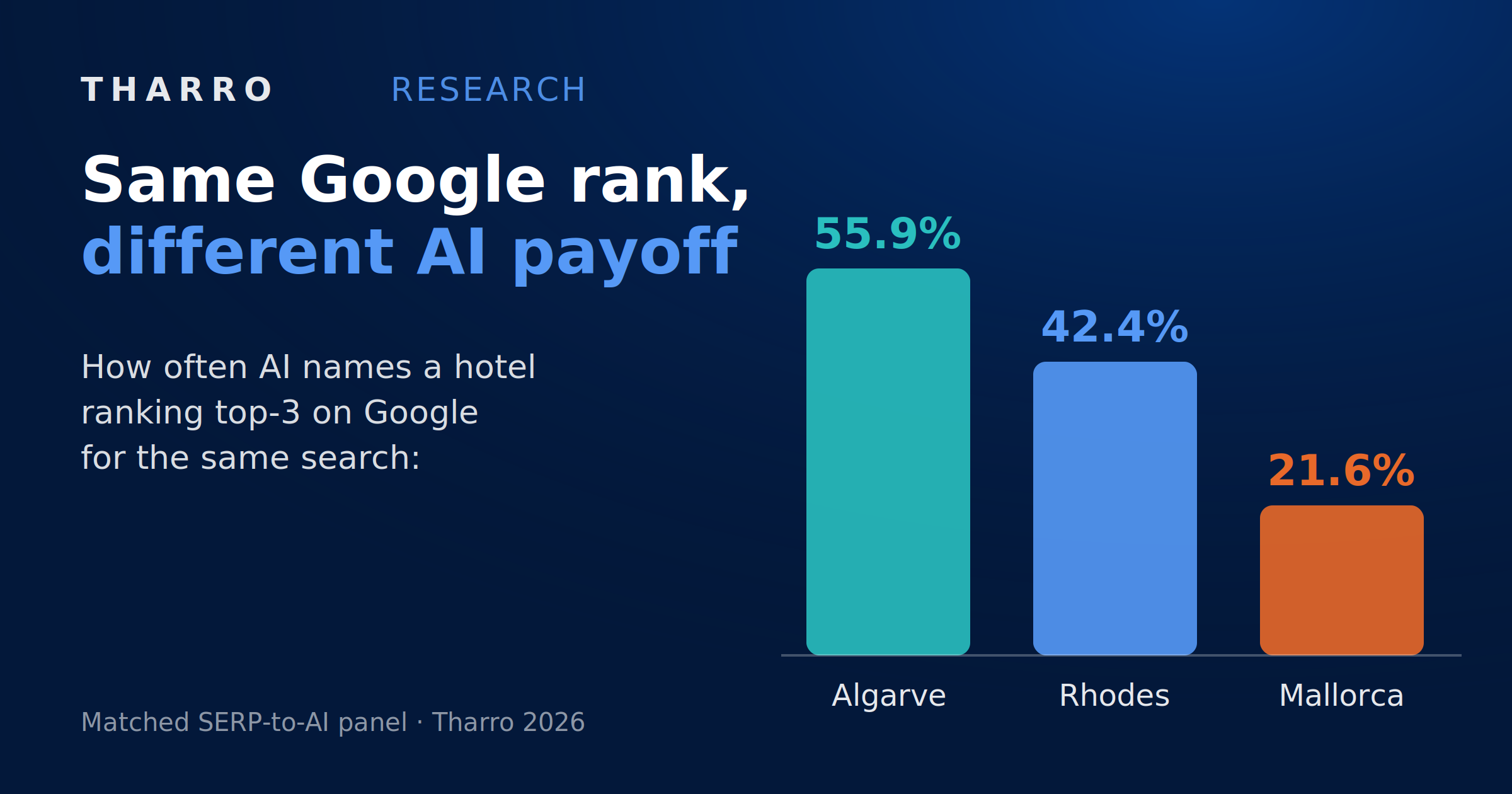
Take a hotel whose own website ranks in Google's top 3 for an unbranded search. How often do AI engines name that hotel for the same search?
- Algarve: 55.9% of the time (falling to 18.8% for hotels ranked 21+)
- Rhodes: 42.4% (falling to 25.5%)
- Mallorca: 21.6% (falling to 12.9%)
In the Algarve, a top-3 Google position converts to AI presence at nearly triple Mallorca's rate. Ranking is a strong AI signal in Portugal, a moderate one in Greece — and in Mallorca, barely half the exchange rate of Rhodes. A Mallorcan hotel that has fought its way to the top of Google gets the least AI credit for it of any market we measured.
Why? Market structure. Mallorca has the deepest, noisiest supply (1,225 different hotels named by AI there) and by far the richest layer of non-hotel sources competing to answer traveller questions — so the engines assemble answers from that layer instead of echoing the ranking. Which brings us to the most interesting finding.
Every island has its own "AI source establishment"
We traced every link the AI engines cited — roughly 5,000 citation occurrences per market — and each destination has a distinct trusted-source hierarchy:
Mallorca: booking.com leads (302 citations) — but the #2 most-cited source about Mallorca is abc-mallorca.com (232), the island's local editorial magazine, ahead of Expedia, Tripadvisor and every other global platform. seemallorca.com also makes the top 12. In Mallorca, local media is AI infrastructure.
Algarve: expedia.co.uk edges booking.com (279 vs 268), and the local layer is thematic: algarveportugaltourism.com (150), algarvetravel.guide (111) and — uniquely among our markets — golfbreaks.com (101). The engines have learned that the Algarve is a golf destination and cite accordingly.
Rhodes: the global platforms dominate the top (booking, expedia, travelmyth, tripadvisor), but the local layer surfaces operators rather than media: beleontours.com (111), rhodesislandhotels.com (76), and the Greek chain domain hhotels.gr (63). Rhodes' AI answers run through the trade.
Three islands, three different definitions of "the sources AI trusts." A visibility strategy copied from one market to another misses the local establishment that actually feeds the machine.
What this means on each island
For Mallorcan hotels: your SEO converts worst, and your local editorial converts best — coverage in abc-mallorca and the island's guide layer is cited more than almost any OTA. The earned-media route to AI visibility is unusually open here, and unusually necessary.
For Algarve hotels: rankings still pay — protect them. And the theme layer is the multiplier: presence in golf, family and beach-holiday sources puts you in the specific pipes the engines drink from. If you have a golf story and golfbreaks doesn't know it, that's a measurable AI-visibility gap.
For Rhodes hotels: the operator and trade layer carries unusual weight — the sources being cited are the ones that package and sell the island. Distribution relationships double as visibility relationships.
For every DMO in between: your destination's local editorial and guide sites are being read by AI as the authority layer for your market. Whether that layer is healthy, current and hotel-rich is now a destination-competitiveness question, not a media question.
Methodology: identical protocol per market — unbranded traveller search intents (Mallorca 249, Algarve 250, Rhodes 196), full ChatGPT and Google AI Mode answers collected June 2026, matched against Google organic results for the same searches; hotel mention rates computed on hotels whose own websites rank for each search; citations traced per market (Mallorca 5,046, Algarve 4,969, Rhodes 3,665 occurrences). Findings are cross-sectional. Part of Tharro's 2026 SERP-to-AI carryover research.