Research
AI Hotel Visibility Isn't Winner-Take-All: 3,380-Hotel Study
Everyone assumes AI concentrates hotel visibility into a few winners. Data on 3,380 recommended hotels says the opposite: wide, shallow, open to independents.

The Biggest Myth About AI Hotel Visibility: That It's Winner-Take-All
The standard fear about AI travel planning goes like this: where Google shows ten blue links, an AI answer shows five hotels — so visibility will collapse into a tiny elite, and everyone else disappears.
It's a reasonable theory. Our data says it's wrong.
We recorded every hotel that ChatGPT and Google's AI Mode named across 695 unbranded searches in Mallorca, the Algarve and Rhodes. If AI were winner-take-all, we'd have found a short list of hotels named again and again.
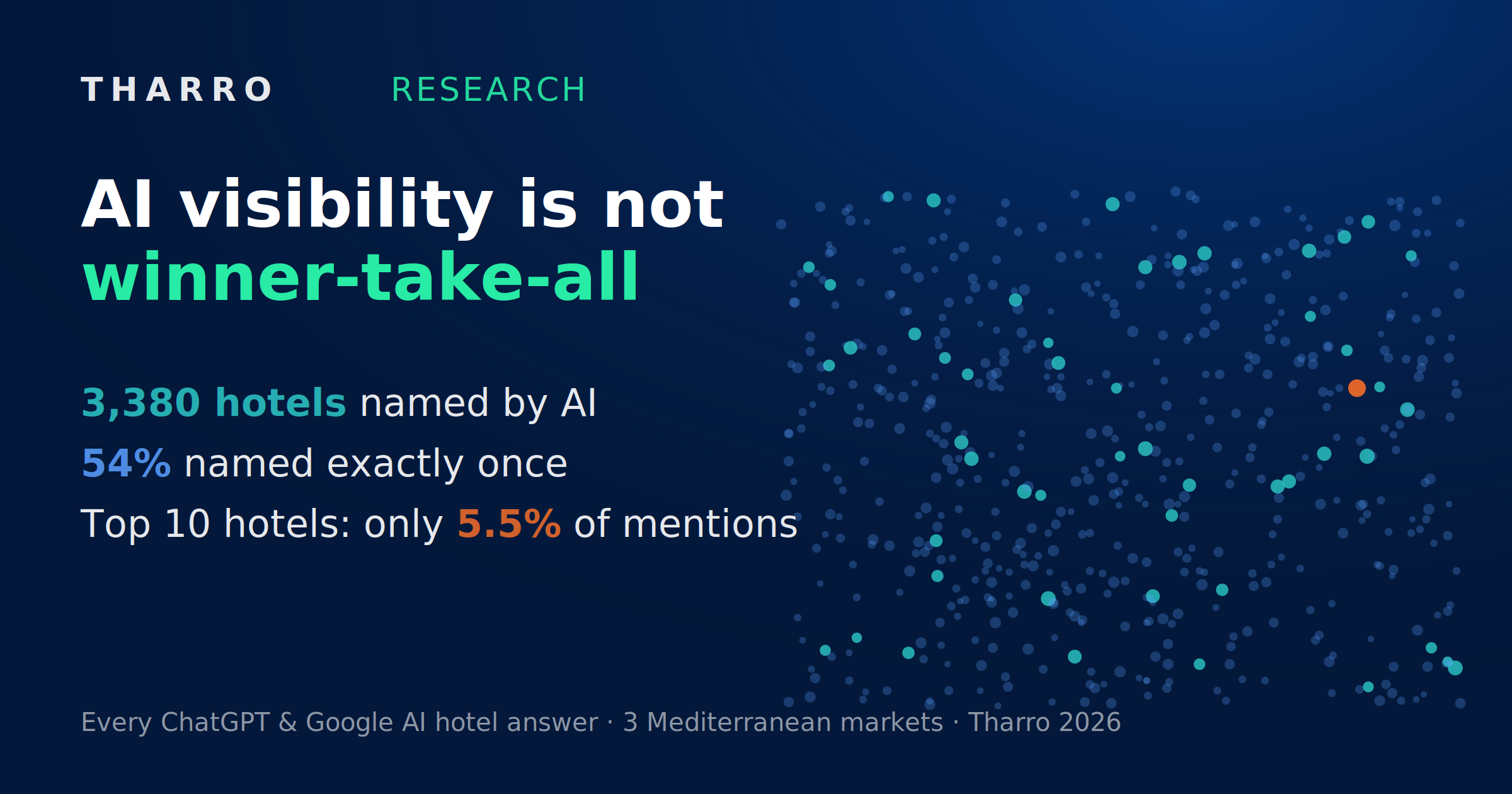
Instead, the engines named 3,380 different hotels.
Wide — and shallow
The distribution is the opposite of concentrated:
- 53.8% of all recommended hotels were named exactly once in the entire study.
- The top 10 most-named hotels account for just 5.5% of all recommendations.
- The Gini coefficient of mention concentration is 0.54 — unequal, but far from the near-1.0 a winner-take-all market would show.
- ChatGPT is the widest sprayer: it named 2,432 distinct hotels, most of them a single time.
AI answers are not a fortress guarded by ten winners. They're a lottery wheel that spins on every question — the same market question asked twice can surface different hotels, and thousands of properties rotate through the answers.
That's simultaneously the good news and the real problem. The good news: the door is open. If more than three thousand hotels across three islands can get named, obscurity is not structural — there is no closed shortlist you failed to make. The problem: presence is unstable. Being named once is not visibility; it's a cameo. What separates hotels that keep appearing from those that flicker once?
What repeat visibility correlates with — and what it doesn't
We matched the named hotels to their business profiles and tested what predicts being named often rather than once:
- Review volume: correlation ρ = 0.34 with naming frequency — the strongest controllable signal we found. The median recommended hotel carries around 550 reviews.
- Establishment class: 76% of the hotels surfaced in AI Mode's answer cards are 4–5 star properties.
- Guest rating quality: ρ = 0.08 — essentially nothing. A 4.7 does not out-appear a 4.3 in any meaningful way.
The pattern is a floor, not a ladder. Being obscure — thin review base, incomplete profiles, invisible in the sources AI reads — keeps you in the named-once crowd. But beyond "established and well-reviewed," pushing metrics higher doesn't buy proportionally more appearances. You cannot polish your way from the floor to the podium, because there is no podium — only the floor, and the wheel.
What independents should take from this
Retire the fatalism. "AI only recommends the big names" is measurably false — half the hotels AI names are named once, and they include guesthouses, fincas and two-star pensions. The competition is not for ten slots; it's for rotation frequency.
Build the floor, not the trophy cabinet. Review volume over rating perfectionism. Complete, machine-readable profiles everywhere AI looks — Google Business Profile, OTA listings, review platforms. The floor signals are boring, and they're the ones that correlate.
Show up in more questions. Wide-and-shallow visibility means the engines assemble answers per question, from theme-shaped sources. A hotel present in the family-holiday sources, the couples sources and the golf sources enters three lotteries instead of one.
Measure frequency, not existence. "We appeared in ChatGPT" is a screenshot, not a metric. The number that matters is how often you appear across the season's worth of questions your guests actually ask — which is a measurable number, and the one to move.
Methodology: 695 unbranded search intents across Mallorca, the Algarve and Rhodes; full ChatGPT and Google AI Mode answers collected June 2026; 10,681 hotel mentions consolidated into 3,380 named entities; 1,006 entities matched to Google Business Profiles for the correlation analysis (Spearman ρ on naming frequency). Findings are cross-sectional and associational. Part of Tharro's 2026 SERP-to-AI carryover research.