Research
Who Owns the AI Answer Surface in Hotel Search?
When an AI assistant recommends a hotel it credits a source. We looked at whose domains those sources belong to. Hotels are rarely the answer.

There is a layer above the answer that almost nobody looks at: the list of sources underneath it.
Ask an assistant for hotel recommendations and you get names. Look slightly lower and you get something more interesting — the sources it drew on. That list is the real competitive surface, and it does not belong to hotels.
The pattern
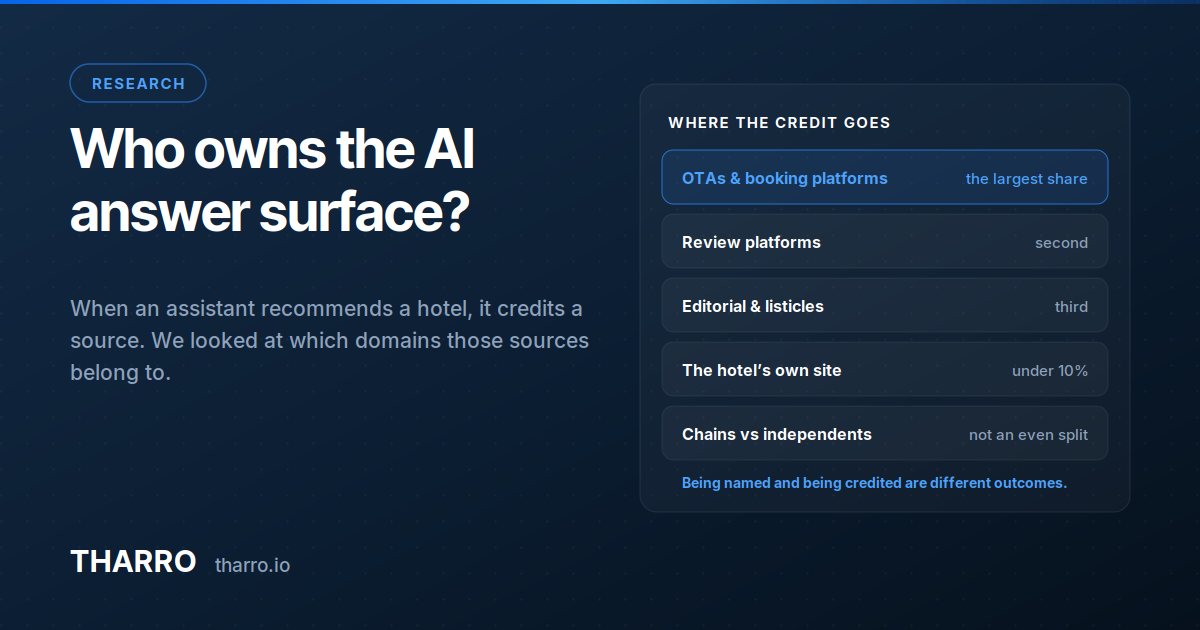
Across AI hotel recommendations we analysed, the sources credited break down consistently: online travel agencies take the largest share, review platforms come second, editorial and listicle sites third, and the hotel's own website is cited in under 10% of cases.
This is the shape of the OTA paradox. Hotels get named more than they expect. They get credited far less. Visibility rises while booking authority stays exactly where it was.
Why the sources skew that way
Three mechanisms, none of them conspiratorial.
Volume. An OTA listing page for one hotel carries dozens of structured facts, hundreds of reviews and a price. The hotel's own room page carries a gallery and four bullets. A model retrieving information about that property finds more of it in one place.
Freshness. OTA listings change daily. Hotel websites change quarterly at best. A retrieval system that weights recency is weighting against you by design.
Readability. Many hotel websites do not render their content without JavaScript. An OTA page nearly always does. If your page arrives empty, it cannot be cited no matter how authoritative it is.
Chains and independents are not in the same position
The split is not even. Chain properties benefit from a brand-level entity that assistants already recognise, from consistent listing data across every property, and from a corporate site with real depth behind it. An independent hotel arrives with none of that and is assembled almost entirely from third-party sources.
This has a strategic implication that runs against instinct. For an independent, the fastest route to AI visibility is usually not the website — it is the third-party sources the model actually reads. Listing accuracy, review depth across more than one platform, and editorial presence do more, sooner, than a homepage rewrite.
The website work still matters. It is what converts a mention into a citation, and citation is what protects margin. But it is second in sequence, not first.
What this means for the way you measure
If you track only whether you are mentioned, you are watching half the board. A hotel can climb steadily in mention rate while every one of those mentions credits Booking.com — which is a marketing win and a commercial non-event.
Measure both, separately: mention rate and citation rate, with citations recorded by source type. The gap between them is the number that maps to margin.
Three things worth doing
Audit the sources, not just the answers. For your top unbranded prompts, record which domains get credited. That list tells you where to work — and it is usually four or five domains, not the whole web.
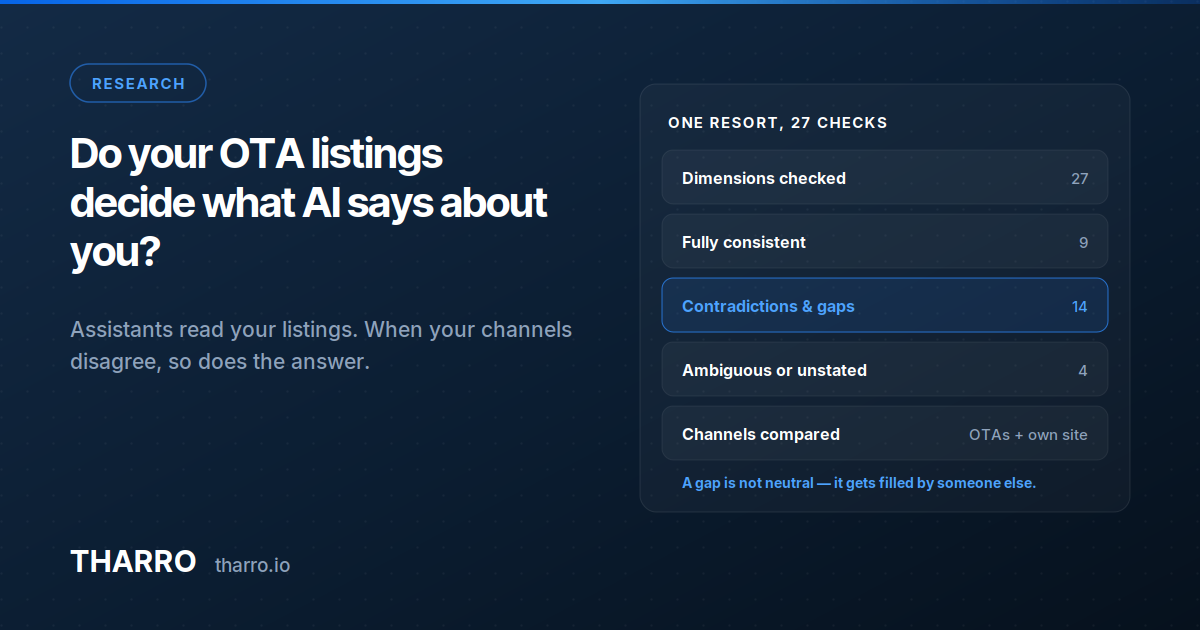
Fix the source that is easiest to fix. Your OTA listings are entirely under your control and are read constantly. Contradictions between channels propagate directly into what assistants say about you.
Then make your own site citable. Readable without JavaScript, substantive on the pages that carry your argument, structured data present. That is what moves you from named to credited.
FAQ
Does being cited actually change bookings? It changes who the booking is attributed to. A recommendation credited to an OTA tends to route through one; a recommendation credited to your site sends the traveller to you. The revenue difference is the commission.
Can a small independent compete here? Yes, and often faster than in classic SEO — the sources assistants read are fewer and more fixable than a whole SERP. Listing accuracy and review depth are within reach of any property.
Which sources should I prioritise? The ones actually credited for your prompts. It varies by market. Measure before deciding.
Do assistants prefer OTAs deliberately? No. They favour sources that are dense, current and readable. OTA pages happen to be all three.
Want to see which sources AI assistants credit when they answer questions about your hotel? See how Tharro measures it or book a 30-minute call.