Growth
Hotel Keyword Clusters: Which Searches Are Worth Winning
Most hotel keyword lists are inherited and never audited. Five verdicts turn a list of terms into a set of decisions you can act on.

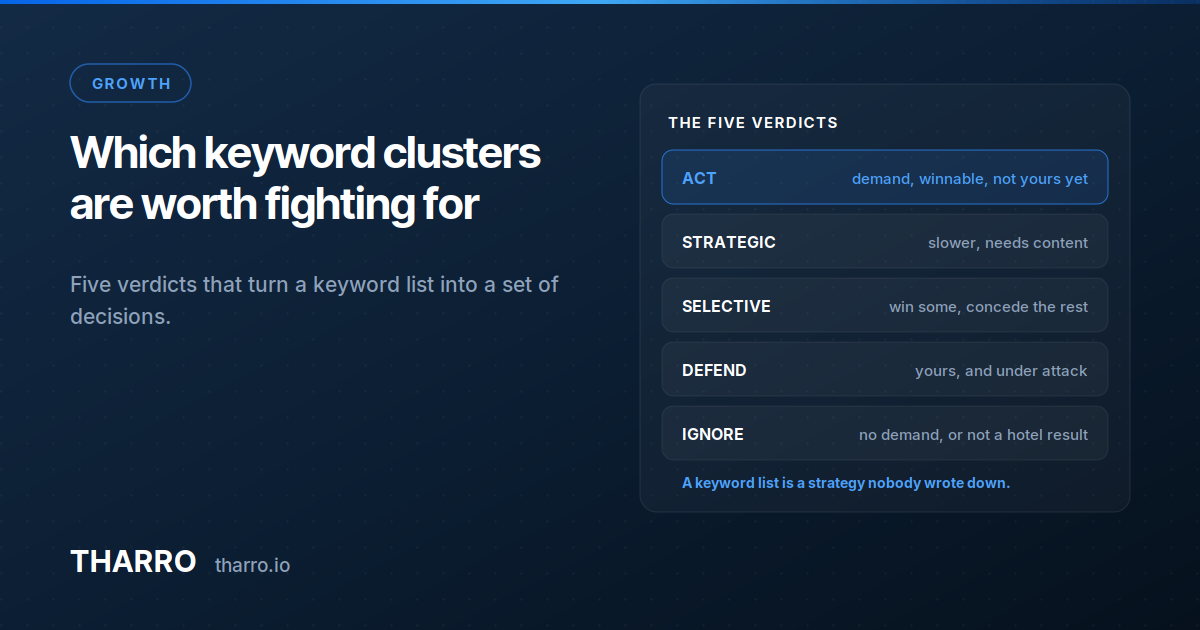
A keyword list is a strategy. Almost nobody treats it like one.
Your hotel tracks a set of search terms. Somebody assembled it — an agency, a predecessor, a tool's default suggestion — and it has quietly defined what "our search visibility" means ever since.
Nobody has audited it since. In the sets we look at, that shows: a third of terms carry no measurable demand, a large share of the volume sits on queries no hotel can win, and competitor brand names pad the count without ever producing an action.
The problem with ranking reports
A rank report answers "where are we?" for every term equally. It cannot answer "should we care?", so every red arrow looks like a problem and every green one like a win.
That produces two specific failures. You spend months on terms you were never going to win, because the natural winner is an encyclopedia or a wedding portal. And you ignore terms you are one decent page away from taking, because they sit at position 14 among a hundred other position-14s.
Clustering fixes the first half — grouping terms that return substantially the same result set, because they are one decision, not twelve. Verdicts fix the second.
Five verdicts
ACT — real demand, a result a hotel can realistically win, and you are not there yet. These are the fights worth having. There should be few of them; if a third of your clusters are ACT, the criteria are too loose.
STRATEGIC — worth pursuing, but slowly. Usually needs a genuine content asset rather than an on-page tweak, and pays back over quarters. The trap is treating these as ACT and giving up in six weeks.
SELECTIVE — a cluster where you can win some terms and should concede the rest. Pick the ones that convert, ignore the head term. This verdict exists because "win the cluster" is often the wrong ambition.
DEFEND — you hold it and someone is bidding or ranking against you. Frequently branded. Cheap to protect, expensive to lose, and invisible on a report that only shows movement.
IGNORE — no demand, or a result type hotels don't win. Getting a term to IGNORE is a win: it removes a permanent red arrow from a report and frees the attention it was consuming.
What a verdict has to show to be trusted
A verdict with no evidence behind it is just an opinion with a label. Each one should carry:
- The demand — real monthly volume in the relevant source market, not a rank-derived estimate
- Your position, and which specific term in the cluster it refers to
- Who is above you, by domain type — because position eight among OTAs is a different situation from position eight among hotels
- What changed since the last cycle, marked as movement and not confused with "new"
Without those, you cannot argue with a verdict. Being able to argue with it is the point.
The three keyword types are three different jobs
Collapsing them into one report is how a strong brand hides a weak unbranded position.
Branded terms measure defence. You will rank first; the question is who else is on the page.
Unbranded terms measure competition. This is where new guests come from and where a hotel's real standing lives.
Competitor-branded terms are a conquesting decision most hotels have never consciously made. Worth deciding either way rather than leaving them in the list unverdicted.
Where to start
Take your current list and do three passes. Strip everything with no measurable demand — note how many, it is usually the first surprise. Group what remains by result overlap rather than by topic. Then, for each group, ask whether a hotel can win that result at all.
Whatever survives is your actual keyword strategy. It will be much smaller than the list you started with, and it will be the first version anyone wrote on purpose.
FAQ
How many clusters should a hotel have? Typically twenty to forty for a single property in one market. If you have hundreds, they are topics rather than clusters.
How do I decide cluster membership? By result overlap. If two terms return substantially the same page of results, one action affects both.
How often do verdicts change? Weekly is right. Movement matters; noise doesn't. A cluster that flips verdict every week has criteria set too tightly.
Should paid and organic share clusters? Yes. The buy-or-earn decision is easier when both sit against the same demand and the same competitive picture.
Want your keyword set audited and verdicted against real demand? See how Tharro does it or book a 30-minute call.