Growth
Hotel SEO in the AI Era: What Still Matters and What Stopped
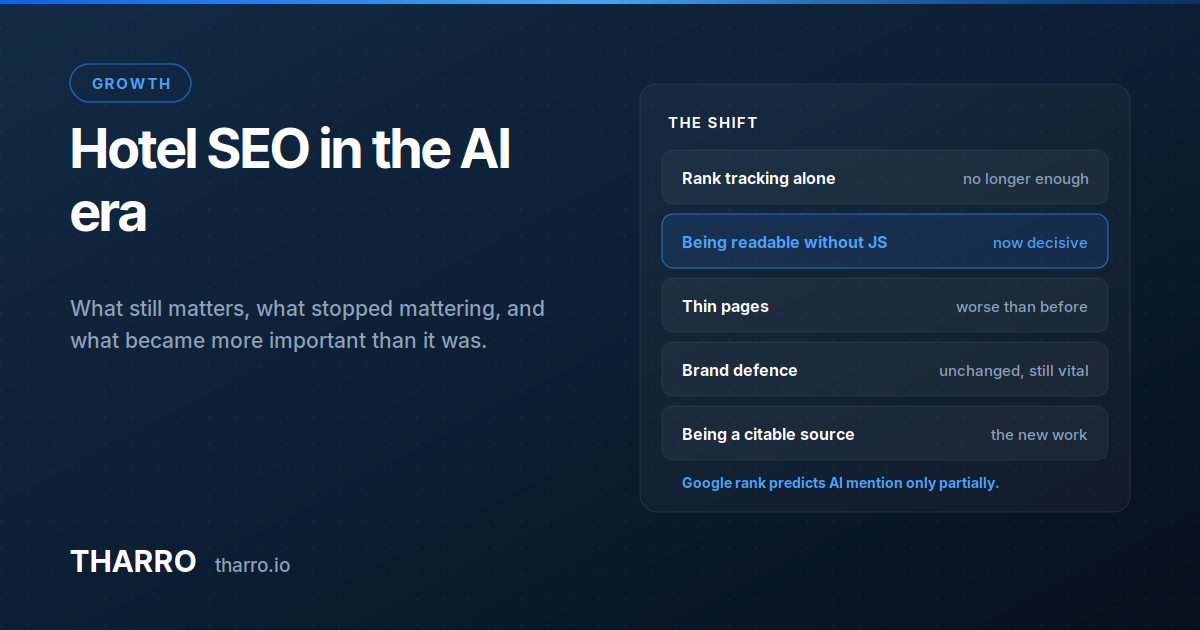
Rank tracking alone stopped being enough. Being readable without JavaScript became decisive. An honest account of what changed in hotel SEO and what didn't.

Most of what you were told about hotel SEO is still true. The parts that changed, changed completely.
There is a genre of article claiming SEO is dead, published annually since about 2011. This is not one of those. Search still sends more travellers to hotels than any other channel, and most classic SEO advice still works.
But three things genuinely shifted, and pretending otherwise costs money.
What stopped mattering
Rank tracking as the whole picture. A position is now a position within a result that may contain an AI Overview, a hotel pack, four ads and a map before any organic link. Ranking third means something different than it did, and the click curve behind most reporting was calibrated on a page that no longer exists.
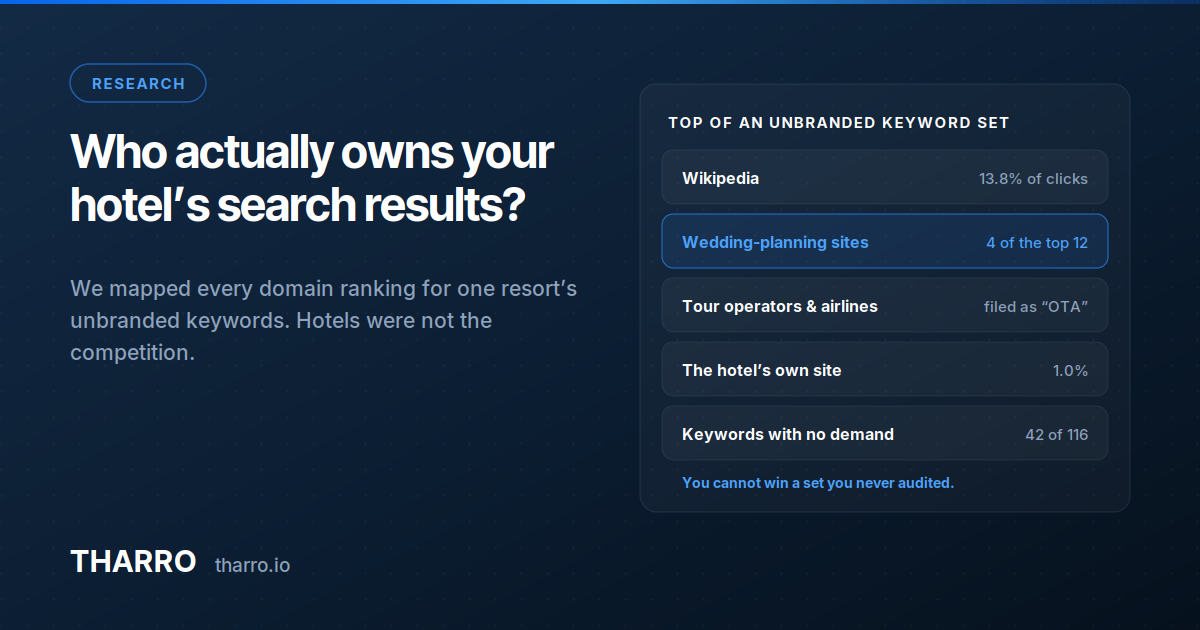
Keyword volume as the primary sort. The highest-volume term in a hotel's set is frequently one no hotel wins — a destination query owned by an encyclopedia or a portal. Sorting by volume sorts by unwinnable-ness surprisingly often.
Thin pages doing anything at all. A room page with a gallery, a price and four bullets used to rank on the strength of the domain. It now has nothing for a retrieval system to work with, and increasingly nothing for Google either.
What still matters, unchanged
Technical health. Crawlability, status codes, canonicals, speed. Boring, still foundational, still the thing most often broken after a redesign.
Brand defence. People searching your name are your highest-intent traffic and the cheapest to lose. Who else appears on your branded results is a question with a direct revenue answer.
Genuinely useful content. Not "content" as a volume exercise — actual answers to what travellers ask. This mattered before and matters more now, because a page that answers a question well is a page that can be quoted.
Internal linking. Still how a search engine understands what your site is about, and now also how a retrieval system finds the page that answers a specific question.
What became decisive
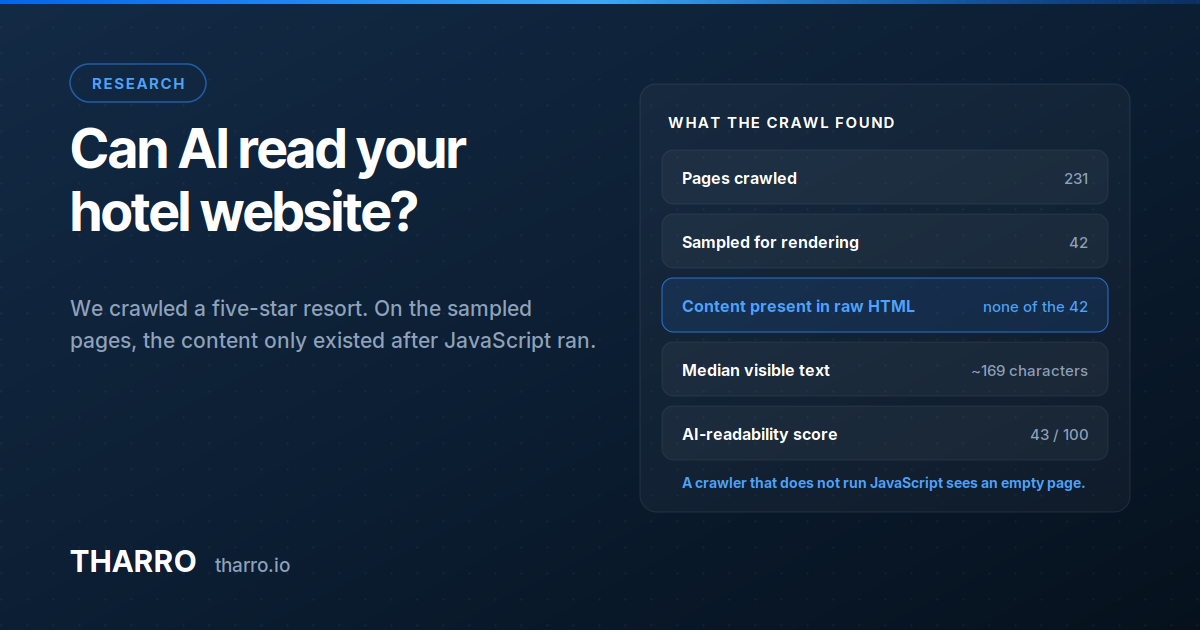
Whether a machine can read your site without running a browser. This is the big one. Googlebot renders JavaScript and mostly copes. Several AI crawlers do not, and live retrieval is time-constrained. We crawled a five-star resort and found that on the sampled pages, the content did not exist in the raw HTML at all — invisible to anything not running a full browser, while its Google rankings looked perfectly healthy.
Being a citable source rather than a ranking one. Ranking gets you a click. Citation gets you credited when an assistant answers on your behalf. These are different outcomes with different work behind them, and a hotel's own site is the cited source in under 10% of AI recommendations.
What third parties say about you. Search has always been partly off-page. AI answers are overwhelmingly off-page: they are assembled from OTA listings, reviews and editorial coverage far more than from your website. Your listings are now source material, not just a shopfront.
The uncomfortable overlap
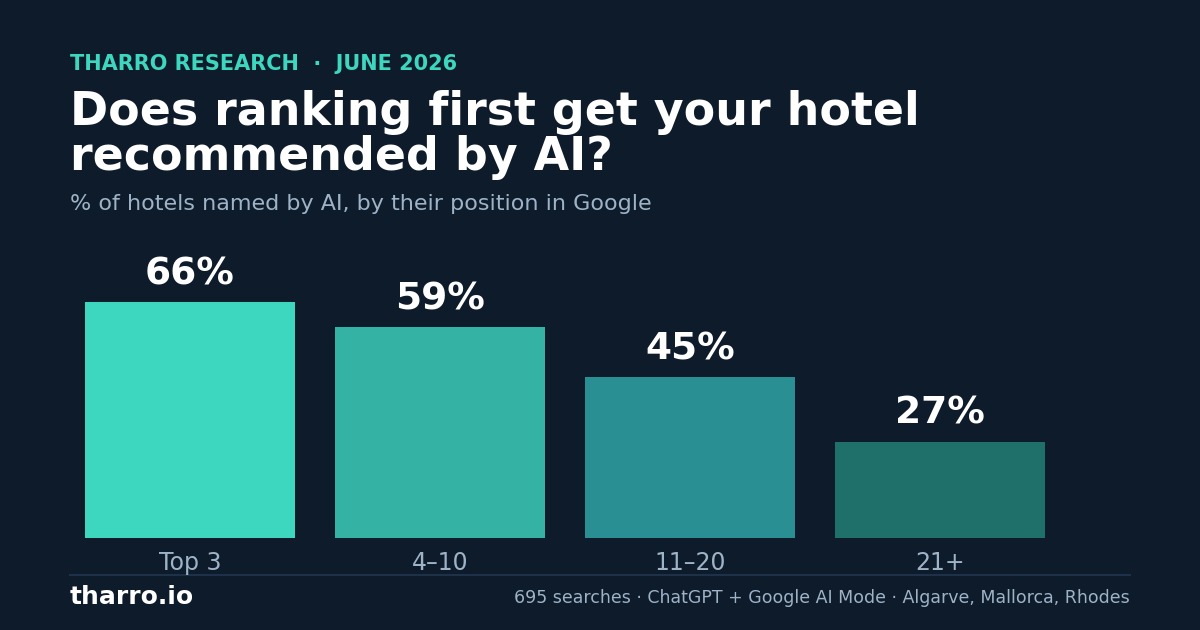
Google rank and AI mention are related but not the same. Our research found that ranking well predicts AI visibility only partially — strong search positions help and guarantee nothing, and the assistants disagree with each other as much as they disagree with Google.
Practically: you cannot infer your AI standing from your rank report, and you cannot fix it by doing more of the same SEO. There is overlap in the work — readable pages, real content, accurate structured data serve both — but there is also work that only serves one.
What to do differently
Audit whether your pages render server-side. One command, five minutes, and it is the single most common blocker.
Sort your keyword set by winnability before volume, and give each cluster a verdict rather than a position.
Measure the two surfaces separately. Rank reporting and AI visibility measurement answer different questions; one report claiming to do both usually does neither.
And put real effort into the sources that aren't yours. It is the least satisfying recommendation in hotel marketing and currently the highest-yield.
FAQ
Is SEO still worth investing in for hotels? Yes. Search remains the largest discovery channel. What changed is that it is no longer the only one worth measuring.
Will AI Overviews kill hotel organic traffic? They reduce clicks on informational queries most. Transactional and branded queries are far less affected. Measure your own mix rather than the headline.
Should I hire an SEO agency or an AI visibility specialist? Mostly the same skill set, applied to a wider surface. Ask any candidate how they would check whether your site renders without JavaScript — the answer is diagnostic.
How long before AI visibility work shows results? Listing and review work can move within weeks. Website readability moves as crawlers refresh. Editorial presence takes months.
Want your search and AI visibility measured on the same page, against the same competitors? See how Tharro does it or book a 30-minute call.