Research
Who Actually Owns Your Hotel's Search Results?
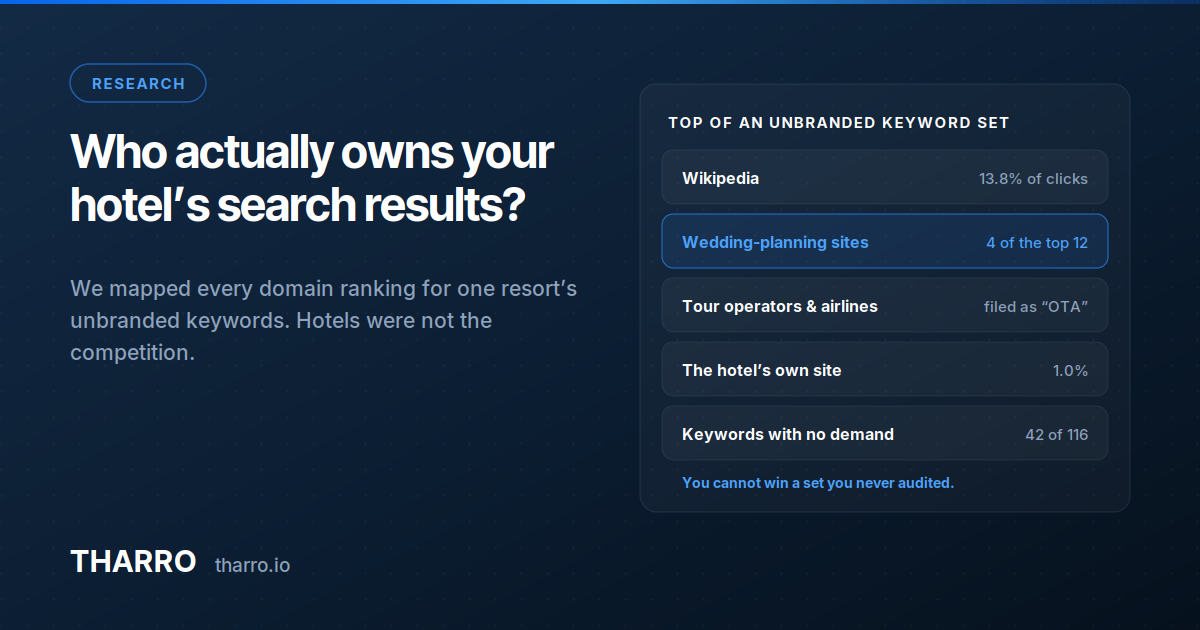
We mapped every domain ranking across one resort's unbranded keyword set. Wikipedia led it, wedding sites took four of the top twelve.

Hotels track their rankings. Very few track who is standing above them, and it is rarely who they expect.
Ask a hotel who it competes with in search and you get the comp set: the four or five properties down the road. Ask what it tracks and you get positions for a list of keywords.
Neither of those tells you who is actually taking the clicks. We mapped every domain appearing across the unbranded keyword set of a five-star Mediterranean resort — 116 keywords, roughly 14,000 monthly searches, one source market — and ranked the domains by estimated share of clicks.
The comp set barely featured.
What the map showed
Wikipedia was the single largest recipient of clicks in the set, at just under 14%.
Four of the top twelve domains were wedding-planning sites. One of them held a third of the clicks on the wedding-related terms, which by themselves accounted for about a third of the entire unbranded pool — nine keywords out of 116 carrying a disproportionate share of the volume.
Tour operators and an airline appeared throughout, filed in most tooling under the generic label "OTA".
The hotel's own website captured about 1% of the clicks available across its own tracked keyword set.
42 of the 116 keywords had no measurable search demand at all — a third of the tracked set was inert.
Three things worth taking from that
The keyword set is a strategic decision disguised as an admin task
That 1% figure looks like a performance number. It mostly isn't. It is a statement about what got tracked.
A third of the set had no demand. Another third of the volume sat in wedding queries — a category where the natural winners are planning portals, not hotels, and where a hotel's realistic ceiling is low regardless of effort. The set was assembled at some point by someone reasonable, and it quietly determined what "our search visibility" would mean forever after.
Before optimising a set, audit it. Which terms have demand. Which are winnable by a hotel at all. Which are there because someone added them in 2023.
Some SERPs are not lost — they were never yours
Wikipedia ranking first for destination queries is not a competitive failure. Neither is a wedding portal owning wedding-planning terms. Those are informational searches, and the results are correct.
The mistake is treating every SERP the same way. A useful keyword set separates three things: terms you can realistically win, terms you should defend because they carry your name, and terms where the right move is to appear in someone else's result rather than to outrank it. Getting listed in the wedding portal is a better play than trying to outrank it — and it's a play nobody makes while the report shows position 14 and a red arrow.
"OTA" hides your actual competition
Tour operators and airlines are not OTAs. They buy differently, they rank for different reasons, and they convert differently. Grouping them together produces a tidy pie chart and a wrong strategy.
In most hotel-market tooling, the taxonomy has five or six buckets and everything commercial that isn't a hotel gets called an OTA. So a tour operator sitting third on your most valuable terms — a partner you might already work with — reads as an OTA you should be fighting. Understanding who really owns the SERP starts with a domain taxonomy that reflects hotel distribution rather than generic web categories.
How to run this on your own market
You do not need a platform for a first pass, though you do need a couple of hours.
- Take your unbranded keyword set. Just unbranded — branded terms will tell you that you rank first for your own name, which is not information.
- Strip the terms with no demand. Anything with no measurable volume comes out. Note how many that is; it is usually the first surprise.
- For each remaining term, record the top ten domains. Not your position — the domains.
- Weight by search volume and an approximate click curve so a first position on a 4,000/month term outweighs a first position on a 20/month term.
- Categorise the domains honestly. Hotel, OTA, metasearch, tour operator, editorial, informational, destination site. Resist the urge to compress.
What comes out is a picture of who owns the market's attention. It is usually uncomfortable, and it is far more useful than a rank report — because it tells you where to fight, where to partner and where to stop spending.
The pattern underneath
The resort above was not badly optimised. It ranked respectably on the terms it was tracking. It had an agency, a content plan and a reporting cadence.
What it did not have was a view of who else was in the room. Its search reporting answered "where do we rank?" every month, competently, and never once answered "who is taking the clicks?" — a different question with a completely different set of actions attached.
Most hotel search reporting has the same shape. It is not wrong. It is just answering a question that was framed before the SERP filled up with everyone else.
FAQ
Why exclude branded keywords? Because you win them by default. Branded performance is worth watching as a defence problem, but it tells you nothing about competitive standing.
Isn't Wikipedia ranking first normal? Entirely. That's the point — it means those clicks were never available to you, and a report that counts them as lost is misleading you about the size of the opportunity.
How many keywords should a hotel track? Fewer than most do. A hundred terms with demand, relevance and a realistic hotel ceiling beats six hundred that include every competitor's brand name.
What is a realistic click share for a hotel on unbranded terms? It depends heavily on the market and on what the SERP contains. The number matters far less than its direction and how it compares to the hotels you lose bookings to.
Does this change with AI Overviews in the results? Yes, and it makes it more pressing. AI Overviews push organic results down and change the click curve, so a position that used to earn traffic may now earn very little. Worth measuring separately.
Want to see who owns the search results in your market — by domain, by source market, organic and paid? See how Tharro maps it or book a 30-minute call.