Growth
Marketing Intelligence vs Revenue Management for Hotels
Revenue management optimises the demand you already receive. Marketing intelligence decides whether you receive it. Where the line sits.

Every hotel with an RMS has been told it has demand covered. It has half of it covered, and the half it's missing is the one that happens first.
Revenue management is the most mature discipline in hotel commercial operations. It has decades of theory, real science, dedicated software and, in most hotels above a certain size, a person whose entire job it is.
Hotel marketing intelligence is newer, less defined, and frequently assumed to be a subset of the same thing. It isn't. The two systems answer different questions, and the gap between them is where a specific and expensive class of mistake lives.
The line
Revenue management optimises the demand you already receive.
Given the bookings coming in, the pace against last year, the pickup curve and the competitive rate picture — what should tonight's room cost, how many should be held for later, which channel and which length of stay should be favoured?
Marketing intelligence decides whether you receive it in the first place.
Given that demand exists somewhere — is it reaching you? Do travellers in that market find you on Google? Does an assistant name you when someone asks for a hotel like yours? Does your listing say the same thing everywhere? Does your reputation hold up against the four hotels you're compared with?
One works on conversion of visible demand. The other works on whether you are visible to the demand at all. Both are necessary. Neither substitutes.
What falls through the gap
The failure mode is specific and it is common:
Your German market is down 20% year on year. The RMS sees it as softness and responds correctly — it adjusts rates, shifts inventory, protects the pace. That is the right response if the market is genuinely softer.
But there are three quite different situations that look identical on a pickup report:
- German demand for your destination actually fell.
- German demand is flat, and you lost visibility — your Google position slipped, or an assistant stopped naming you to German travellers.
- German demand rose, and a competitor took the additional share.
The RMS cannot distinguish them, because it only sees the demand that arrived. In case one, discounting is correct. In cases two and three, discounting is expensive and does nothing about the cause — you have made a visibility problem cheaper rather than fixed it.
Telling those three apart requires market demand data and your own visibility data, read side by side. That is the marketing intelligence job, and it's why reading demand and visibility together matters more than either alone.
Who owns which decision
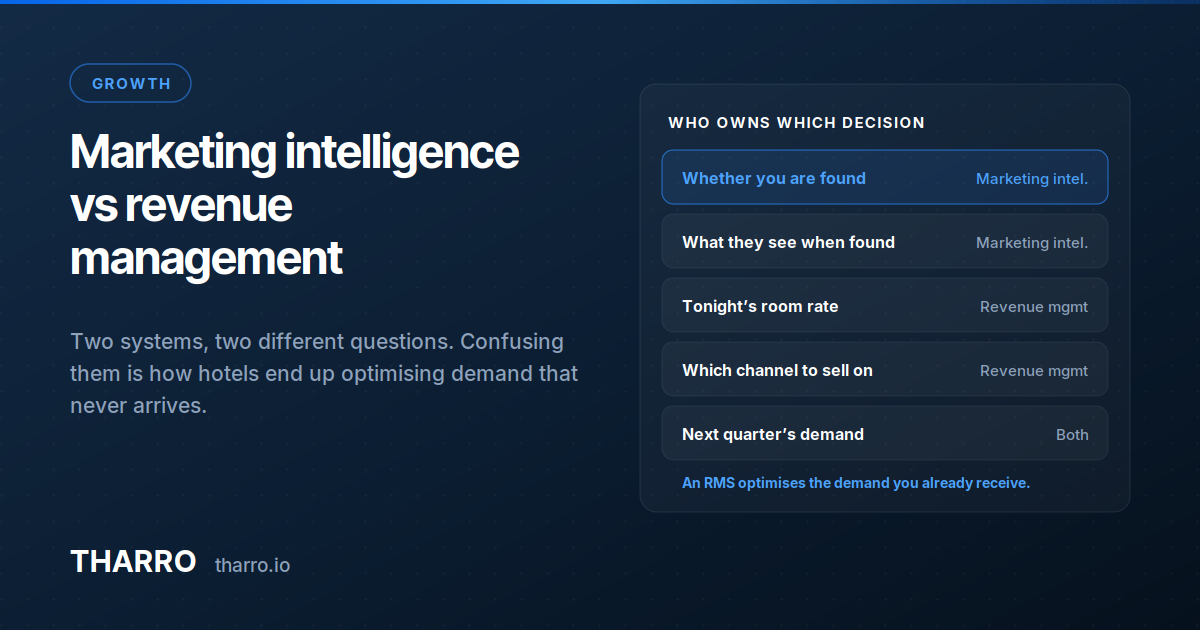
| Decision | Owner |
|---|---|
| Whether travellers can find you | Marketing intelligence |
| What they see when they do | Marketing intelligence |
| Whether your listing and reviews hold up against the comp set | Marketing intelligence |
| Tonight's rate | Revenue management |
| Length-of-stay and channel controls | Revenue management |
| Overbooking and inventory allocation | Revenue management |
| Where demand is going next quarter | Both — from one board |
The last row is the interesting one. Forward demand is genuinely shared: an RMS wants it to set rate strategy, marketing wants it to decide where to be visible and when. Most hotels have it in neither system, or in two systems that disagree.
Why this is becoming urgent
Revenue management matured in a world where discovery was relatively stable. Travellers searched Google or went to an OTA. Visibility was a slow-moving variable, so treating it as a constant and optimising the rest was reasonable.
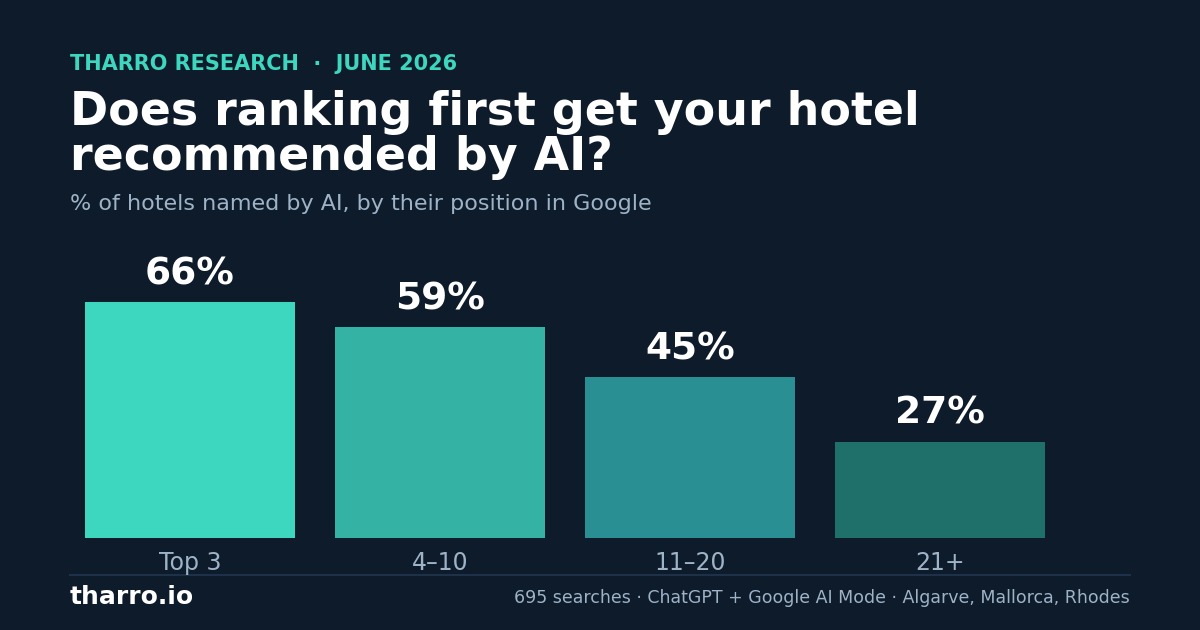
That assumption has broken. Discovery now runs across search, OTAs, metasearch, social and AI assistants — and the surfaces disagree. Our research found that Google ranking only partially predicts whether an AI assistant recommends a hotel, and the assistants barely agree with each other. Visibility is now a fast-moving variable that a hotel can lose in a quarter without anything appearing on a pickup report until the damage is done.
Meanwhile the intermediaries you compete with run both systems as one. An OTA does not separate "should we be visible for this query" from "what should this room cost" — it optimises them together, in real time, with the same data. Hotels running a sophisticated RMS and no visibility layer are bringing half a system to that.
What this means practically
You do not need to choose. You need to stop assuming one covers the other.
If you have an RMS and no marketing intelligence, you are optimising a funnel without knowing its width. The specific test: when a market softens, can you tell whether demand fell or you lost share? If not, that's the gap.
If you have marketing intelligence and no RMS, you can drive visibility and still leave money on the table when it converts.
If you have both but they never meet, the failure is quieter. Revenue sets strategy from pace. Marketing sets budget from last month's report. Nobody notices that the market where marketing is spending is the one revenue quietly wrote off in January.
The practical fix is not a system. It is a standing meeting where forward demand, current visibility and rate position are read off the same page — and one board that both functions accept as the source.
FAQ
Does marketing intelligence replace an RMS? No. They operate on different stages of the same funnel. An RMS optimises demand that has arrived; marketing intelligence works on whether it arrives.
Can an RMS tell me if I'm losing visibility? Not directly. It sees the outcome — fewer bookings — without the cause. Softer demand and lost share look the same on a pickup report.
Which should a smaller hotel buy first? It depends on where the loss is. If you're full at rates below the market, that's a revenue problem. If you have availability while the market is busy, that's a visibility problem. Diagnose before buying.
Where does a channel manager fit? It's distribution plumbing — it moves inventory and rates to channels. It doesn't tell you whether travellers see you on those channels, or anywhere else.
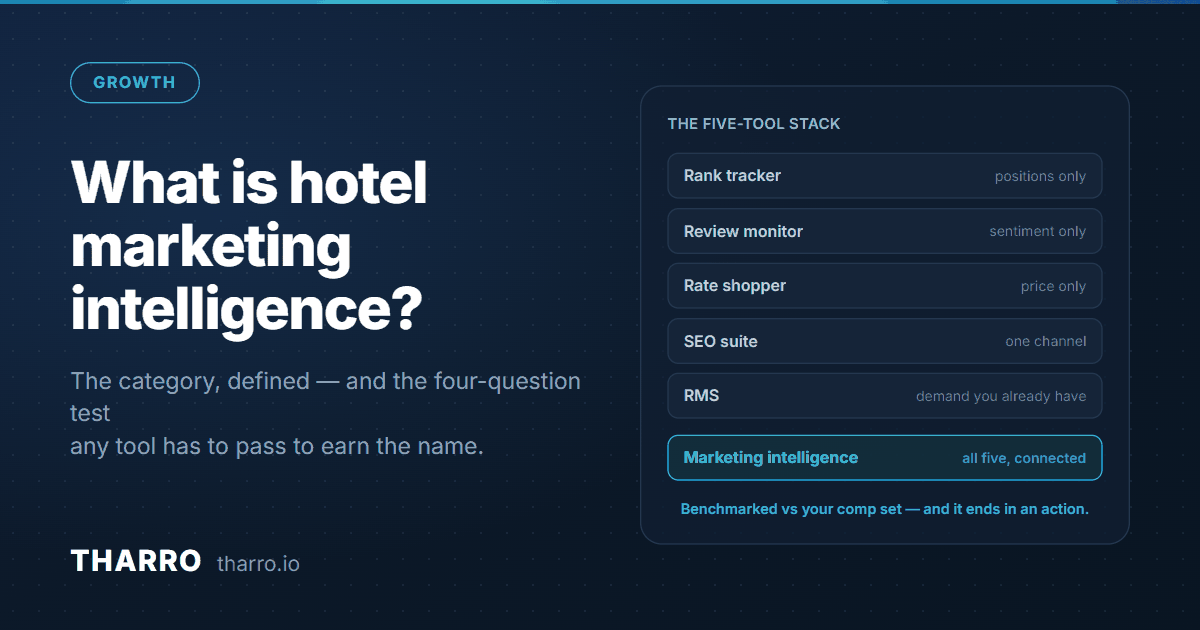
Isn't this just marketing reporting with a better name? The test is in the definition: connected across channels, benchmarked against your actual comp set, and ending in a prioritised action. Reporting that does none of those is reporting.
Want demand, visibility and price position on one board — benchmarked against your comp set? Explore the platform or book a 30-minute call.