Research
Hotel Source Market Analysis: What Each Country Searches For
167,000 travel searches, four source markets: Poles type “all inclusive”, Brits type villas, Germans type beaches. How to market to each source market.

Reading 5 of The Mediterranean Pulse · August 2026. The canonical version of this study lives at tharro.io/research.
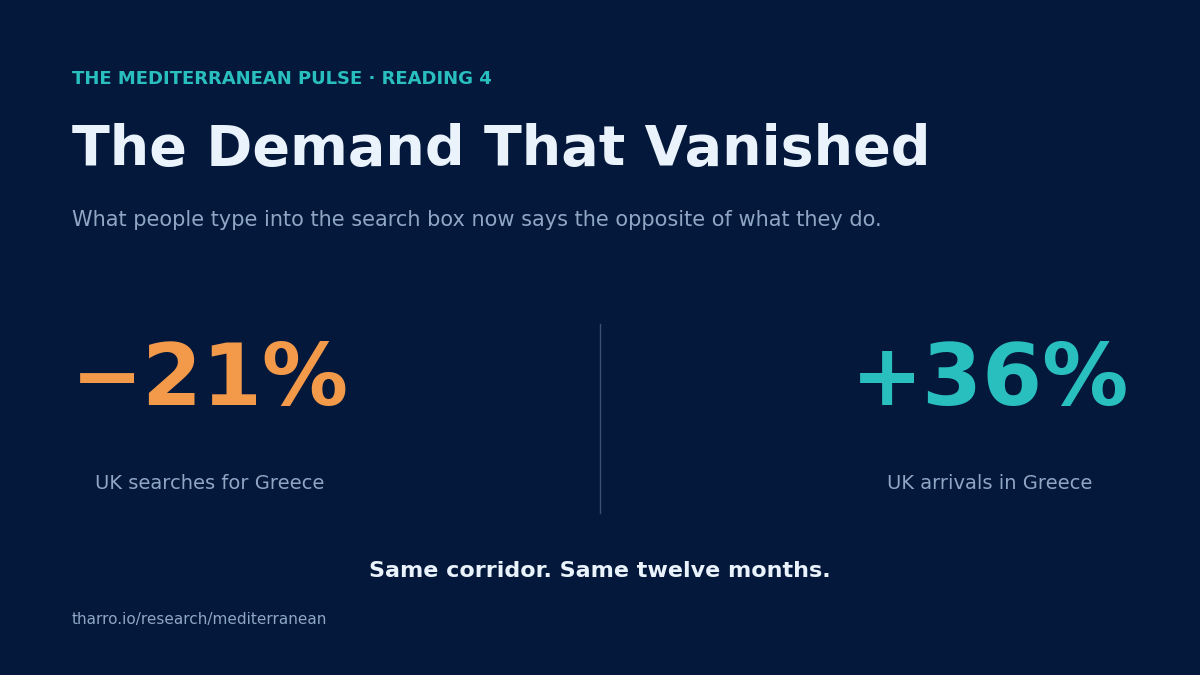
Reading 4 showed that the volume drained out of the search box. Before we leave it behind, one more thing it can still do: tell you how each market thinks — because roughly one search in eight names the kind of holiday it wants. Family. All-inclusive. Villa. Golf. Budget. Luxury.
We tagged those searches across our full universe — 167,000 destination-pointing keywords in the UK, Germany, Poland and Sweden — and read the mix per market, per destination. The result is a map of how each country imagines each place. It is not the same map twice.
The package gradient: new markets type the product, old markets type the place
The single cleanest divide in the data. Share of intent-declaring searches that say "all-inclusive":
| All-inclusive share | CY | ES | FR | GR | HR | IT | MT | PT | TR |
|---|---|---|---|---|---|---|---|---|---|
| Poland | 49% | 57% | 29% | 31% | 39% | 40% | 44% | 41% | 61% |
| Sweden | 38% | 44% | 25% | 35% | 51% | 56% | 26% | 30% | 68% |
| UK | 8% | 16% | 6% | 11% | 10% | 9% | 12% | 11% | 20% |
| Germany | 6% | 17% | 6% | 8% | 10% | 11% | 16% | 13% | 20% |
Poles and Swedes search the Mediterranean as a product: the board basis comes before the geography. Brits and Germans search it as a place: their intent-declaring searches are dominated by beaches, regions, resorts — German searches about Cyprus are 80% beach terms, the purest place-search in the whole set.
This is the same divide Reading 4 found from the other side: the newer markets are the ones still researching in the search box, and they research in package language. If Poland and Sweden are on your target list, your visibility battle is fought on product terms — "all inclusive," board basis, package + month — not destination lyricism.
The same island is a different product in every language
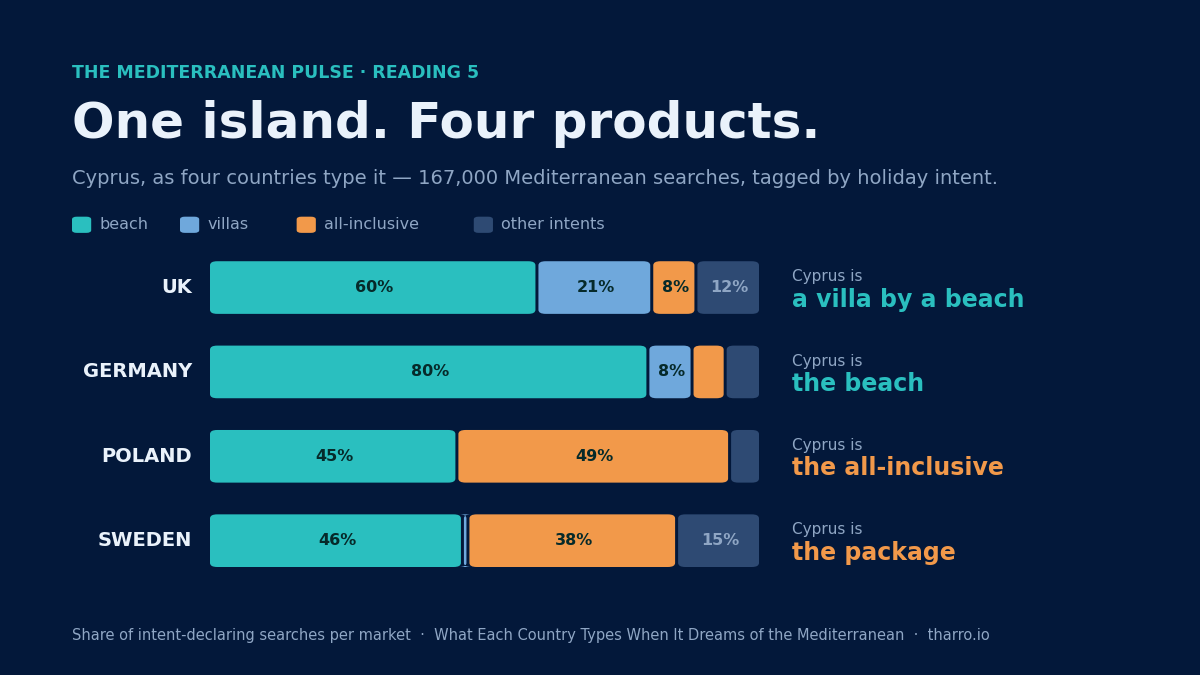
Cyprus, as four countries type it:
| Cyprus searches | beach | villas | all-inclusive | luxury | budget |
|---|---|---|---|---|---|
| UK | 59% | 21% | 8% | 4% | 3% |
| Germany | 80% | 8% | 6% | 1% | 1% |
| Poland | 45% | 0% | 49% | 1% | 2% |
| Sweden | 46% | 1% | 38% | 2% | — |
To a Brit, Cyprus is a villa by a beach — one UK–Cyprus intent search in five is a villa search, the highest villa share Cyprus has anywhere. To a German it is simply the beach. To a Pole and a Swede it is an all-inclusive package. Same island, four different products — and Spain, Greece and Croatia split the same way.
The operational consequence is blunt: source-market landing pages that are translations of each other are answering four different questions with one answer.
The niche map: who owns what, where
Some destinations over-index so hard on a theme in a given market that they effectively own it there:
Turkey owns budget — everywhere. In every one of the four markets, Turkey's budget share runs 1.5–2.5× the market average; in British searches, one Turkey search in five is a budget search. Turkey is also the most differentiated destination in all four markets — its search profile resembles no one else's. Turkey has its own lane.
Golf belongs to Iberia. Spain and Portugal own golf in British searches (2.4–2.6× the average); in Swedish searches Portugal's golf share runs at eleven times the market average — the Swedish Algarve pattern, which also carries villas (13%) and an outsized luxury share.
Villas have two owners. Croatia owns villa searches in Germany (21% of its mix, 2.5× average). Greece owns them in Poland (3.2× average) — the only place Polish package logic gives way to villa logic.
Malta is searched upmarket. Malta's luxury share over-indexes in three of the four markets — 1.6× in the UK, 1.9× in Germany, 5× in Sweden. The destination compounding on every layer of this series is also the one being imagined most expensively.
Cyprus competes everywhere and owns nowhere
Put every destination's search profile next to every other's, market by market, and one pattern stands out. In British searches, Cyprus's profile is a near-perfect twin of Croatia's. In German searches, it is a twin of Greece's. In Polish searches, a twin of Malta's.
Three markets, three different head-on rivals — and no market where Cyprus's mix is distinctively its own. Turkey owns budget, Iberia owns golf, Croatia and Greece each own villas somewhere, Malta is acquiring luxury. Cyprus holds no theme anywhere at that level. In the language of its own searchers, Cyprus is always in someone else's lane.
For Cypriot hotels the comp set implication is direct: your real search rival is not fixed — it is Croatia in London, Greece in Berlin, Malta in Warsaw. Rate-watch and campaign benchmarks should follow that geography.
One more thing everyone types
Across all four languages, the single biggest destination queries are weather queries — cyprus weather, Zypern wetter, cypr pogoda, väder Algarve, month by month, tens of thousands strong. The largest question travellers ask about your destination is one most hotel websites never answer. It is also the cheapest content position on this whole map.
What hoteliers should do with search intent data
Speak each market's grammar. Package terms and board basis for Poland and Sweden; places, beaches and villas for the UK; the beach itself for Germany. One message per market, not one message translated four times.
Benchmark against your twin, not your neighbour. Your search-profile rival differs by market. Price-watch and bid against the destination your searchers actually treat as your substitute in that language.
Buy the niche, not the noise. Owning a theme in one market — the way Croatia owns German villa searches — is far cheaper than fighting for generic destination terms, and it is the position that survives the shrinking of the search surface.
Answer the weather question. The biggest query class about every destination is a forecast. Month-by-month climate content, in the source market's language, sits on the largest untapped intent in the universe.
Method
Universe: the ~167,000 destination-pointing keywords from Reading 4 (UK, Germany, Poland, Sweden × nine destinations, deduplicated pointing volume). Intent tagging: multilingual profile matcher across ten holiday profiles (family, all-inclusive, beach, budget, villas, golf, luxury, adults-only, nightlife, winter); a keyword can carry multiple profiles; two further profiles were excluded for measurement reliability. Roughly one search in eight declares an intent profile; shares are of intent-declaring volume. Israel is covered by this study's AI layer; its search side remains a declared gap. Over-index = a destination's profile share divided by the market-wide share for that profile; ownership claims require both an index above 1.5 and a meaningful share.
Reading 5 of The Mediterranean Pulse. Reading 4 showed the volume draining out of the search box; this reading read what remains inside it. Next: where the deciding moved — Reading 6: The Mediterranean, According to AI, and whether AI's picture of each destination matches its searchers'.