Research
How AI Is Rebuilding the Hotel Booking Journey
Travelers now ask AI to find, compare and book hotels. Where the journey has moved, who is wired in, and what a hotel needs before an agent can book it.

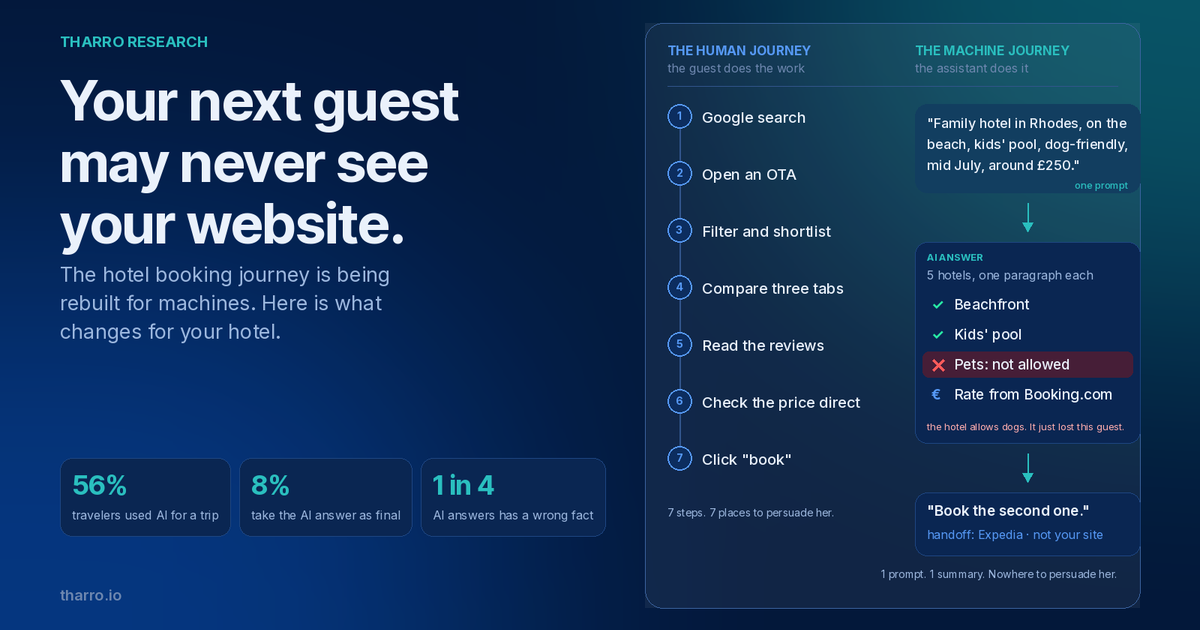
Your next guest may never see your website. For twenty years the way a guest found and booked a hotel looked roughly the same. That journey is being replaced by one where a machine sits between the guest and the hotel. This is what the change consists of, how far along it is, and what a hotel needs in place that it did not need before.
They typed a destination into Google. They opened Booking.com or Expedia and a couple of tabs. They filtered by price and rating, compared three or four hotels side by side, read the reviews, checked the photos, maybe visited your website to see if the direct rate was better, and clicked "book".
Everything you spend money on today was built to win that person at one of those steps. SEO for the Google search. Metasearch bids for the price comparison. OTA listings and content scores for the shortlist. Rate parity for the moment they check your site against the OTA. A booking engine for the click. A review-management tool for the reputation check in between.
That journey is being replaced by one where a machine sits between the guest and your hotel. The guest states what they want once. The assistant reads, compares, decides, and increasingly transacts. The guest never opens your website, never sees your photos in the order you chose, never reads your descriptions. They see what the machine says about you.
This article is about what that change actually consists of, how far along it is, and what a hotel needs to have in place that it did not need before. It is written for hoteliers, not for technologists, and it tries to stay with what is measured rather than what is predicted.
1. The old journey and the machinery built for it
It helps to be precise about the journey we are leaving, because every part of a hotel's commercial stack maps to a step in it.
| Step in the human journey | What the guest did | What the hotel built to win it |
|---|---|---|
| Search | Typed "hotels in Paphos" into Google | SEO, Google Business Profile, a website that ranks |
| Shortlist | Opened an OTA, filtered by price, stars, location | OTA listings, content score, photos, availability on every channel |
| Compare | Three tabs open, prices side by side | Metasearch bids, rate parity, "best price direct" messaging |
| Check | Read reviews, looked at photos, maybe emailed a question | Review management, response rate, FAQ page |
| Decide and book | Clicked through to the OTA or the hotel site | Booking engine, direct-booking incentives, retargeting |
The guest did the work. The hotel's job was to be present and persuasive at each step. Everything was designed to be read by a person with a browser.
2. The same trip, two journeys, head to head
Take one guest and run her through both journeys. Anna, Manchester, family of four, a week in Rhodes in July, wants a beach, a kids' pool, and to bring the dog if she can. Her budget is about £250 a night.
| Step | Human journey (2019 to 2024) | Machine journey (2026 onward) | What changes for the hotel |
|---|---|---|---|
| 1. Intent | Anna types "family hotels Rhodes" into Google. Her intent is one keyword; the rest is in her head. | Anna types the whole brief into ChatGPT or Google AI Mode: "family hotel in Rhodes, on the beach, kids' pool, dog-friendly, mid July, around £250". | You are no longer matched on a keyword. You are matched on five facts at once. Miss one (pets unknown, no "kids' pool" anywhere in your data) and you are filtered out before anyone looks at you. |
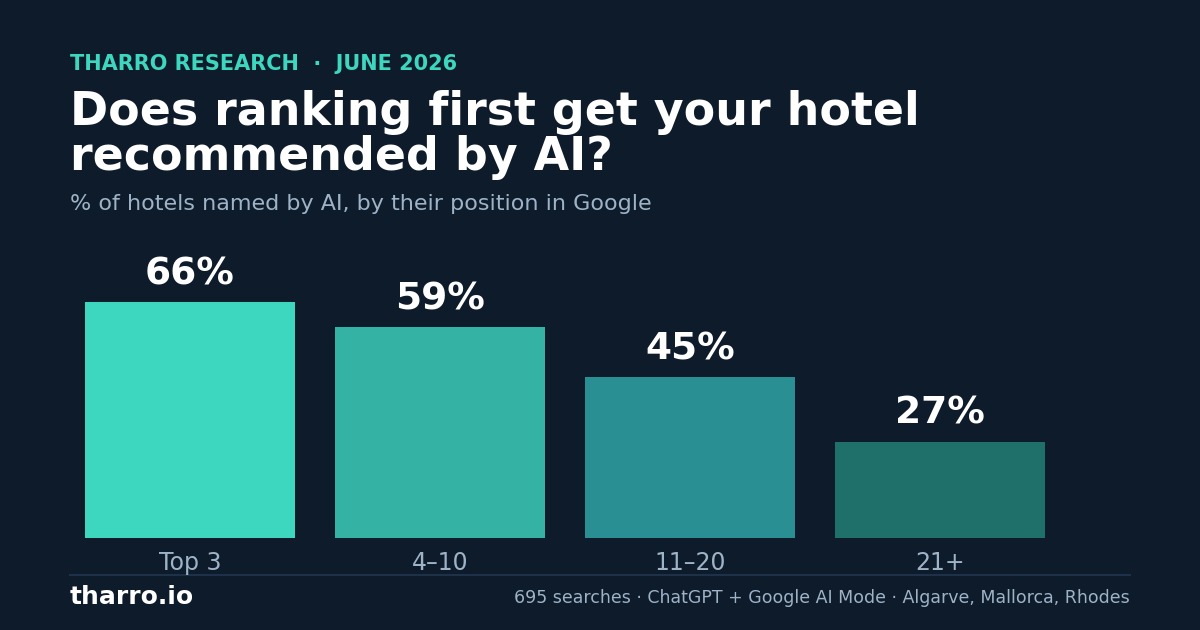
| 2. Search | Ten blue links, ads, a map pack. Anna clicks Booking.com, maybe Tripadvisor, maybe one hotel site. | No list. The assistant reads OTA listings, review sites, your site, blogs and forums, and returns five hotels with a sentence each. | Ranking on page one is worth less. Being in the assistant's five is what counts, and our studies show the five differ by engine: ChatGPT and Google AI Mode top-10 lists shared zero hotels in the same market. |
| 3. Shortlist | Anna filters Booking.com: price, 4-5 stars, beachfront, family. 40 results, she scrolls, opens eight. | The assistant already applied the filters from her brief. She sees five, with reasons: "Hotel X is beachfront with a children's pool, pets allowed on request". | The filter is applied to the facts the machine believes, not the facts on your website. In our audit, 1 in 4 AI answers had at least one wrong fact; pet policy was wrong 23% of the time, almost always "no" when the hotel says yes. |
| 4. Compare | Three tabs side by side. Price, photos, distance to beach, rating. Anna forms her own view. | One paragraph per hotel, written by the machine. Photos are whatever it pulled. Distance is a number it computed or copied from a distance site. | You lose control of the comparison frame. In the old journey your photos and copy sold the room; now a summary sells it, and you did not write the summary. |
| 5. Check | Anna reads 20 reviews, looks at the "pets" line on Booking.com, emails the hotel about the dog. | The assistant summarises the reviews ("guests praise the beach, some mention noise from the road") and states the pet policy as fact. No email is sent. | The check step collapses into the summary. A stale "no pets" on Trivago is now the answer, not one opinion among five. There is no second tab and no email you can reply to. |
| 6. Price | Anna compares the OTA rate with your direct rate; metasearch shows both. "Book direct and save 10%" catches her. | The assistant shows a rate from whichever source it can read live. Today that is Booking.com or Expedia inside the chat; your direct rate appears only if a feed exposes it. | Rate parity was built to win a human comparing two prices. If your direct rate is not in a feed the agent can call, there is no comparison; the OTA rate is the only rate. |
| 7. Book | Anna clicks through to Booking.com or your booking engine and fills in a form. | Anna says "book the second one". The assistant hands off to the partner that can complete it: an OTA, a chain's own system, or a direct-feed partner. In Google AI Mode she pays with Google Pay in the chat. | The "book" link is a plumbing decision made before Anna ever asked. In our Berlin study, 13% of hotel mentions carried a link to the hotel's site; 89% of Expedia mentions linked to Expedia. |
| 8. After booking | Confirmation email from the OTA or from you. Anna emails about a cot and a late check-in. | The assistant that booked it will handle the change, the cot request and the rebooking if a flight moves. Booking.com already calls this "autonomous rebooking". | The guest relationship starts inside the assistant. Whoever processed the booking owns the conversation after it. |
Two things stand out when you read the two columns side by side.
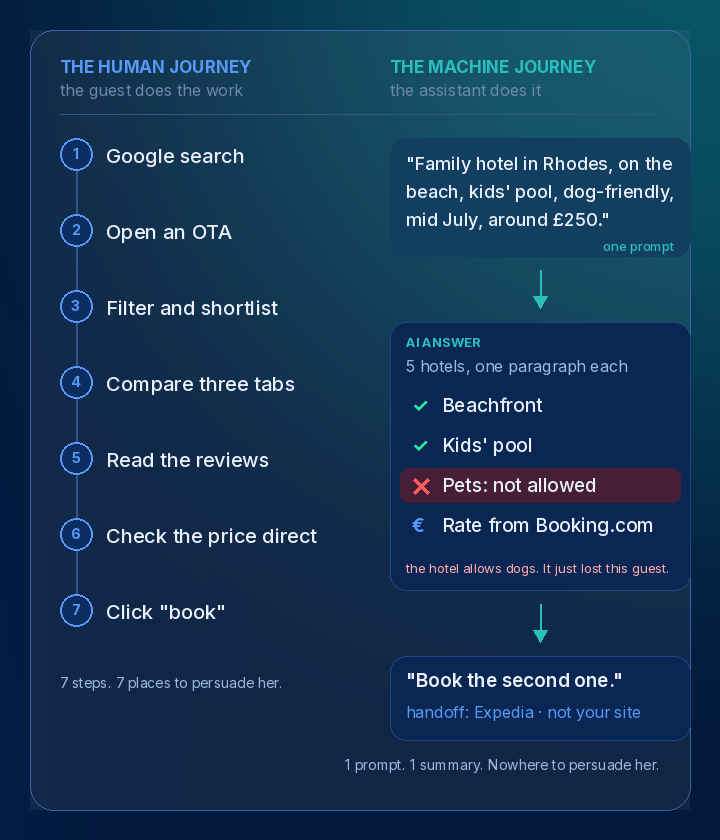
The same guest, both journeys.
First, the human journey had seven places where Anna could correct a wrong impression of your hotel: a photo, a review, your website, an email. The machine journey has one, and it belongs to the machine. Everything you used to fix by being persuasive, you now have to fix by being correct at the source.
Second, the machine journey compresses steps 3 to 6 into a single summary and step 7 into a handoff you did not choose. The old stack had a tool for every step. The new stack needs two things the old one never had: your facts and rates in a form a machine can read and call, and a way to see what the machine is saying.
Here is the same comparison from the hotel's side, tool by tool.
| Old journey: what you built | What it was for | Machine journey: what replaces or extends it |
|---|---|---|
| SEO, a website that ranks | Winning the Google search | Structured data on the site (Hotel, FAQ schema) so the assistant extracts facts instead of guessing; content written to answer a brief, not a keyword |
| OTA listing, content score | Being in the shortlist | Still needed (the OTAs are inside the assistants), plus fact consistency across every listing, because the assistant votes across them |
| Metasearch bids, "book direct" messaging | Winning the price comparison | A live-rate feed an agent can call (channel manager MCP, CRS, direct-feed partner), or your direct rate does not exist to the machine |
| Review management, response rate | Passing the reputation check | Still needed, and now the assistant summarises the reviews; the themes guests repeat become the sentence the machine writes about you |
| Booking engine page, retargeting | Converting the click | A booking flow on your own domain that a machine can complete, not a popup or iframe; and knowing which partner the assistant hands the booking to |
| Nothing | Knowing what the guest was told | Monitoring: asking the assistants what they say about you, per source market, on a schedule, and where they send the booking |
The last row is the whole shift in one line. In the old journey you could see every surface the guest saw. In the new one, the surface is a private conversation, and the only way to see it is to ask.
3. What changed, in three phases
The shift is not one event. It is three phases that are moving at different speeds. Knowing which phase you are in for which guest is most of the strategic clarity a hotel needs.
Phase one, discovery: already moved
Phocuswright's 2026 research is the cleanest measurement. 56% of active US leisure travelers used AI for planning, booking or in-destination help on at least one trip in the past 12 months. Nine months earlier it was 43%. Nine months before that, 33%. Phocuswright called it the fastest behavioral shift the travel industry has seen in a decade.
The number that matters more for a hotel is the one underneath it. General search engines fell from 51% to 36% as the most-used resource for researching travel between mid-2024 and late 2025. Generative AI platforms rose to 33% for trip research, five times what they were in 2024. The first step of the journey, the one your SEO budget was built for, is being shared with a surface that does not show ten blue links.
What this changes: the question "do we rank on Google for hotels in Rhodes" is no longer sufficient. The question is "when someone asks ChatGPT or Google AI Mode for a family hotel in Rhodes with a kids' pool, are we in the answer, and is what it says about us correct". Those are different questions with different answers. Our own studies across Cyprus and five Mediterranean markets found that the hotels named by Google and the hotels named by AI assistants barely overlap: top-10 lists from different engines shared zero hotels, and hotels control roughly 7% of their own presence in AI answers.
Phase two, decision: moving, with a human still in the loop
Here the machine does the comparing. It reads the OTA listing, the reviews, the hotel site, a few blogs, and produces a summary: "The Elysium is on the beach, has an indoor and outdoor pool, allows pets". The guest reads that summary instead of your website.
Two Phocuswright figures describe exactly where this phase stands. Only 8% of travelers said AI answers alone were sufficient. 51% typically clicked through to source websites after seeing AI-generated results. So the human is still checking. But the human is checking a shortlist the machine built, and if the machine's summary of your hotel is wrong, or you are not in it, the click never comes.
What drives action on an AI recommendation, according to the same research: price comparisons at 44%, summarized reviews at 33%, a recognized brand at 32%. In other words, the assistant is doing the "compare" and "check" steps of the old journey on the guest's behalf, and it is doing them from whatever data it can read.
Phase three, transaction: arriving, one channel at a time
This is the phase everyone is writing about and the one that is least far along, so it is worth being exact.
On 27 August 2026 Google switched on hotel booking inside AI Mode for US users. A traveler can chat to find and compare rooms, review cancellation terms, and pay with Google Pay without leaving the conversation. The hotel or OTA remains the merchant of record: it charges the card, sends the confirmation and handles support. The launch partners were Booking.com, Choice Hotels, Expedia, Hilton, Hotels.com, IHG, Marriott, Priceline, Trip.com and Wyndham. Read that list twice. Every name on it is an OTA or a large chain.
OpenAI opened the other front in October 2025 when it put Expedia and Booking.com inside ChatGPT as launch partners for apps, with live flight and hotel data, prices and maps in the chat. Expedia's head of strategic partnerships said gen-AI traffic was small but growing fast and converting to bookings at a higher rate than other traffic.
Then, in March 2026, OpenAI stepped back from owning the transaction. It pulled its in-chat Instant Checkout button, stopped processing travel transactions directly, handed payment off to third-party apps through its Agentic Commerce Protocol, and repositioned the assistant toward discovery and research. Booking Holdings' CEO Glenn Fogel had predicted this on his Q4 2025 call: being merchant of record means handling payments in more than 100 methods and 50 currencies, refunds, chargebacks and regulation in 200-plus countries, and he doubted the AI companies wanted to go that far down the funnel.
What this means in practice: the AI platforms want to own the conversation, not the checkout. The checkout is being handed to whoever is already wired in to process it. Today that is the OTAs and the chains.
4. The new plumbing, and who is connected to it
In the human journey, the hotel's "connection" to the guest was a web page. In the machine journey, the connection is a data feed the assistant can call: availability, rates, facts, and a way to complete a booking. Three things are being built to standardise that, and you will start hearing their names from your technology vendors.
- MCP (Model Context Protocol): the way an AI assistant plugs into a live system to read data and take actions. This is what ChatGPT's apps run on and what your channel manager will use to expose your rates to an agent.
- UCP (Google's Universal Commerce Protocol): Google's standard for an agent to discover a merchant, search its catalog and run a checkout. In May 2026 Google named hotel booking as the next vertical for it.
- AP2 / ACP: the payment layers. Google's Agent Payments Protocol and the OpenAI–Stripe Agentic Commerce Protocol define how an agent is authorised to pay on a guest's behalf without ever seeing the card.
You do not need to understand these. You need to know who in your stack is connected to them, because that decides whether an agent can book you.
Here is the state of play as of September 2026.
Connected or connecting:
- SiteMinder is connecting its distribution platform to AI booking channels through MCP, for both hotel-direct and intermediary channels (announced April 2026).
- Aven Hospitality, the former Sabre hotel technology unit, is embedding MCP across its SynXis central reservation system, which serves more than 35,000 hotels, giving agents access to inventory, pricing and distribution controls.
- Mews launched five products on a single data model it calls an AI-native operating system, and SiteMinder's distribution engine is being embedded natively inside Mews.
- Phocuswright reports 56% of travel companies have implemented standards such as MCP and A2A.
Not connected:
- Of 13 major hotel and hospitality PMS platforms reviewed in June 2026, exactly one shipped an official MCP server, and it was Guesty, a vacation-rental platform, in read-only beta. Most hotel-native PMS platforms had shipped nothing AI-specific.
The gap between those two lists is where most independent hotels sit. The distribution layer (channel managers, CRS) is moving. The property layer (most PMSs) is not. If your rates live in a PMS that has no path to an agent, the only version of your hotel an agent can book is the one on Booking.com.
5. The three routes into the machine
For an independent hotel there are three ways to be bookable by an assistant. They are not exclusive, and they have very different economics.
Route one: the OTA listing (the default, and the one you already have)
Booking.com and Expedia are inside ChatGPT and Google AI Mode today. Your listing on them is, by default, your presence in agentic booking. This works, and it costs what it has always cost: commission, and the guest relationship.
Booking Holdings is not passive about this. Its CFO told investors the company wants to make sure customers coming direct have an experience at least as good as a generic horizontal agent, and Fogel reminded them of partnerships with OpenAI, Anthropic, Google and Amazon. Expedia's annual report now lists agentic AI as a competitive threat, alongside AI-powered competitors and data scraping. They see the same shift you do, and they are buying position in it.
Route two: a direct feed (new, and someone charges for the pipe)
Two companies have built a direct path from hotel inventory into the assistants.
- The Hotels Network, owned by Lighthouse, launched the first direct hotel booking app inside ChatGPT in March 2026. Hotels supply verified content, live rates and real photography; the guest sees them in the chat and is routed to the hotel's own website to complete the reservation. Flat subscription, zero booking commission.
- DirectBooker, backed by former Tripadvisor CEO Stephen Kaufer and ex-Google Travel head Richard Holden, signed five of the ten largest hotel chains in April 2026 and went live with a ChatGPT app and a Claude connector. It uses MCP to deliver real-time availability, rates and member-only benefits that are not on OTAs, and routes every booking to the hotel's official booking channel.
This is the interesting route, and it is worth being clear about what it is: a new intermediary, priced differently. Instead of a percentage of the booking, a fee for being in the feed. It is early. The chains are in. Independents are joining. Nobody can yet tell you what share of bookings it produces.
Route three: your own website (open, but mostly unreadable)
This is the route most hotels assume they have and mostly do not.
The door is open. A March 2026 study parsed the robots.txt files of 105,002 hotel websites across France, Italy, Spain, the Netherlands, the US, the UK and Germany: only 3.3% block any AI crawler at all. 96.7% are fully accessible to AI search.
The house behind the door is another matter. Three problems come up over and over in audits of independent hotel sites:
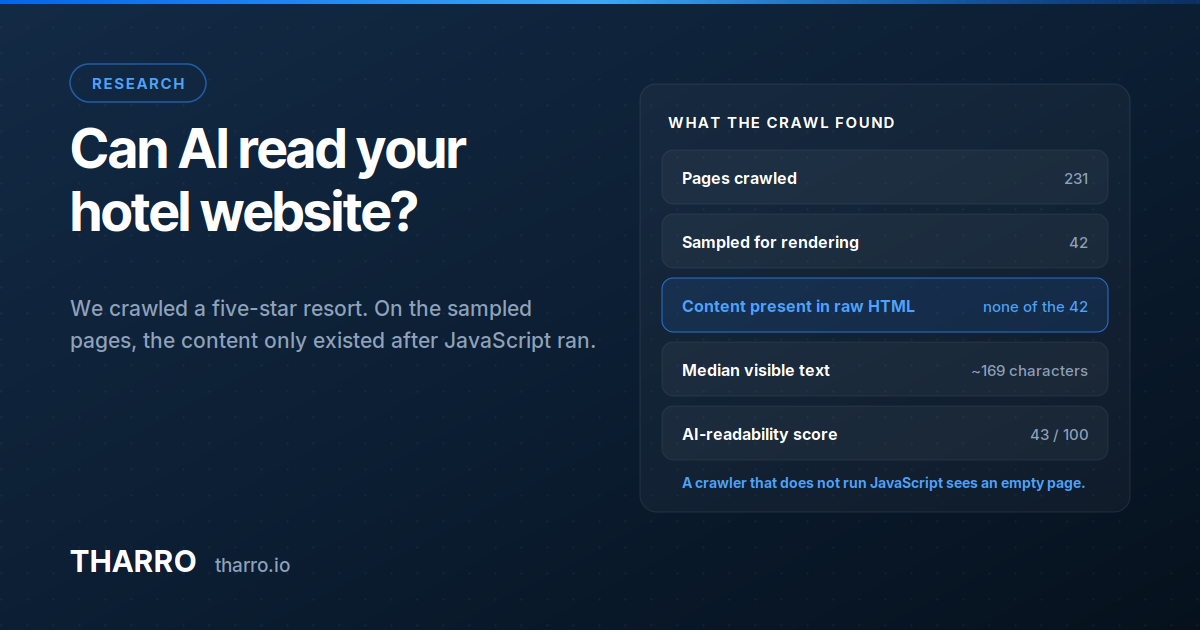
- No structured data. Most independent hotel websites have no schema.org markup. Without it, an assistant has no reliable way to extract your star rating, your amenities or your policies; it guesses from prose, or from an OTA.
- A booking engine an agent cannot use. Many booking engines open in a popup, redirect to a third-party domain, or load inside an iframe. An agent cannot interact with any of those. Your "book direct" button, to a machine, is a dead end.
- Fashionable fixes that do nothing. You will be sold an "llms.txt" file, a text summary of your site "for AI". No major AI provider has committed to reading it. In one 90-day sample of more than 500 million AI bot visits, 408 requests hit an llms.txt file. The crawlers fetch your HTML and read what is there.
So the honest state of route three is: the assistants can reach your site, and when they do, they find a page written for a human, with the facts scattered through marketing copy and the booking flow hidden behind a script. They fill the gaps from Booking.com.
Which brings us to the part of this shift that is being skipped.
6. The layer nobody is checking: is what the machine knows about you correct?
Every announcement above is about connecting inventory to agents so they can book. Almost none of it is about whether the agent's picture of the hotel is right before it books. We tested that.
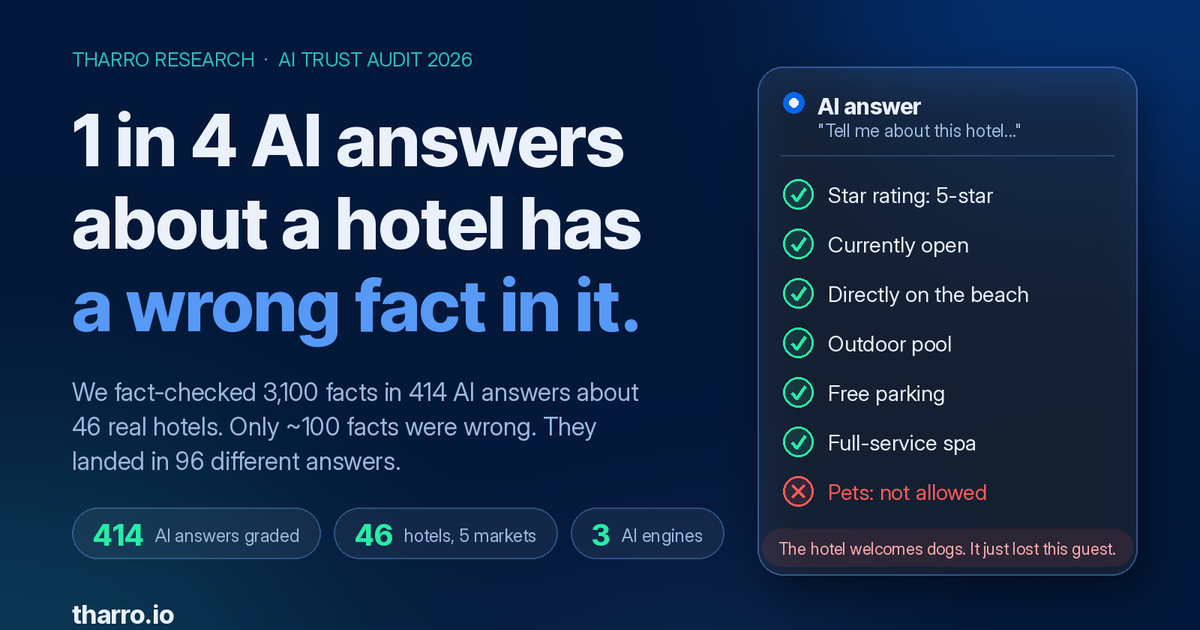
In August 2026 we took 46 four- and five-star hotels across Limassol, Paphos, Athens, Rhodes and Chania, built a verified truth for each one across five sources (the hotel's own site, Booking.com, Google's hotel data, Google Business Profile and Tripadvisor, majority rule, hotel site decisive on policies), then asked Google AI Mode and ChatGPT, with and without web search, for the basic facts a guest asks: open or closed, star rating, pool, beachfront, adults-only, pets, spa, parking, distance to the centre. 450 answers, roughly 3,100 facts checked.
The good news first. Fact by fact, AI is mostly right: 2.5% of stated facts wrong for ChatGPT with search, 2.9% for Google AI Mode, 4.5% for ChatGPT without search. Star rating, open status and adults-only policy were 0% wrong. 16 of the 46 hotels were never wrong on anything.
The number a hotelier should keep is the per-answer one. 23.2% of answers contained at least one wrong fact. Roughly one guest in four asking about your hotel gets at least one thing wrong in the summary they read instead of your website.
The errors have a shape, and the shape tells you where they come from:
- Pet policy was 22.8% wrong, almost always in the same direction: the hotel allows pets, the assistant says no. At Leonardo Plaza Cypria Maris in Paphos, the hotel's own FAQ says dogs up to 10 kg are welcome for a daily fee. Booking.com says "on request". Trivago and Trip.com say no. Google AI Mode said no, twice, and in one of those answers cited the hotel's own website while contradicting it.
- Spas and pools were invented. "No spa" became "has a spa" 14 times; "not on the beach" became "beachfront" 12 times; an outdoor-only pool became "indoor and outdoor" 7 times. In one case the phantom indoor pool traces back to a tour operator's page.
- Stale listings win. Aulus in Chania relaunched as adults-only in April 2026. Google's hotel data and Tripadvisor still described it as kid-friendly, and so did the assistants that read them.
And then there is the case that shows the mechanism most clearly. Curium Palace in Limassol was demolished; the site is now an office development. Expedia, Hotels.com, Kayak and a clone site still had live pages for it. The clone showed a date search, "Sold out! Our last room has already been booked", a green countdown offering a rate 10% cheaper than Booking.com, and 223 reviews. Nothing on any page said "closed". ChatGPT with web search, asked about the hotel, told us availability was offered today, three runs out of three. Google AI Mode got it right three out of three.
The lesson is not that AI hallucinates. Only about a third of the wrong claims in our study matched something in the five canonical listings; the rest came from the wider web, tour-operator pages, distance sites, clones. The lesson is that the assistant is faithful to every stale page ever published about you, and it has no way to tell your current hotel from the paper trail.
In the human journey, a wrong pet policy on Trivago cost you a few guests who checked Trivago. In the machine journey, the assistant reads Trivago, the OTA, the clone site and your FAQ, resolves the conflict by majority or by whatever it read first, and hands the guest a single answer. There is no second tab.
7. What the new infrastructure actually consists of
Put the pieces together and a hotel's commercial infrastructure for the machine journey has four parts. Two of them are new. All four are checkable.
1. One source of truth for facts, and discipline about propagating it. Your policies, amenities, open status and location facts should be identical on your website, Booking.com, Expedia, Google Business Profile and Tripadvisor, and marked up on your site in structured data so a machine can read them without guessing. This is the same discipline you already apply to rates under the name "parity". It now applies to facts, because the assistant treats every listing as a vote.
2. A live-rate pipe an agent can call. Ask your channel manager and your PMS vendor one question: "If a guest asks ChatGPT or Google AI Mode to book us direct, what system answers, and what does it return?" If the answer is "nothing yet", your only bookable version is the OTA one. If the answer is "SiteMinder / Aven / a direct-feed partner", find out what it exposes and whether your member rates and packages are in it.
3. A booking flow a machine can complete. Your booking engine needs to be part of your website, not a popup or an iframe on another domain, and it needs to be reachable from the page the assistant read. If an agent has to "click a button that opens a window", it does not.
4. Monitoring of what the machines say and where they send the booking. This is the part with no analogue in the old stack. You could always look at your OTA listing. You cannot look at the answer ChatGPT gave a guest in Manchester last Tuesday. The only way to know whether you are in the answer, whether the facts are right, and whether the "book" link points at you or at Expedia, is to ask the assistants the way guests do, across the markets you sell into, on a schedule, and read what comes back.
Our Berlin study measured that last point directly. Across 380 query runs on three assistants, when a hotel was mentioned, 13% of those mentions carried a link to the hotel's own site. When Expedia was mentioned, 89% of the mentions carried a link to expedia.com. Same query, same answer, very different odds of the click landing with you. That gap is a pipe problem and a data problem, and you cannot see it without measuring it.
8. What to do this quarter, and what not to spend money on
Do:
- Audit your facts across five listings (site, Booking, Expedia, Google Business Profile, Tripadvisor) for the ten things guests ask: open status, stars, pool, beach, adults-only, pets, spa, parking, distances, breakfast. Fix the disagreements at the source, starting with the ones an assistant gets wrong most (pets, spa, beachfront).
- Add Hotel and FAQ structured data to your website, written from the corrected fact sheet. This is a few hours of developer time and it is the difference between an assistant reading your policy and guessing it.
- Get a written answer from your channel manager and PMS on their agent connectivity: what is live, what is planned, and by when.
- Ask an assistant about your hotel the way a guest would, in your top three source markets, once a month, and read the answers. If you do not want to do it by hand, that is what monitoring tools are for.
- Search for your hotel's old names and any closed or rebranded sister properties. If a clone or an OTA still shows them live, request removal. The assistant will read them.
Do not:
- Do not pay for an llms.txt file as a strategy. Ship it if it is free, expect nothing from it.
- Do not block AI crawlers to "protect your content". You would be removing yourself from the answer while Booking.com stays in it.
- Do not treat the direct-feed vendors as a replacement for your OTA listing this year. They are a second route, not yet a proven volume source. Join one if the economics are clear; keep measuring.
- Do not assume the agentic checkout numbers are large. Discovery has moved; the fully machine-executed booking is still the 8%. Build for where the journey is going, but budget for where it is.
The honest position
Three things are true at the same time, and a hotelier should hold all three.
The guest's front door is still open: half of AI users click through, and only 8% take the answer as final.
The machine's front door is being built by other people, and the people who got there first are the OTAs and the chains. No settled commission model exists yet for an AI-executed booking, and the platforms have made clear they want to own the conversation, not the checkout. Whoever processes the transaction will charge for it.
And in between those two doors, the assistant is already describing your hotel to guests, from whatever it can read, right or wrong, whether or not you are wired in.
The old journey rewarded being persuasive to a person. The new one rewards being correct and connected for a machine, and then verifying that the machine agrees. The first is a website. The second is infrastructure. Most hotels have the first and have not yet noticed they need the second.
Sources: Phocuswright, "The AI Surge: Travel's Fastest Behavioral Shift in a Decade" (March 2026) and "Travel Innovation and Technology Trends 2026"; Skift reporting on Google AI Mode hotel booking (27 Aug 2026), Google UCP for hotels (19 May 2026), Expedia's annual report (Feb 2026) and OpenAI Instant Checkout (Mar 2026); PhocusWire on ChatGPT apps (Oct 2025), SiteMinder MCP (Apr 2026) and Booking Holdings Q1 2026 results; Lighthouse / The Hotels Network and DirectBooker press releases (Mar and Apr 2026); hotel robots.txt study of 105,002 sites (Mar 2026); PMS API and MCP readiness review of 13 platforms (Jun 2026); Tharro AI Trust Audit (46 hotels, 5 markets, 450 answers, Aug 2026) and Tharro Berlin AI booking study (380 query runs, 3 assistants).
FAQ
Can travelers book hotels through AI assistants today?
Yes, on a few channels. Since 27 August 2026 Google AI Mode lets US travelers find, compare and book hotels in the chat and pay with Google Pay; the hotel or OTA remains the merchant of record. Expedia and Booking.com have apps inside ChatGPT with live rates. OpenAI itself stepped back from processing travel payments in March 2026 and hands the checkout to partner apps. The launch partners on every channel are OTAs and large chains; independent hotels reach these channels through their OTA listing, through a direct-feed partner, or not at all.
What is agentic booking for hotels?
Agentic booking is when an AI assistant, acting for a traveler, searches availability, compares options and completes a reservation through machine-readable connections instead of a person clicking through a website. It needs three things a hotel website was never built to provide: facts a machine can read without guessing, a live-rate connection it can call, and a booking flow it can complete without a popup or an iframe.
How is the AI booking journey different from the OTA journey?
In the OTA journey the guest does the work: search, filter, compare tabs, read reviews, check the direct rate, click. In the AI journey the guest states the whole brief once and the assistant does the filtering, comparing and checking, then hands the booking to a partner it is connected to. The seven places a hotel could persuade the guest collapse into one summary the hotel did not write. Phocuswright found 56% of US travelers used AI for a trip in the past year, but only 8% treat the AI answer as final.
What does a hotel need to be bookable by an AI agent?
Four things. One source of truth for facts, kept identical across the hotel site, OTAs, Google Business Profile and Tripadvisor, and marked up as structured data on the site. A live-rate feed an agent can call, through a channel manager or CRS with an MCP connection or a direct-feed partner. A booking flow on the hotel's own domain that a machine can complete. And monitoring of what the assistants say about the hotel in each source market and where they send the booking, because that answer is a private conversation the hotel cannot otherwise see.
Tharro shows you what ChatGPT, Google AI Mode and Perplexity say about your hotel in each of your source markets, which facts they get wrong, and where they send the booking. See how it works on the AI visibility page, or check your listings for the contradictions AI is repeating on the listing health page.