Growth
llms.txt for Hotels: Does It Actually Do Anything?
What the file is, what the evidence says about whether AI assistants read it, and a hotel-specific template if you decide to publish one.

A file called llms.txt has been appearing on websites for a while now, usually with a confident claim attached. Here is what is actually known, and what a hotel should do about it.
Someone has probably told you your hotel needs an llms.txt. Possibly an agency. Possibly a LinkedIn post with a lot of arrows in the graphic. The pitch is that it's the robots.txt of the AI era — publish one and assistants will understand your business.
That pitch overstates it. The file is still worth considering. Both of those things are true at once, which is why this is worth twenty minutes of your attention rather than a purchase decision.
What the file actually is
llms.txt is a markdown file at the root of your domain — yourhotel.com/llms.txt — proposed in late 2024 as a way to give language models a clean, curated summary of a site.
The reasoning behind it is sound. A modern website is mostly navigation, scripts, cookie banners and layout. The actual substance is a small fraction of what a crawler has to wade through. llms.txt offers a shortcut: here is who we are, here are the pages that matter, in plain markdown with no markup to parse.
The format is deliberately simple. An H1 with your name, a blockquote summary, then sections of annotated links.
The honest answer on whether it works
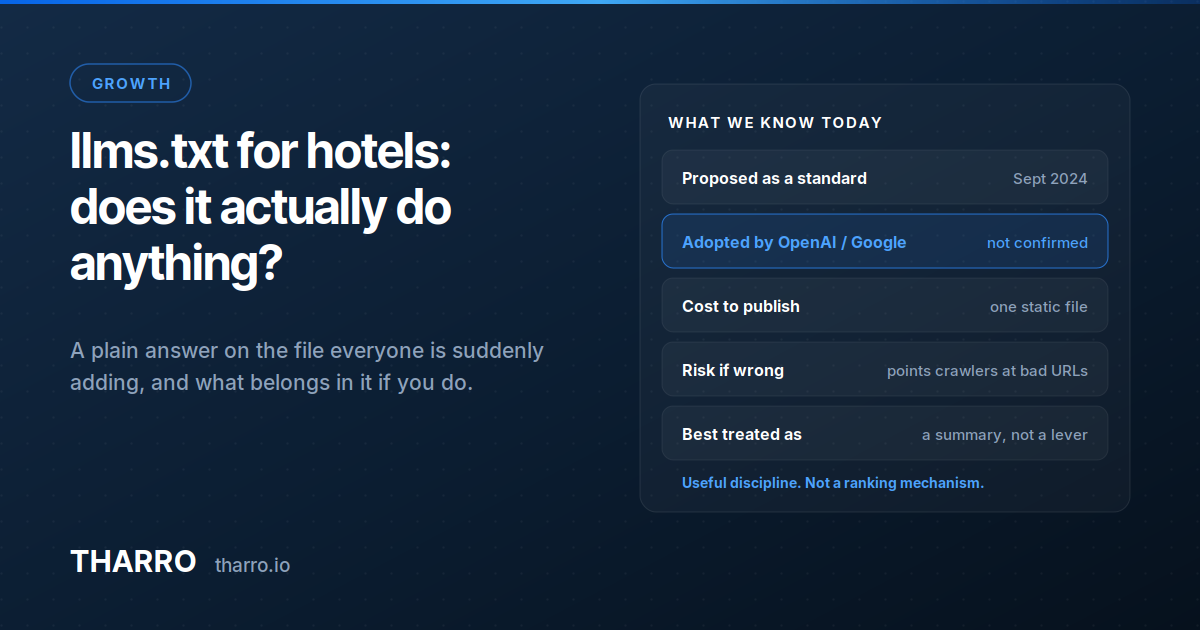
No major AI provider has confirmed that they read it. Not OpenAI, not Google, not Anthropic. There is no public documentation committing to support, and no reliable way to observe it working from the outside.
Anyone telling you it is a ranking mechanism is guessing — and the guess is doing commercial work for them.
So why is this article not simply "don't bother"? Three reasons.
It costs almost nothing. One static file, written once. The downside case is that a text file sits on your server unread.
Adoption is real regardless of confirmation. Enough sites publish one that it is becoming a convention, and conventions have a way of becoming supported after the fact rather than before.
And the exercise itself is the actual value — which is the part nobody mentions.
The real reason to write one
Writing an llms.txt forces you to answer, in about 200 words and without marketing language, what your hotel is and what a stranger needs to know about it.
Most hotels cannot do this quickly. Try it. Not the brochure sentence — the useful one. What kind of property, in what location, for which traveller, with what genuinely distinguishes it from the four hotels a guest is comparing you against.
That paragraph is the same thing an AI assistant is trying to construct about you from whatever sources it can find. If you can't write it, the model is assembling it from your OTA listing, your reviews and a tour operator's description of you — which is exactly how hotels end up with a positioning they never chose.
The file may or may not be read. The clarity is useful either way.
What goes in a hotel's llms.txt
Keep it factual. This is a reference document, not a landing page — superlatives are the fastest way to make it useless.
# The Example Hotel

> A 78-room independent hotel on the seafront in Limassol, Cyprus.
> Adults-only, open March to November, 400m from the old town.
> Known for its rooftop restaurant and its 1960s modernist architecture,
> restored in 2019. Direct booking at examplehotel.com.

Key facts: 78 rooms across four categories, all sea-facing. Two restaurants,
one rooftop. Spa with three treatment rooms. No conference facilities.
Nearest airport Larnaca (LCA), 55 minutes by car. Check-in 15:00,
check-out 11:00. Dogs permitted in garden rooms.

## Rooms and rates
- [Room types](https://examplehotel.com/rooms): All four categories, sizes, occupancy, what is included
- [Offers](https://examplehotel.com/offers): Current direct-booking rates and packages

## The hotel
- [Restaurants](https://examplehotel.com/dining): Both restaurants, cuisine, opening hours, whether non-guests can book
- [Spa](https://examplehotel.com/spa): Treatments, hours, booking
- [Location](https://examplehotel.com/location): What is walkable, transfer times, the beach

## Practical
- [FAQ](https://examplehotel.com/faq): Check-in, parking, accessibility, children, pets
- [Contact](https://examplehotel.com/contact)
Four rules that matter more than the structure:
Every link must be a URL you want indexed. This is the one way to actively harm yourself with this file. Pointing crawlers at legacy URL patterns, staging paths or pages you are trying to de-index does real damage — a wrong index is worse than no index.
Answer the questions travellers actually ask. Adults-only. Distance to the beach. Whether the restaurant takes outside bookings. Whether there's a lift. These are the specifics that appear in traveller queries, and the specifics that separate a useful answer from a generic one.
State what you are not. "No conference facilities", "adults-only", "closed December to February" are among the most valuable lines in the file. They stop you being recommended to the wrong guest, which is a worse outcome than not being recommended.
Keep it current, or don't publish it. A file that describes last season's restaurant concept is a liability. If nobody owns updating it, skip the whole thing.
What it will not do
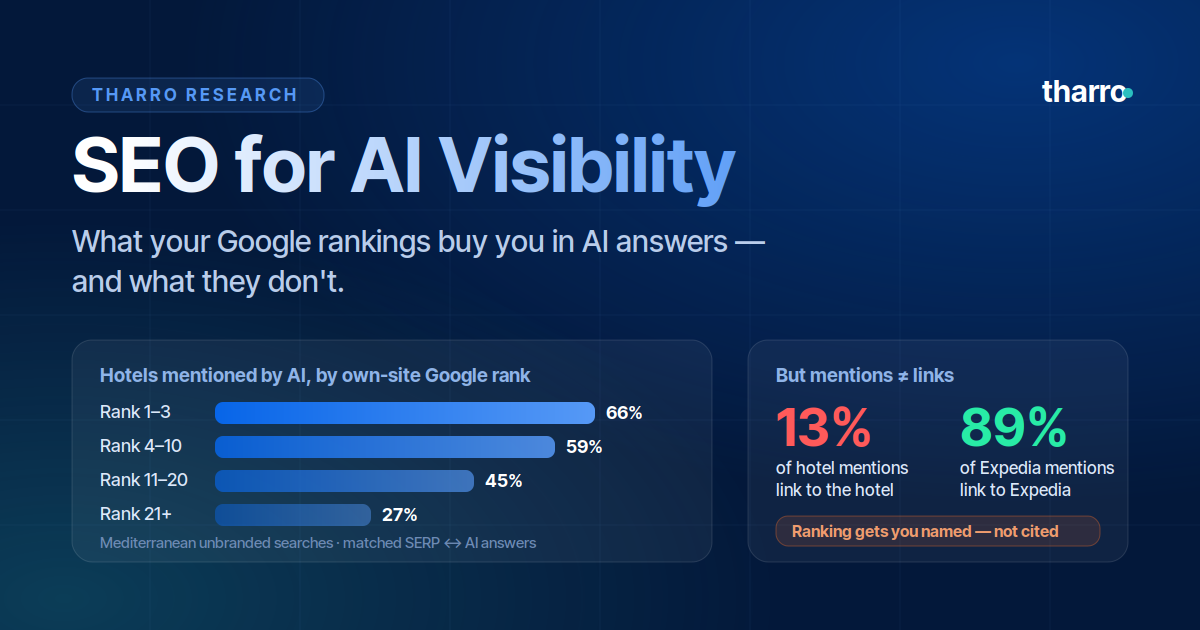
It will not make an assistant recommend you. Recommendations are built from what the wider web says about you — reviews, OTA listings, editorial coverage, your own pages — and one file on your own domain does not outweigh that. How AI assistants actually choose which hotels to name is a much larger question, and this file is a footnote in it.
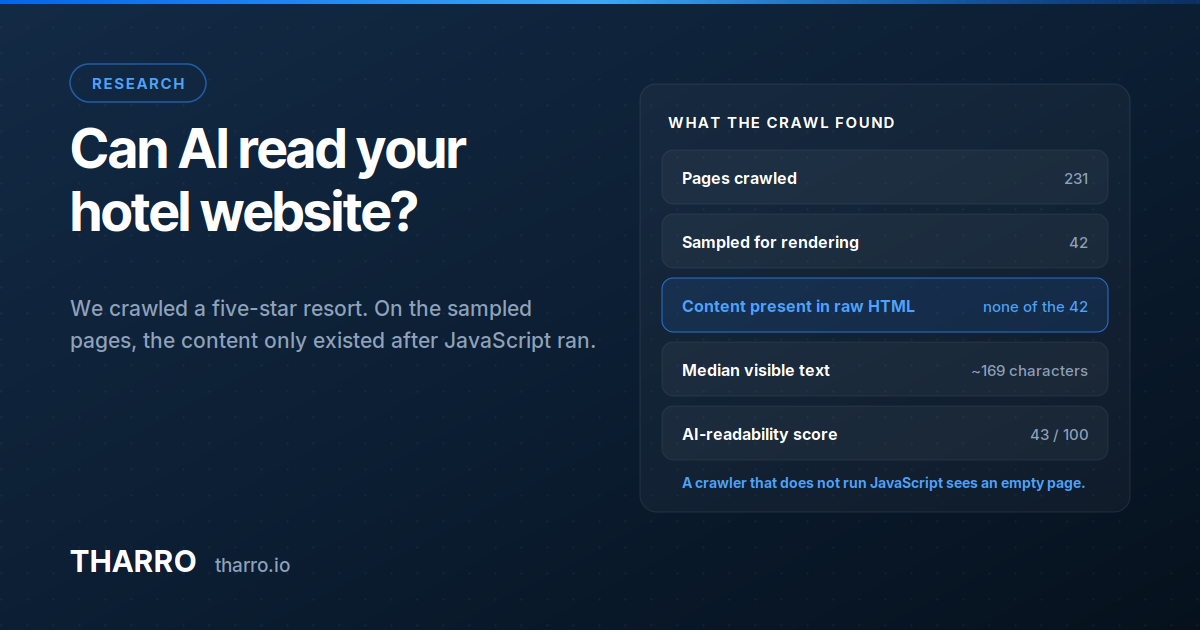
It will not fix an unreadable website. If your pages arrive empty and only render with JavaScript, llms.txt points a crawler at pages it cannot read. Fix that first.
It is not a substitute for structured data. Schema.org markup is documented, supported and demonstrably used. If you are choosing where to spend an afternoon, spend it there.
The verdict
Publish one if you can write it in an hour and someone will keep it current. Treat it as useful discipline with a possible upside, not as a lever.
And be sceptical of anyone selling it as more than that — including, in a few months, whoever is quoting this article back at you.
FAQ
Where does llms.txt go?
The root of your domain: yourhotel.com/llms.txt. Plain markdown, served as text.
Is llms.txt the same as robots.txt?
No. robots.txt controls crawler access and is universally supported. llms.txt is a content summary with no confirmed support from any major provider.
Will it hurt my SEO? No. It is a static file that search engines ignore. The only real risk is linking to URLs you don't want crawled.
Should I use llms-full.txt as well? Only if it can be generated automatically from your site. A hand-maintained full version goes stale within months, and a stale index is worse than none.
How is this different from an AI visibility strategy? Completely. This is a file on your own server. AI visibility is about what the wider web says about you — the sources assistants actually draw on.
Want to see which sources AI assistants use when they answer questions about your hotel? See how Tharro measures it or book a 30-minute call.