Research
Tour Operators Are Not OTAs
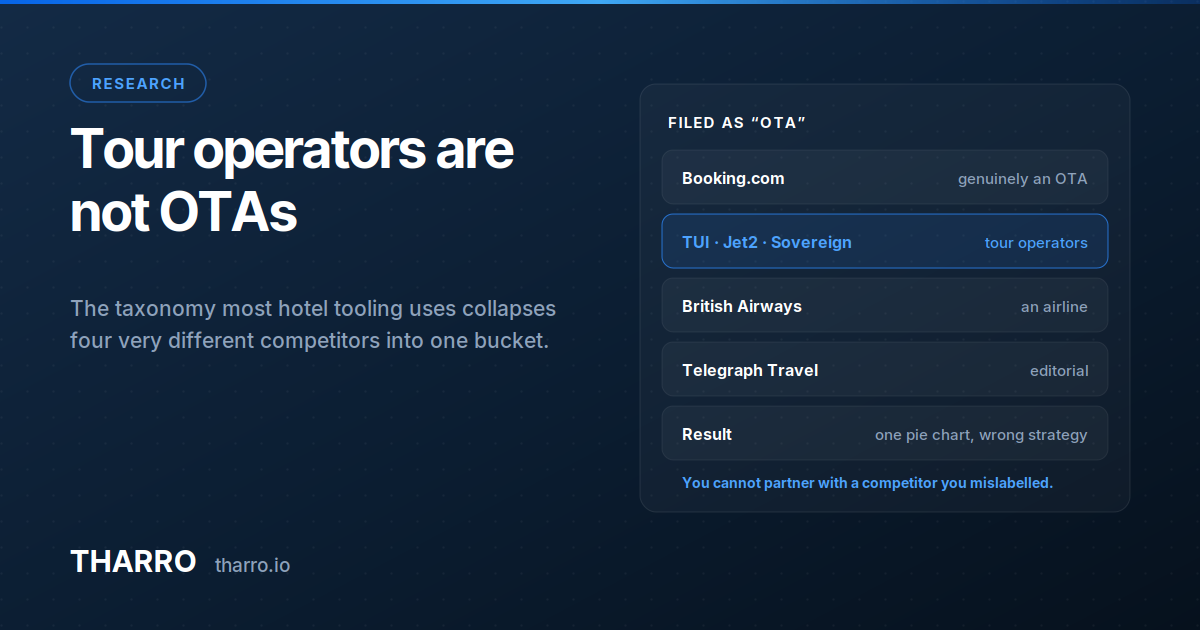
Most hotel tooling files tour operators, airlines and editorial sites under one label. That simplification produces a tidy chart and a wrong strategy.

A category error inside your reporting tool quietly becomes a category error inside your strategy.
Look at the domains ranking around a hotel on unbranded searches and you find something most reporting hides: several of the biggest are not OTAs at all.
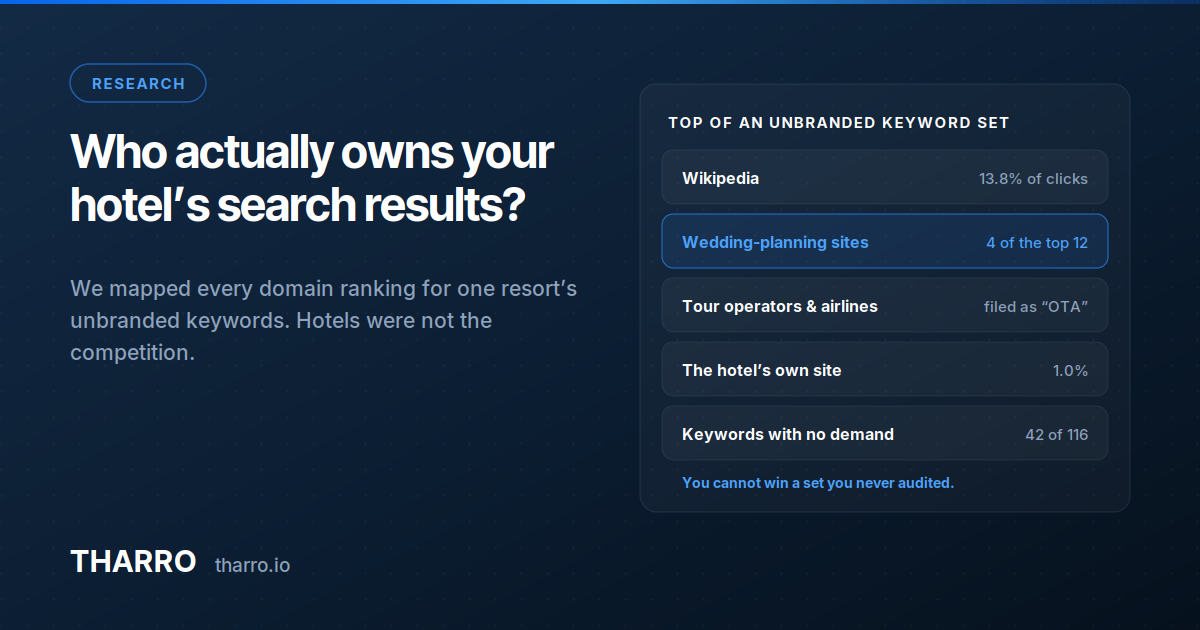
In one market we mapped, the domains sitting alongside a resort's own site included tour operators, a scheduled airline's holiday arm, and a national newspaper's travel section. Every one of them was filed under the same label: OTA.
How the collapse happens
Domain classification in hotel tooling typically runs on a handful of buckets — hotel, OTA, metasearch, social, unknown. There is no bucket for tour operator, none for editorial, none for destination organisation.
So everything commercial that isn't a hotel becomes an OTA, and everything else becomes unknown. The result is a clean pie chart in which one slice is doing four unrelated jobs.
Worse, these classifications tend to be imported once and never reviewed. A domain typed in a bulk migration two years ago is still carrying that type today, with no confidence score and no human ever having looked at it.
Why it changes what you should do
These are genuinely different competitors, with different economics and different correct responses.
An OTA sells your room on commission. You are on it, you compete with it for your own branded traffic, and the strategic question is how much of your demand it intermediates.
A tour operator may be a partner you already contract with. It sells packages, ranks on entirely different terms, and its presence high on your unbranded results may be selling your rooms — or a competitor's. "Outrank the OTA" is a coherent goal. "Outrank your own distribution partner" usually isn't; the right move is to check whether your property is even in their offer.
An airline's holiday arm competes on route economics, not accommodation content. There is very little you can do about its ranking and very little reason to try.
An editorial site is a citation opportunity. A national newspaper ranking above you for "best hotels in X" is not a competitor — it is a page you should be in. Getting listed there is achievable, and it feeds AI answers as well as search.
Four domains, one label, four different correct actions. Three of them are invisible while the label says OTA.
The AI consequence
This taxonomy problem does not stay inside your SEO report.
The same third-party sites are what assistants read when they answer questions about your market. A listicle you could realistically appear in gets filed as a competitor to beat rather than a placement to pursue — so nobody pursues it, and the source keeps recommending someone else.
The sources an assistant credits are a short list, and a meaningful share of them are editorial. Mislabelling them as OTAs means the single most tractable AI visibility action never gets proposed.
What a usable taxonomy looks like
For hotels specifically, the minimum useful set:
- Hotel — direct competitors and your own domain
- OTA — commission-based accommodation resellers
- Metasearch — price comparison, not inventory
- Tour operator — packages; frequently a partner
- Airline / transport — route-led, largely outside your influence
- Editorial — press, listicles, guides; a placement target
- Destination / DMO — official tourism bodies; a partnership target
- Informational — encyclopedias and reference; not competition
Eight buckets rather than five, and the four additions are exactly where the actionable opportunities sit.
Two rules matter as much as the list. Every classification should carry a confidence score, so bulk-imported guesses are distinguishable from reviewed ones. And there should be one taxonomy, not several — where two modules classify domains independently, they will contradict each other, and the same domain will be an OTA on one screen and something else on the next.
FAQ
Does this affect my rankings? No. It affects what you conclude from them, and therefore what you do.
How do I classify domains myself? For a first pass, take the top thirty domains across your unbranded set and label them by hand. Thirty covers most of the picture and takes an hour.
Is a tour operator ranking above me a bad thing? It depends entirely on whether your property is in their offer. If it is, that ranking may be selling your rooms. Check before treating it as a loss.
How do I get into an editorial listicle? Direct outreach with a genuine angle. These pages get updated more often than hotels assume, and most authors are receptive to a well-argued addition.
Want to see who really owns your search results — properly classified? See how Tharro maps it or book a 30-minute call.