AI
GEO for Hotels: Each AI Engine Needs a Different Playbook
GEO for hotels is not SEO with new words. Data-backed guide: how AI engines pick hotels, why each engine needs a different playbook, and where to start.

For twenty years, hotel digital marketing had one grammar: rank on Google, win the click. Generative engine optimization — GEO, sometimes called AI search optimization — is what happens when the results page stops being a list of links and becomes a single answer. For hotels, that shift is not theoretical, and it is not evenly distributed. This guide covers what the data says, why hotel GEO is different from generic GEO, and the playbook we'd run — engine by engine.
The state of play, in numbers
Skip the hype and the doom; here's what's actually measured as of mid-2026:
- Adoption is mainstream. 56% of US leisure travelers have used AI for at least one trip (Phocuswright), and search engines' share of travel research fell from 51% to 36% in one year. Allianz puts AI trip-planning at 37% of US travelers; among likely AI users in IMG's 2026 outlook survey, 75% use it for recommendations — precisely the moment a hotel gets chosen or skipped.
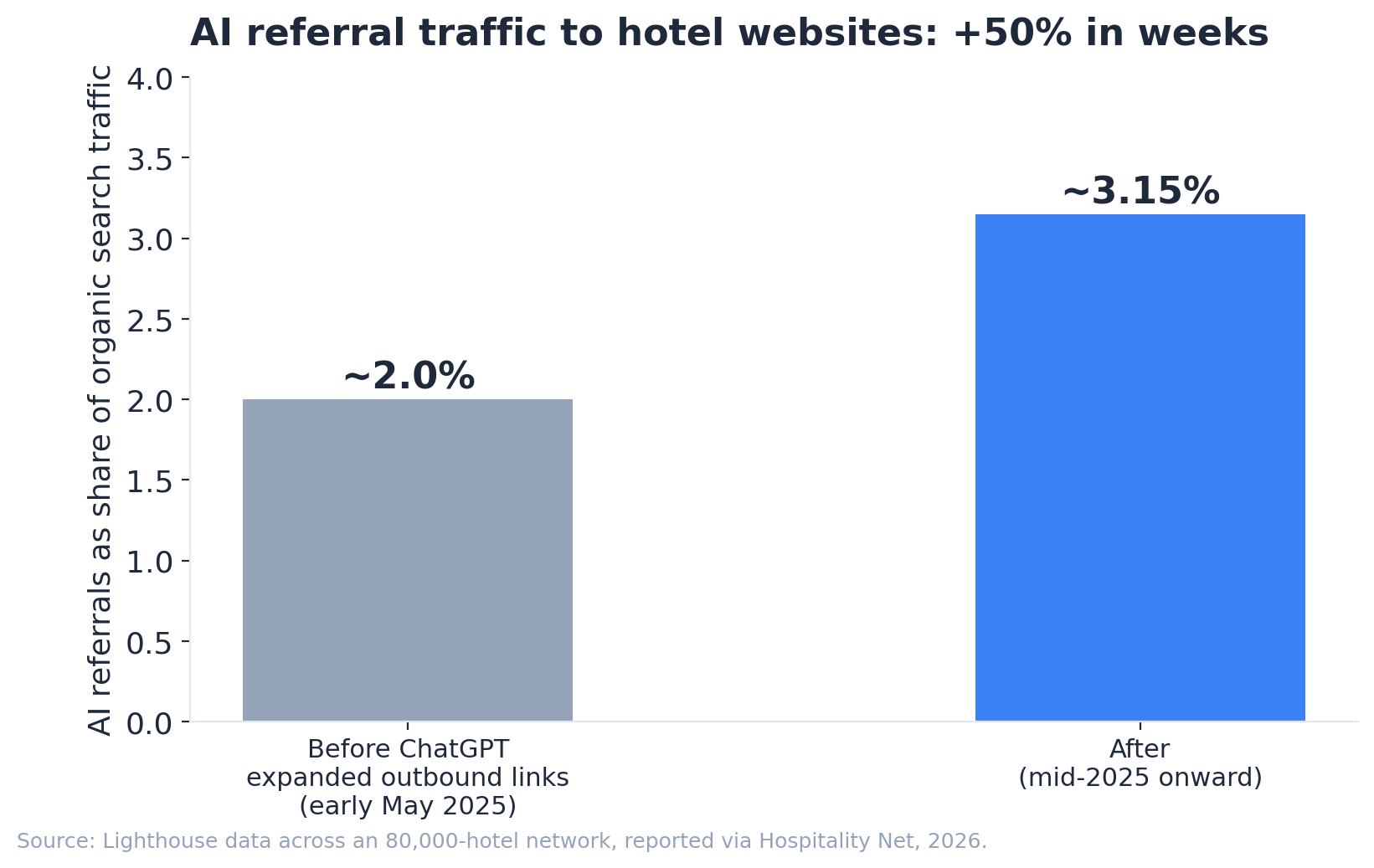
- The traffic is real but early. Lighthouse, measuring across roughly 80,000 hotels, puts AI referrals at just under 1% of hotel website visits — but relative to organic search, AI's share grew from about 2% to over 3% within weeks of ChatGPT adding more outbound links. Adobe recorded AI-driven travel traffic up 194% year over year, with the conversion gap versus traditional channels closing by roughly 70% since tracking began.
- The intent is high. A traveler who clicks through from an AI answer has already asked a specific question and received a specific recommendation. They're deciding, not browsing.
A channel at 1% of visits growing this fast is exactly where organic search was two decades ago — except this time the winners' list is short and mostly unclaimed.
Why hotel GEO is not generic GEO
Most GEO advice is written for SaaS companies and publishers. Hotels operate under three constraints those guides never mention — all three from our own measurement work across European markets.
Constraint 1: You control ~7% of your inputs. Across three independent Tharro studies, hotels' own sites and profiles made up roughly 7% of the sources AI engines rely on when discussing them. The rest is OTAs, review platforms, editorial, and forums. GEO for a hotel is therefore mostly off-site work — shaping what third parties say — with on-site work as the foundation, not the strategy.
Constraint 2: Ranking doesn't transfer. We verified that even hotels in Google's top 3 for their target queries get their own site cited by AI less than 20% of the time. Traditional hotel SEO and GEO overlap in inputs (content, reviews, structured data) but not in outcomes. You can win the SERP and still be narrated by Booking.com.
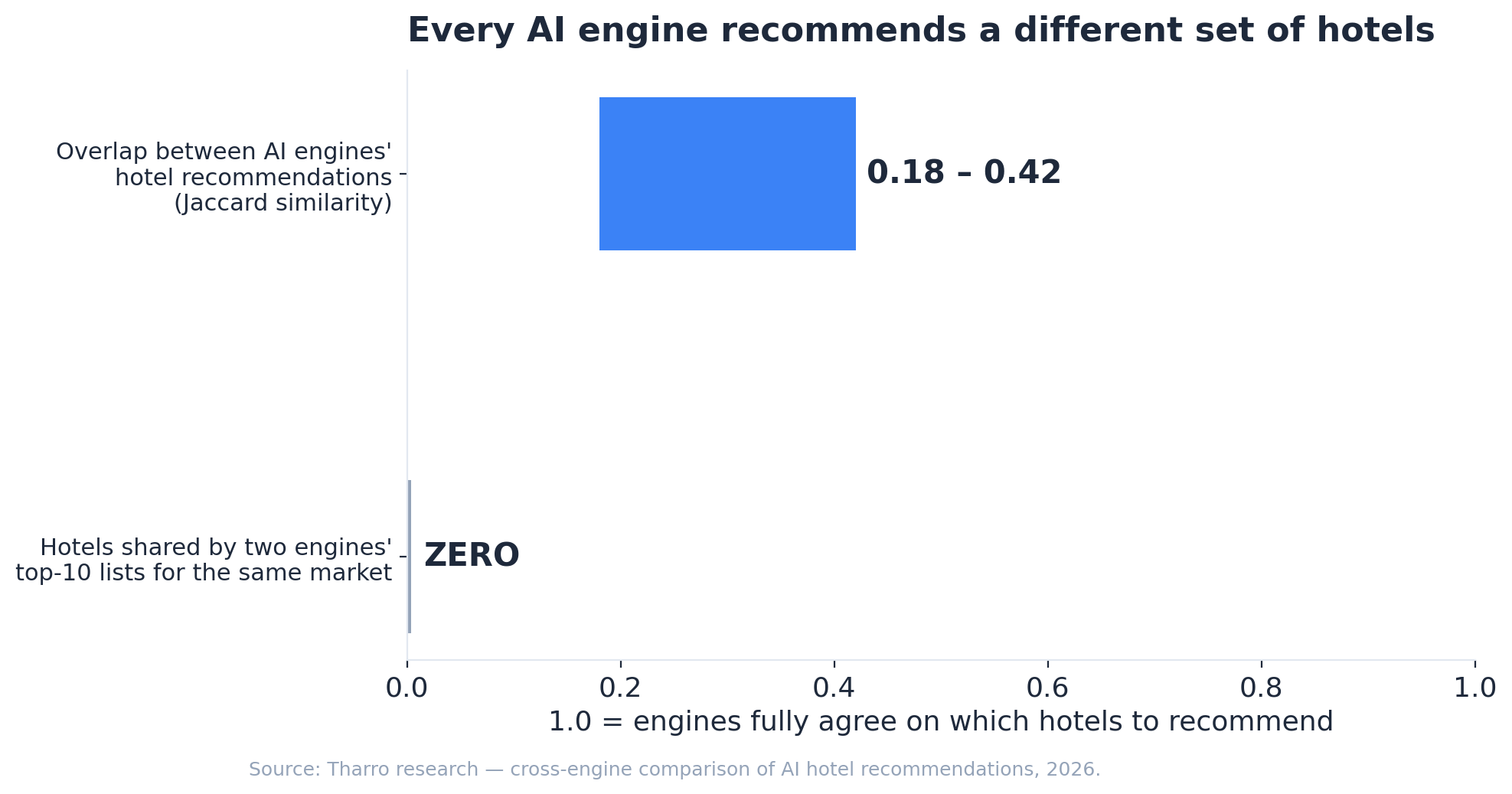
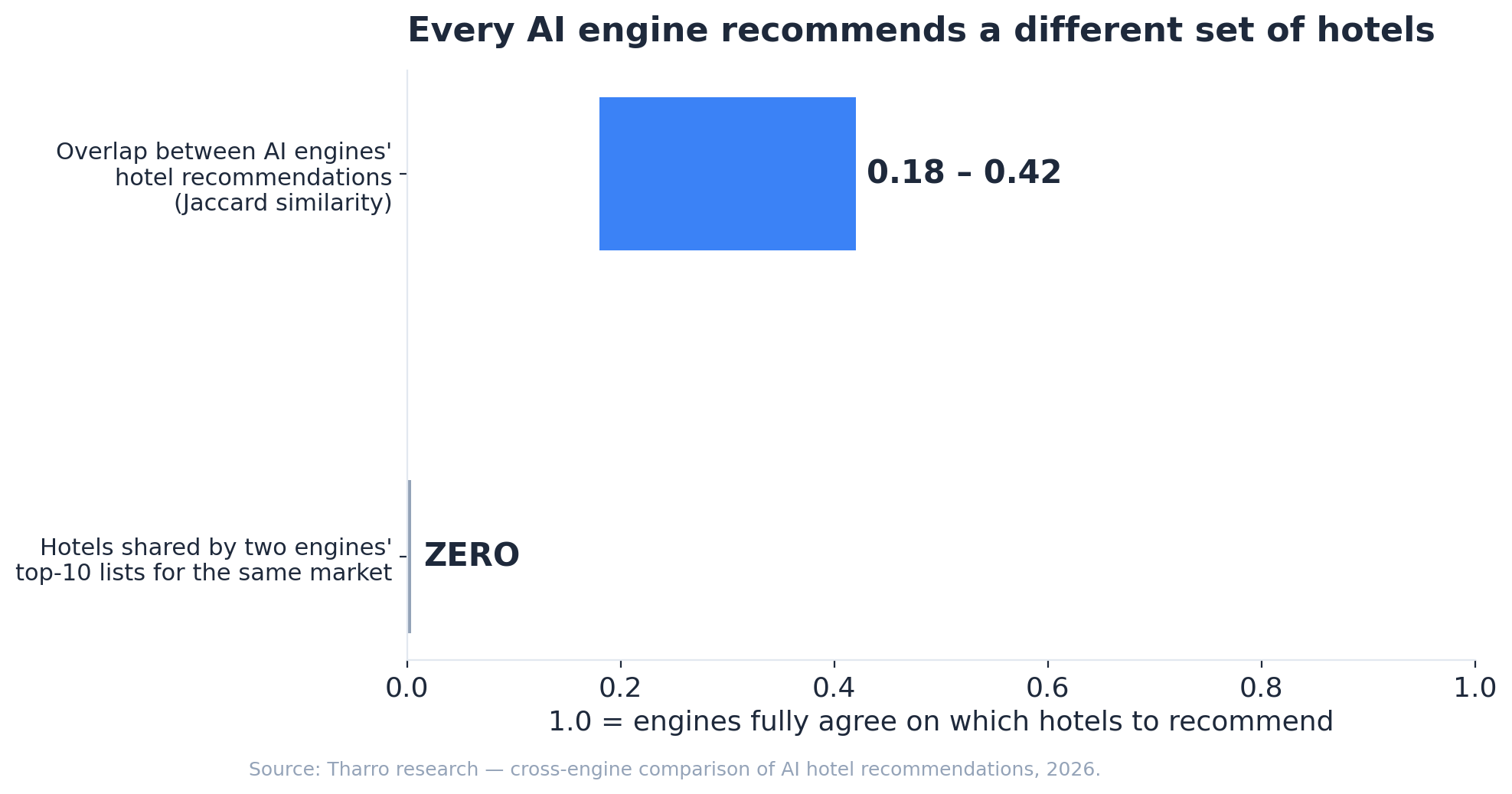
Constraint 3: There is no single "AI" to optimize for. When we compared engines' recommendations for the same markets, agreement ranged from 0.18 to 0.42 on a 0–1 scale — and some pairs of top-10 lists shared zero hotels. The engines are not different doors into one room. They are different rooms.
The engine split: one question, two machines
The most useful finding in our research is also the simplest to act on. ChatGPT is a reputation surface. Its hotel answers assemble from Tripadvisor, Reddit, editorial lists, and travel guides — sources you can influence through review strategy, community presence, and PR. Google's AI Mode is a transaction surface. Its answers lean on OTAs, operators, and metasearch — sources you influence structurally, through listings, feeds, and your Google Business Profile.
Same traveler, same question, opposite playbooks:
| ChatGPT (reputation surface) | Google AI Mode (transaction surface) | |
|---|---|---|
| Pulls from | Tripadvisor, Reddit, editorial, guides | OTAs, metasearch, GBP, operators |
| You win by | Review recency & depth, community mentions, earned media | Complete GBP, clean listings, schema, feed accuracy |
| Nature of the work | Earnable (marketing/PR) | Structural (technical/distribution) |
| Time horizon | Months, compounding | Weeks, mostly one-time |
A hotel that treats "AI optimization" as one workstream will typically do half of each and win neither.
The hotel GEO playbook
Foundation (structural, do once, weeks):
- Google Business Profile at 100% completeness — the anchor of Google's AI surfaces.
- Hotel schema markup across your site — rooms, amenities, geo, rates.
- Listing consistency across OTAs and metasearch — AI cross-references; contradictions cost trust.
- A direct booking path worth linking to — because the direct pipe is opening (see the Lighthouse data above), and it only pays if your site converts.
Reputation (earnable, ongoing, compounding):
- Review recency as a standing KPI — fresh, detailed reviews on Tripadvisor and Booking.com outweigh a large stale archive.
- Content only you can write — area guides, "best for" pages, seasonal expertise. Thin sites get described by their OTA listings.
- Earned mentions in the sources AI trusts — destination guides, local media, travel blogs, community threads. With ~93% of your AI presence off-site, this is the highest-ceiling work you can do.
Targeting (strategic):
- Pick personas you can actually win. Our persona analysis found hotel-owned sources earning 18.7% of citations for honeymoon queries versus 0.0% for nightlife in the same market. GEO effort aimed at a persona where hotel sources are never cited is effort spent on a locked door. (For the tactical version of this and the review playbook, see how to get your hotel recommended by ChatGPT.)
Measurement (non-negotiable):
- Monitor across engines, personas, and time. One ChatGPT test is an anecdote; engines disagree with each other and drift week to week. This is the part that can't be done manually at any useful scale — a reliable read takes hundreds of structured queries tracked over time, which is what Tharro's AI Visibility engine exists to do, benchmarked against your comp set and connected to your demand data so you optimize for markets that are actually searching.
The honest conclusion: nobody owns this yet
In our published Cyprus AI Visibility Study — 720 captured AI answers across engines and personas — the most-recommended hotel in the market held a 2.1% share of voice, and 62% of hotels were named exactly once. There is no incumbent. There is no equivalent of the OTA that already locked up page one. That's the difference between GEO in 2026 and SEO in 2010: this time, everyone can see the shift happening in the data while the leaderboard is still blank.
The hotels that treat the next twelve months as the window — foundation now, reputation compounding, measurement running — will be the names AI reaches for when the traffic curve stops being "early." The rest will be reading about themselves in someone else's Booking.com listing.
FAQ
What is generative engine optimization for hotels? Generative engine optimization (GEO) is the practice of improving how AI engines — ChatGPT, Gemini, Google's AI Mode — describe and recommend your hotel when travelers ask where to stay. Because hotels' own sites make up only ~7% of the sources AI relies on, hotel GEO is mostly off-site work: shaping the OTA listings, reviews, and editorial coverage the engines actually read, on top of a structurally sound site and Google Business Profile.
GEO vs SEO for hotels — what's the difference? SEO wins you a ranked position in Google's list of links; GEO wins you a place inside the AI's answer itself. The inputs overlap — content, reviews, structured data — but the outcomes don't transfer: even hotels in Google's top 3 get their own site cited by AI less than 20% of the time. They are separate scoreboards, and each needs its own tracking; the AI-side one is what is an AI visibility score.
How do hotels start with GEO? Start with the structural foundation: a complete Google Business Profile, hotel schema markup, and consistent listings across OTAs and metasearch. Then build the compounding reputation layer — fresh detailed reviews and earned mentions in the sources AI trusts. Finally, measure across engines and personas over time, because engines disagree with each other and drift week to week.
Should hotels hire a generative engine optimization service? For most hotels, measurement should come before spend. A GEO service optimizes inputs whose effect you can't see without tracking — so first establish where you stand in AI answers today, against your comp set, and which sources the engines cite in your market. Tharro's AI Visibility Report shows the benchmark for free; from there you'll know whether the gap is worth external help or fixable in-house.
See where your hotel stands today across ChatGPT, Gemini, and Google AI — track your hotel's AI visibility or start a free trial and get your AI visibility score, benchmarked against your competitors, in minutes.