Growth
Six Places Your Hotel's Direct Bookings Leak to OTAs
OTA commission is not one cost. It is six leaks along the guest path, each with a number, each in a place your PMS, RMS and rate shopper cannot see.

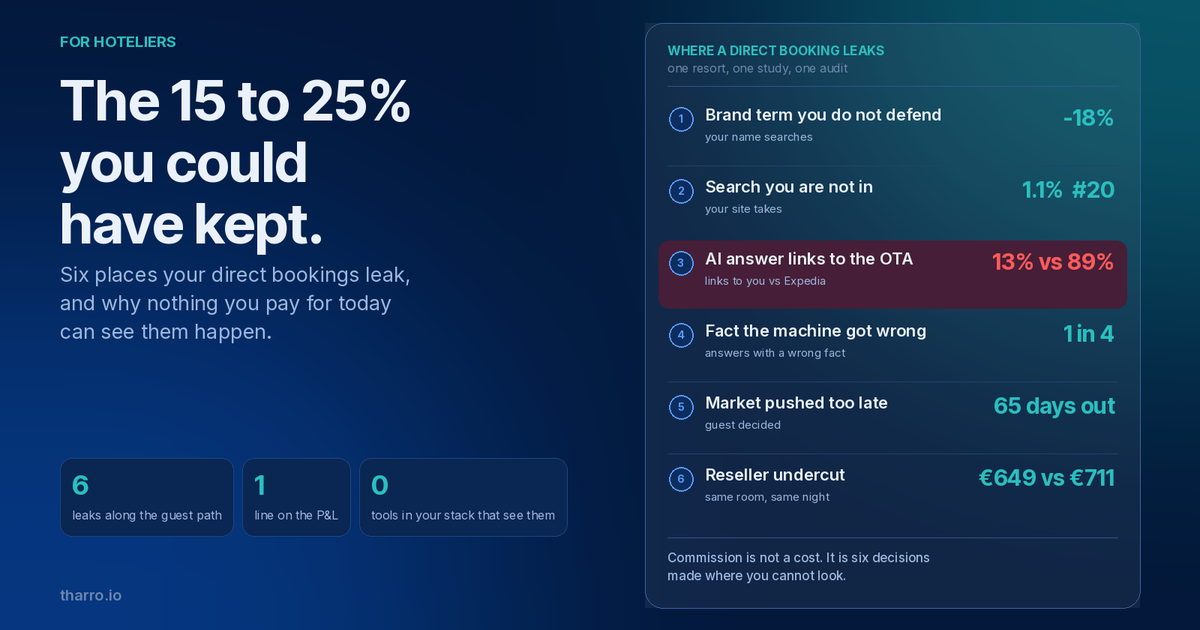
Commission arrives as one line on the P&L. It is actually six separate decisions, made in six places you cannot see from inside the hotel. Every hotelier knows the number. Depending on the contract and the channel, an OTA booking costs 15 to 25% of the room revenue.
It is the largest marketing cost most hotels carry, and the one that gets the least scrutiny, because it does not look like a decision. It looks like a cost of doing business. The commission line goes up when occupancy goes up, and everyone nods.
But a guest does not decide to pay you through Booking.com at the moment they click "book". They were routed there earlier, at one of a handful of moments along the way, and at each moment something specific happened: an ad sat above your name, a search you were absent from, an AI answer that linked to Expedia, a policy the machine got wrong, an offer that opened too late, a reseller that undercut you by sixty euros.
Six leaks, six causes, six fixes. They arrive on your P&L as one line because nothing you pay for today can see any of them happen.
The numbers below come from two places: our own studies, and one Mediterranean resort we work with, September 2026, name withheld.
The six leaks
| # | Leak | The moment | The number | What it costs you |
|---|---|---|---|---|
| 1 | The brand term you do not defend | A guest who already chose you types your name into Google. An ad sits above your site. It is not yours. | One resort: searches for the market's hotel names grew 9% year on year; searches for this hotel's own name fell 18%. The hotel knew neither number. | The cheapest booking you will ever lose. The guest needed no persuading. Commission paid on a customer you had already won. |
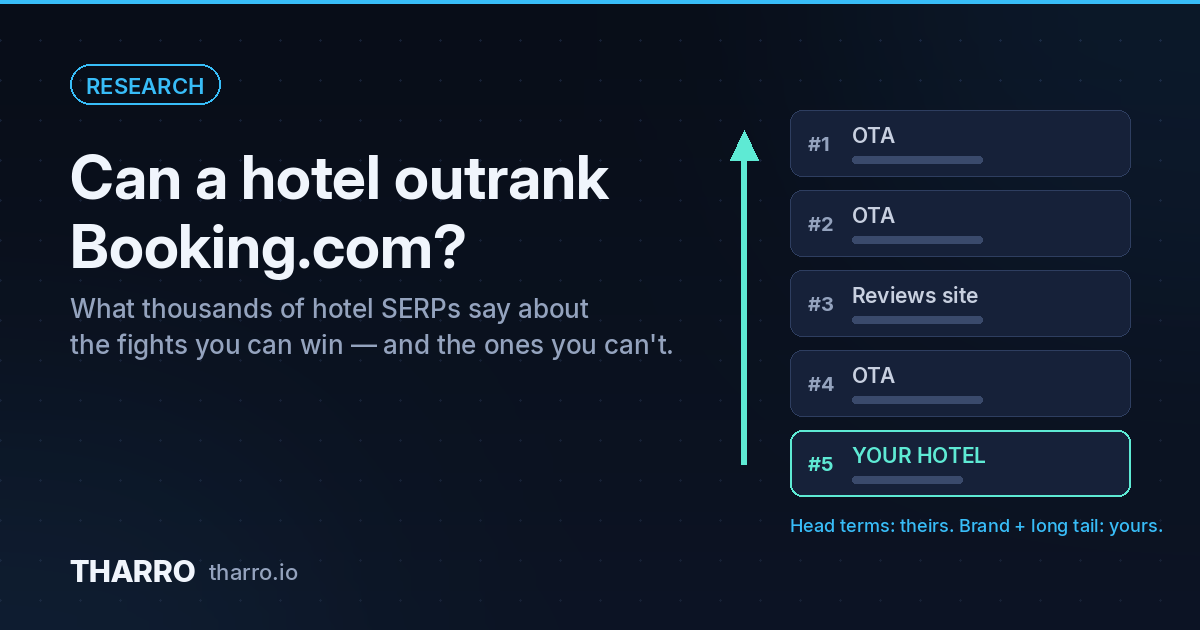
| 2 | The search you are not in | A guest with no hotel in mind types "beach hotel Limassol". This is the search that creates new demand. | 12,800 monthly clicks on unbranded searches around one Limassol resort (UK, week 35). Editorial sites 47.1%, OTAs and tour operators 36.9%, metasearch 9.8%, all hotels together 3.9%. This hotel's site: 1.1%, ranked #20. | The shortlist gets built without you, or with you as a line inside an OTA listing. The shortlist is the OTA's. |
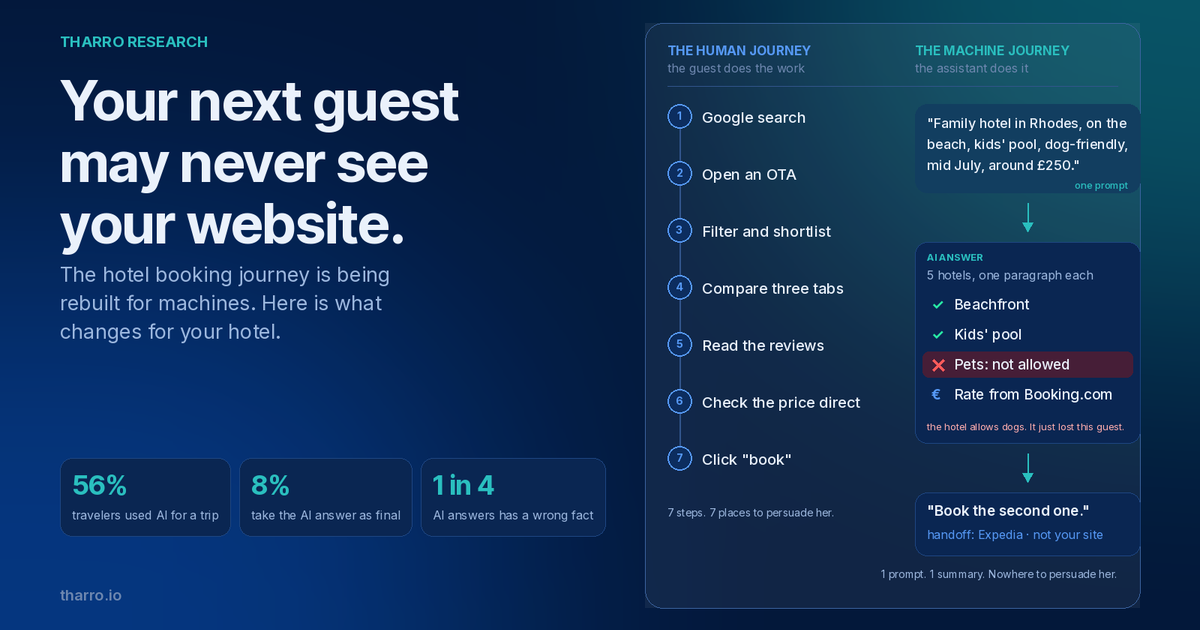
| 3 | The AI answer that links to Expedia | ChatGPT or Google AI Mode names you. The link under your name goes to an OTA. | Berlin study, 380 query runs, 3 assistants, 4,085 recommendations: 13% of hotel mentions carried a link to the hotel's site; 89% of Expedia mentions linked to expedia.com; OTAs overall 64%. | Recommended at commission. The guest clicks the only link there is and lands on an OTA page that also shows your three closest competitors. |
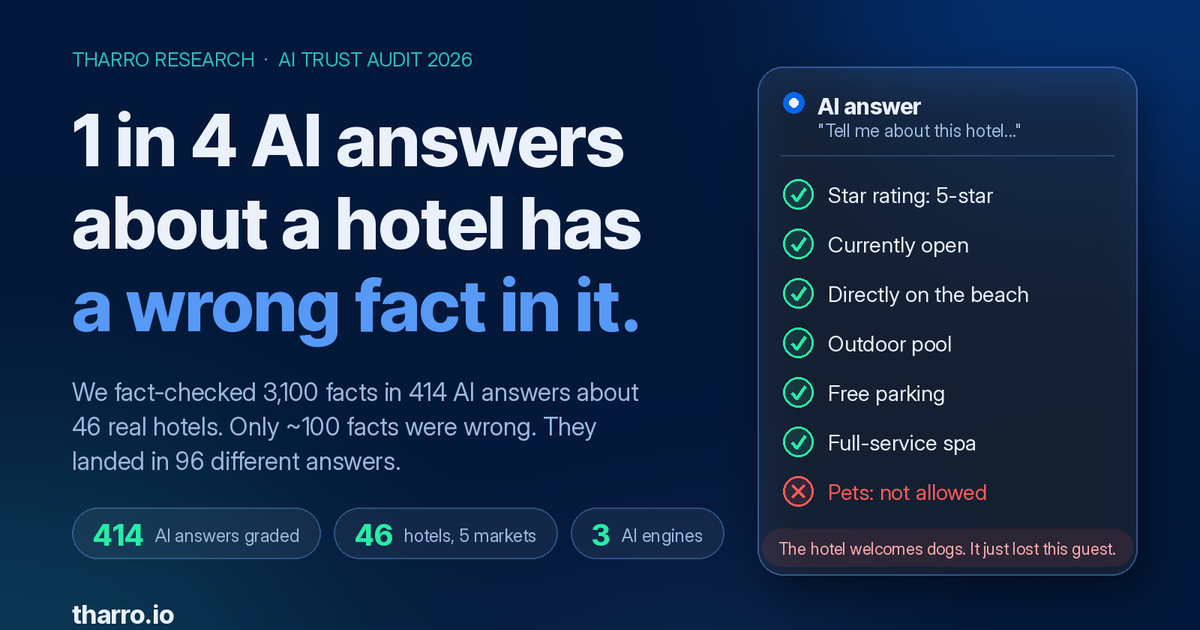
| 4 | The fact the machine got wrong | The guest asked for dogs, a spa, or the beach. The assistant applies the filter to what it believes about you. | AI Trust Audit, 46 hotels, 5 markets: 23% of answers carry at least one wrong fact. Pet policy wrong 22.8% of the time, almost always "no" when the hotel says yes. | Filtered out of the shortlist on a fact you got right. You will never know the guest existed. |
| 5 | The market you pushed too late | You open the October offer in late September. | Same resort: UK guests for the October half-term decided about 65 days before arrival. The offer opened at about 30. | The room sells anyway, through whoever was visible when the guest decided. At 65 days out with no direct offer running, that is the OTA. |
| 6 | The rate a reseller undercut | The guest is comparing prices. The same room, same night, is cheaper on a site you did not know had your inventory. | One Saturday in the next 30 days: official rate €711. A reseller €649. The two closest competitors €705 and €700. | Parity loss on that booking, plus the direct booking itself. A guest who sees €649 does not go back to pay €711. |
Two of those deserve a second look, because they are the ones hoteliers push back on.
On leak 2, the hotel ranked in the top ten for several of those searches and had a rank-tracking report saying so. What the report did not say is that ranking eighth on a page where the seven above you are Booking.com, Expedia, TUI, Tripadvisor and two travel magazines is worth 1.1% of the clicks. "We rank #8" and "we take 1.1%" describe the same fact. Only one of them tells you what to do.
On leak 4, one Paphos hotel is the whole mechanism in miniature. The hotel's own FAQ welcomes dogs up to 10 kg for a daily fee. Booking.com says "on request". Trivago and Trip.com say no. Google AI Mode said no, and in one of its answers cited the hotel's own website while contradicting it. The assistant treats every listing as a vote, and the votes are counted somewhere you are not.
Why nothing you pay for catches them
Each tool in a hotel's stack does what it was built for. The leaks live in the gaps between them.
| # | Leak | The tool you would expect to catch it | Why it does not | What you would need to see instead |
|---|---|---|---|---|
| 1 | Brand term | GA4, the OTA extranet | GA4 shows the brand traffic that reached your site, not the brand traffic that did not. The extranet shows the booking, not that the guest searched your name first. | Brand search volume per source market, against the market's other hotel names, and a flag when an intermediary's ad sits above yours on your own term. |
| 2 | Search you are not in | Rank tracker, agency SEO report | A rank tracker shows your position. It does not show the market: who else is on the page, what share of clicks each position gets, whether the clicks above you belong to hotels or intermediaries. | Share of voice per source market: total clicks in play, who takes them, your share, and which keyword clusters a hotel can win at all. |
| 3 | AI link to Expedia | Nothing | The AI answer is a private conversation between the guest and the assistant. No tool in the stack can open it. | Someone asking the assistants what your guests ask, per engine and per market, and recording how often you are named, cited, and linked. Three different numbers. |
| 4 | Wrong fact | Your OTA listings, the review tool | You can read your Booking.com listing. You cannot read the summary the assistant built from it plus Trivago, a tour operator page and a clone site, or see which source it trusted when they disagreed. | Every fact that disagrees across your listings, ranked by how often AI is repeating the wrong version. |
| 5 | Pushed too late | The RMS | Pickup against your own pace tells you about last year's guests through last year's channels. It does not show when each source market is searching for October, now. | Search demand and booking windows per source market, ahead of arrival, with the movement flagged. |
| 6 | Reseller undercut | The rate shopper | It answers "what are my competitors charging" for the competitors you named. The reseller is not a competitor. It is you, cheaper, somewhere else. | Your rate against your market standing, day by day, every channel your room appears on, with a verdict per day. |
What the six have in common
In every case, the hotel found out after the fact, if at all, from the commission line. In none of them did anything in the hotel's stack raise a hand at the moment the guest was being routed away.
That is not a failure of the tools. The PMS is a system of record. The RMS optimises the price you set. The rate shopper watches the competitors you named. The review tool reads what guests wrote after the stay. GA4 counts the people who reached you. Between them there is a hole, and the hole is the guest who was deciding, this week, in a specific source market, on Google, in an AI answer, on a listing or on a price page, and was routed to an intermediary before you knew they existed.
Hotels do not have a marketing problem. They have a visibility problem: the decisions that cost them the most are being made where they cannot look.
What we would not claim
You cannot plug all six. Some unbranded searches are permanently owned by OTAs and magazines, and no hotel will outrank Booking.com for "hotels in Rhodes". Some AI answers will link to Expedia no matter how clean your data is, because the assistant's checkout partner is Expedia. Commission does not go to zero.
The claim is smaller and truer. Today a hotel cannot say which of the six leaks it is bleeding from, in which market, this week. A leak you can see is a leak with a Monday action attached: defend that term, fix that fact, open that offer, close that reseller. A leak you cannot see is a percentage on the P&L that everyone nods at.
Where Tharro sits
Tharro watches the six places a hotel's direct bookings leak, in every source market the hotel sells into, every week, and turns what moved into a ranked list of actions with the reason attached. Not a dashboard of everything. The three to five things that cost a booking this week, in the order they cost it.
| # | Leak | What Tharro shows you | The Monday action it produces |
|---|---|---|---|
| 1 | Brand term | Brand searches per market, who is above you on your own name | "Defend brand terms in the UK. Search volume moved; an OTA is bidding." |
| 2 | Search you are not in | Share of voice on the searches that create demand, winnable clusters vs owned by intermediaries | "Go after these 40 searches in Germany. Ignore these 300." |
| 3 | AI link to Expedia | What ChatGPT, Google AI Mode and Perplexity say about you, and whether the link is yours | "AI Mode names you in 7 of 10 family queries in the UK and links Expedia in 6. Fix the source it is reading." |
| 4 | Wrong fact | Listing contradictions across channels, ranked by which ones AI repeats | "Fix three facts on the Booking listing before June. ChatGPT is citing the old pet policy." |
| 5 | Pushed too late | Search demand and booking windows by source market, movement flagged | "UK October demand is two weeks early. Open the offer now; the competitor already did." |
| 6 | Reseller undercut | Your rate against market standing, day by day, resellers included | "Saturday 12 October: a reseller is €62 under your official rate. Close it." |
The commission line will still be there next month. The difference is that you will know which of the six it came through, and you will have done something about at least one of them before the guest decided.
Data in this article: one Mediterranean resort's Tharro readings, September 2026, name withheld (brand-strength change, UK share of voice week 35, October half-term booking window, next-30-day rate standing); Tharro Berlin AI booking study (380 query executions, 3 assistants, 95 queries, 4,085 recommendations); Tharro AI Trust Audit, August 2026 (46 hotels, 5 markets, 450 answers, ~3,100 facts checked). The Monday actions in the last table are examples of the form, not readings from the resort. The 15 to 25% commission range is the typical contracted range for European four- and five-star independents.
FAQ
How much does an OTA booking cost a hotel?
Typically 15 to 25% of the room revenue for European four- and five-star independents, depending on the contract and the channel. It is usually the largest single marketing cost a hotel carries, and it is treated as a fixed cost of doing business because it arrives on the P&L as one line rather than as the six separate moments at which a guest was routed to the OTA.
Where do hotel direct bookings leak to OTAs?
At six moments along the guest's path: an OTA ad above the hotel's own name on a brand search; unbranded searches where the hotel's site takes a fraction of the clicks (one resort measured at 1.1%, ranked #20); AI answers that name the hotel but link to an OTA (13% of hotel mentions linked to the hotel's site versus 89% of Expedia mentions linking to Expedia in our Berlin study); AI answers with a wrong fact that filters the hotel out (1 in 4 answers in our audit); an offer opened after the market had already decided (65 days out for the UK October half-term at one resort); and a reseller undercutting the official rate.
Why does a rate shopper not catch a reseller undercutting my rate?
Because a rate shopper answers the question "what are my competitors charging" for the competitors you named. A reseller is not a competitor; it is your own room, cheaper, on a site you did not list. Seeing it requires watching every channel your inventory appears on, day by day, not a comp set.
How can a hotel reduce OTA commission without dropping the OTAs?
By seeing which of the six leaks it is bleeding from, in which source market, this week, and acting on that one: defending a brand term where an intermediary is bidding, fixing a listing fact that AI is repeating, opening an offer before the market decides, closing a reseller that is under the official rate. Commission does not go to zero, but a leak you can see has an action attached; a leak you cannot see is a percentage everyone nods at.
Tharro watches the six places your direct bookings leak, in every source market you sell into, every week, and turns what moved into a ranked list of actions with the reason attached. See how the weekly plan works on the hotel marketing intelligence page, or start with the hotel direct bookings guide.