Research
Who Gets the Click When a Guest Searches Your Hotel by Name?
UK searches for 300 hotels in Cyprus and Greece: the hotel's own site is first on 37% of brand searches and missing on 35%. Who takes the rest, and why.

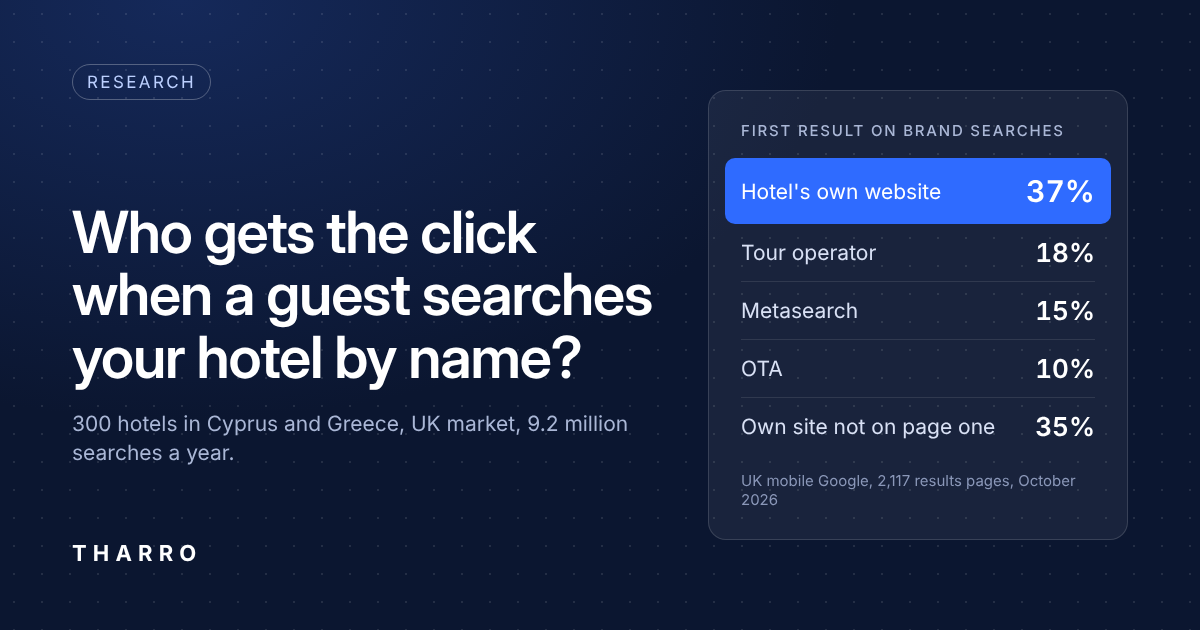
We measured UK Google searches for 300 four and five star hotels in Cyprus and Greece, by name, and then looked at what Google shows when someone types that name. Three things came out of it. The demand for hotel names held up when generic travel search collapsed. The hotel's own website is first on 37% of those searches. And the reason a hotel wins or loses its own name has nothing to do with stars, price or rating.
The demand that held
From 2025, a decline in UK Google searches for generic travel terms started. Searches for "hotels in Paphos", "hotels in Crete", "hotels in Kos" and every other destination we checked are down by two thirds and have not recovered. Searches for "[destination] holidays" fell by a fifth. Searches for TUI, Jet2 and Booking.com barely moved.
Searches for a specific hotel, by name, fell by about a quarter over the same period, and then stopped falling. Summer 2026 is within 3% of summer 2025 for the 300 hotels in the study. Generic hotel searches are still falling, down another 18% this summer.
| UK Google searches | May to Dec 2025 vs 2024 | Summer 2026 vs summer 2025 |
|---|---|---|
| 300 hotels, searched by name | -28% | -3% |
| "hotels in [destination]" | -66% | -18% |
| "[destination] holidays" | -21% | -15% |
| TUI, Jet2, Booking.com | -2% | -2% |
The cause of the decline is outside the scope of this study. What it shows is which part of a hotel's demand is stable now. It is the part where the guest already knows the hotel's name.
How much name demand a hotel has
The 300 hotels drew 9.2 million UK searches by name in the twelve months to August 2026. The median hotel gets about 13,000 a year, 1,100 a month. The top 30 hotels hold 47% of the total.
The biggest names are not the luxury names. They are the large resorts sold by UK tour operators: Olympic Lagoon in Paphos (261,000 searches) and Ayia Napa (241,000), Stella Palace in Crete (339,000), Sani and Ikos in Halkidiki. Four Seasons Limassol gets about 37,000. Parklane about 36,000.
Per hotel, Kos, Corfu and Protaras are the strongest markets, with a median hotel at 47,000 to 56,000 searches a year. Santorini, Mykonos, Rhodes and Halkidiki are the weakest, at 8,000 to 12,000.
Who is first when a guest searches your name
For each hotel we collected the Google results page, UK, mobile, for its main brand keywords: 2,117 pages, each confirmed by Google's own hotel panel, covering 9 million searches.
The hotel's own website is the first result on 37% of brand searches. It is somewhere in the top three on 49%. It is not on the first page at all on 35%.
When the hotel is not first, a tour operator is, on 18% of searches: TUI, Jet2, loveholidays, On the Beach. A metasearch site is first on 15%: Tripadvisor, Trivago, Kayak. An OTA is first on 10%: Booking.com, Expedia, Hotels.com.
Hotel by hotel, of the 282 with at least 1,000 confirmed searches, 103 are first on most of their brand searches. 62 are never first. 78 are missing from the first page on most of them.
Two facts about this are not what most hoteliers expect. The study looks only at organic results and the price box; paid ads change with bidding from day to day and need repeated captures to measure.
The price box is not the hotel's either. Google's hotel price box appears on 95% of these pages. The official site holds a position in it on about 12% of them. The rest of the time the prices shown under the hotel's own name come from OTAs and tour operators.
When the site is missing, it is usually the site. We sorted the 614 pages where the hotel's website was absent by what Google shows instead. On 41% of that search volume, Google ranks the hotel's own Facebook or Instagram page and still does not rank its website. Google knows the hotel. The website is the part that does not rank.
It depends on the hotel, not the category
Star class makes no difference: four star hotels are first on 36% of their brand searches, five star on 38%. Chains are absent far less often than independents (19% against 40%) but are first no more often. What they gain in presence they lose to OTAs and metasearch at the top.
The market makes a large difference.
| Market | Own site first | Own site absent |
|---|---|---|
| Halkidiki | 65% | 8% |
| Crete | 56% | 24% |
| Limassol | 52% | 18% |
| Corfu | 42% | 23% |
| Protaras | 38% | 33% |
| Rhodes | 33% | 48% |
| Kos | 23% | 29% |
| Ayia Napa | 24% | 69% |
| Paphos | 17% | 69% |
But the market is not destiny. In Paphos, two five star hotels sit on the same page format:
| Brand searches | Own site first | Own site absent | |
|---|---|---|---|
| Olympic Lagoon Resort Paphos | 261,000 | 1% | 99% |
| Almyra Hotel | 56,000 | 98% | 1% |
On "olympic lagoon paphos", 254,000 searches a year, the first six organic results are the Telegraph, TUI, Kayak, easyJet, Tripadvisor and a golf travel site. The same contrast repeats in every market: Creta Maris at 99% next to Gouves Park at 0% in Crete, Amathus Beach at 90% next to Atlantica Bay at 14% in Limassol. Winning one's own name is a property of the individual hotel.
Two different leaks
Hotels split in two by how many tour operators appear on their results page. Package hotels, the ones with many operators selling them, are first on 42% of their brand searches and lose the top spot to a tour operator on 23%. Hotels with few operators, which includes most city and boutique properties, are first on only 27% and lose the top spot to Booking.com, Tripadvisor and their peers on 33%.
So the two groups have different opponents. Neither is losing more than the other.
Bigger brands are not targeted more. The size of a hotel's name demand has no relationship with how often it is first or with the number of intermediaries on its page. A hotel with 30,000 searches a month and a hotel with 3,000 lose the same share.
What makes a name big
We tested what relates to the size of a hotel's name demand.
| Factor | Relationship with brand size |
|---|---|
| Google review count | 0.34 |
| Tour operators on the results page | 0.32 |
| Star class | 0.25 |
| Nightly rate | 0.10 |
| Google rating | 0.01 |
Rating has no relationship at all. Price almost none. What relates to a big name is scale and tour operator distribution: the median hotel with the fewest tour operators on its page gets 8,000 searches a year, the one with the most gets 36,000. All factors together explain about a quarter of the differences between hotels.
This cuts against the comfortable story that a good hotel builds a big brand. In these markets the biggest names were built by volume, much of it through tour operators. It does not change what the name is worth once it exists. Those searches happen, every month, and someone collects them.
What this means for a hotel
Name searches are an opportunity, not a result. A hotel can have 200,000 searches a year for its name and get almost no direct bookings from them if its website is not on the first page: the searches go to whoever is first. Two numbers decide the direct bookings a hotel gets from its name: how many people search it, and what share of them reach the hotel. The data says most hotels have far more room on the second. A hotel first on 37% of its name searches gains more from reaching 60% than from a 20% rise in searches, and the 60% is within reach, because 103 hotels in the sample are already there.
A euro figure can be put on the leak with assumed click and booking rates. Under cautious rates, intermediaries collect about €12 million a year of room revenue from these 300 hotels' name searches in the UK market alone; under middle assumptions, about €52 million. The range is wide, so we do not lean on it. The positions are measured. The money is inferred.
What to check for your own hotel
Three questions, each answerable in five minutes with a phone and a UK VPN, or in one query with the data behind this study.
- Type your hotel's name into Google. Is your website first, somewhere, or missing? Now type it with your town and with your country. The answers differ more often than you would think: "parklane cyprus" is searched almost as often as "parklane limassol".
- If your site is missing, is your Facebook page there? If yes, the problem is your website, not Google.
- Who is first instead? A tour operator, Tripadvisor, or a copycat booking site with your name in its domain? Each needs a different fix.
Method in brief
301 hotels, the most reviewed four and five star hotels in 13 markets plus a must-have list, one excluded for unreliable keyword data. Keyword suggestions and monthly UK volumes from Google Ads, January 2023 to August 2026, with a second collection from DataForSEO's database, each hotel's own site rankings and Google autocomplete. A keyword counts for a hotel if it contains the hotel's name; spelling variants with identical volumes count once; the top 15 keywords per hotel were confirmed on Google's results page by the hotel's own knowledge panel, and 98% of counted volume passed. Results pages collected on UK mobile in October 2026, one capture. Control: generic destination and travel brand keywords, same source and period. Limits: one origin market, one capture, no booking data from hotels, no room counts. The full paper, with every table and the limits, is available on request.
FAQ
What counts as a brand search in this study? A UK Google search that contains the hotel's name, including spelling variants, with or without the town or country. Keywords with comparison words such as "best" or "cheap" are excluded. The top 15 keywords per hotel were checked on the results page: a keyword counts only if Google shows that hotel's own knowledge panel.
Why only the UK market? The UK is the largest single source market for both Cyprus and Greece, and one origin keeps the search volumes and results pages comparable across all 300 hotels. Other markets would need their own collection.
Does a group website count as the hotel's own site? Yes. Where a hotel is presented on its group's website, that domain was treated as the hotel's own site. The absences reported are cases where neither the hotel's domain nor its group's domain appears on the first page.
Why are paid ads not included? Ad presence on a brand search changes with bidding from day to day. A single capture cannot measure it, so the study covers organic results and Google's hotel price box only.
Want the figures for your own hotel? Tharro tracks brand searches, positions and who is first for every hotel in these 13 markets. See how Tharro works.